
To use AI correctly
The province currently has over 400 primary, secondary, and high schools. In recent times, digital technology and artificial intelligence (AI) have been strongly applied to teaching, creating enthusiasm for learning and making complex knowledge more intuitive, easy to understand, and easy to remember. AI has also become a useful tool to support students' learning; however, without guidance from teachers and supervision from families, students can easily become dependent on and misuse it.
 Báo Lạng Sơn•17/11/2025
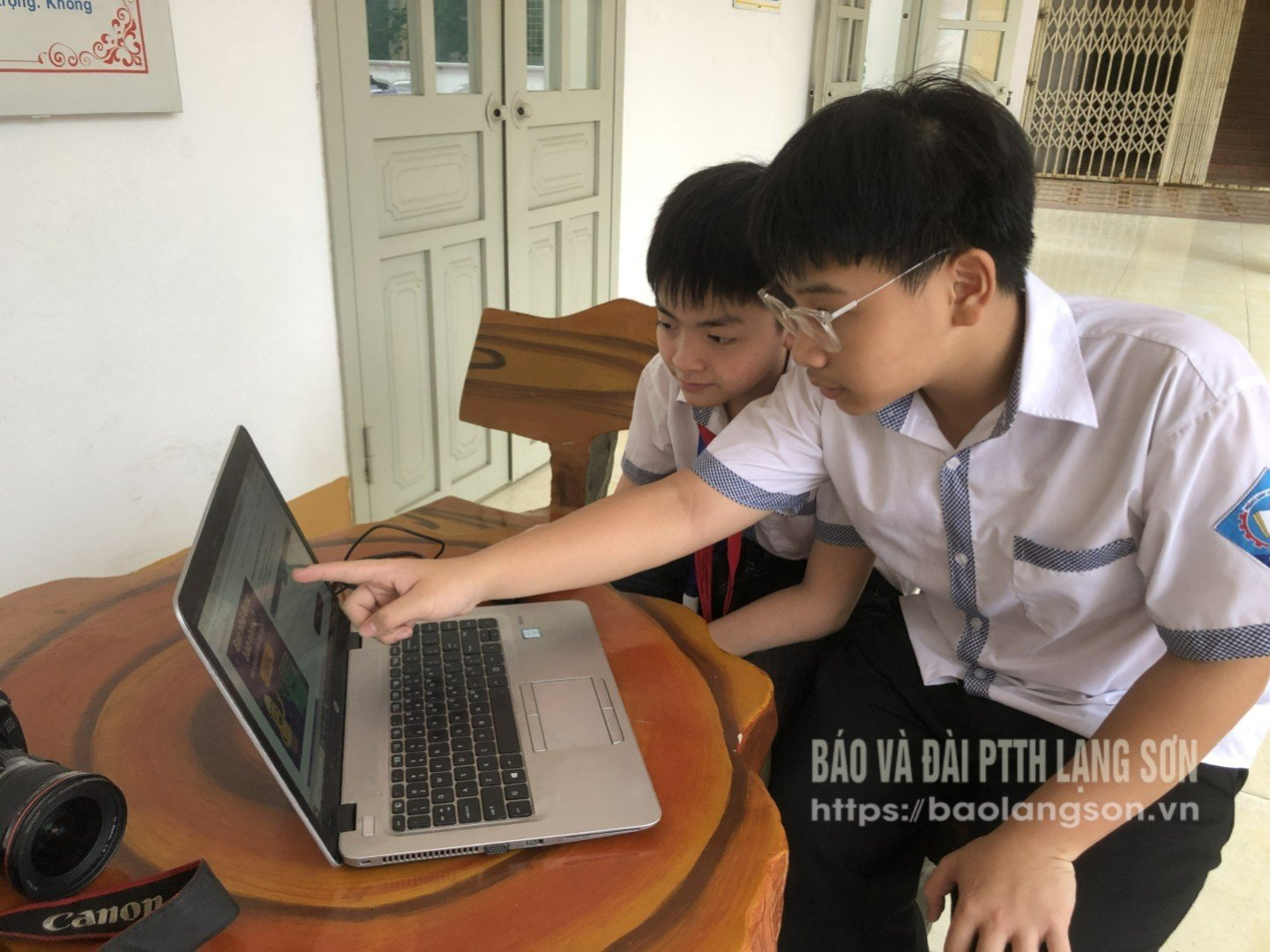
Students at Tam Thanh Secondary School are applying artificial intelligence to self-study mathematics.
In the digital age, AI-based learning tools are opening up new ways for students to access knowledge easily and effectively. AI platforms can simplify complex concepts, guiding students step-by-step in the process of acquiring and consolidating knowledge. With the ability to analyze abilities and learning speed, AI can adjust content and difficulty levels to suit each student; many tools also encourage students to discuss and debate. In reality, the use of AI by students to search for information, solve problems, create outlines, and summarize content during their studies is becoming increasingly common. However, over-reliance on artificial intelligence can lead to laziness in students' thinking, analysis, and problem-solving skills.
You may also like

Does having gallstones for a long time increase the risk of bile duct cancer?Numerous studies now suggest that chronic inflammation of the biliary tract, persistent gallstones, certain congenital abnormalities of the biliary tract, or genetic mutations are associated with biliary tract cancer.

Dong A University 'leaps' up the sustainable university rankings 2026DNVN - Dong A University has made an impressive leap in ranking for the second consecutive year, appearing in the Times Higher Education (THE) Sustainability Impact Ratings 2026.
When will the results of the 2026 high school graduation exams be announced?At 8:00 AM on July 1st, the Ministry of Education and Training will announce the results of the 2026 high school graduation exam. What should candidates keep in mind?
To prevent students from misusing artificial intelligence, in March 2025, the Ministry of Education and Training issued a digital competency framework for learners comprising 6 competency domains and 24 component competencies ranging from basic to advanced levels, such as: data mining; communication and collaboration in the digital environment; digital content creation; safety; problem-solving; and artificial intelligence application. This is an important direction to help students develop digital competencies.
"AI will not replace humans; those who know how to use artificial intelligence will replace those who don't; the use of AI requires careful consideration, purpose, ethics, and confidentiality; and especially, always verify information before making a decision." Mr. Nguyen Minh Tu, Physics teacher, Chu Van An High School for the Gifted |
In addition, schools in the province have proactively adjusted their teaching and assessment methods to help students understand and use AI correctly, honestly, and creatively. Schools have collaborated in disseminating information and providing guidance on knowledge, tools, and methods for applying AI in learning. They have also clearly defined the boundary between creativity and cheating to guide students in their application.
As those directly involved in teaching, setting questions, evaluating, and grading, teachers in schools have proactively guided students in applying AI. Many teachers design open-ended lessons, enhancing students' creative thinking by allowing them to prepare content at home beforehand, without limiting their ability to search for and research information. During class time, teachers and students focus on discussing and debating ideas to reach a common understanding on the lesson topic. Teachers require students to clearly indicate the content that was supported by AI in exercises; they design types of exercises that encourage critical thinking, such as comparing, modifying, and refuting the results generated by AI. For example, instead of analyzing the character Thuy Kieu in the Tale of Kieu, teachers guide students to use AI to create different outlines, then explain the reasons for choosing the best outline. Or they create personalized questions that cannot be copied, such as interviewing grandparents about wartime memories or what the student's family did last week to protect the environment…
You may also like
Phu Tho province is stepping up the use of AI in labor and production.During its growth model transformation, Phu Tho province is gradually integrating artificial intelligence (AI) into production, business management, and human resource development. From high-tech factories and automated production lines to small and medium-sized enterprises applying AI in business, the province is forming a new foundation for a digitally skilled workforce, meeting the demands of the modern economy.
Young lecturer Bui Xuan Canh: The ultimate goal of all scientific research is to improve the quality of human life.Having graduated with a degree in information technology engineering and having the opportunity to work at large organizations, Bui Xuan Canh chose to stay at Lac Hong University to teach and has won numerous awards in the field of artificial intelligence (AI) both domestically and internationally.

Smartphones and AI are reshaping rural India.By the standards of Uttar Pradesh, a vast and impoverished state in northern India, Nagepur is a relatively affluent village, as many households have access to toilets, running water, electricity, and even internet access. Smartphones, once a rarity in Nagepur, are now commonplace and have contributed to improving the lives of its residents.
Mr. Nguyen Minh Tu, a physics teacher at Chu Van An High School for the Gifted, stated: Currently, there is no situation of students abusing AI, especially in natural science subjects, because the learning and testing process is strictly supervised, and students are not allowed to use assistive devices. Exam questions are presented in multiple versions and randomly shuffled, making it difficult for AI to solve them. Furthermore, AI can only handle problem types found in the data system it has been trained on; for problems requiring critical thinking or those not yet appearing, the tool does not produce accurate results. We always remind students of the principle: AI does not replace humans; those who know how to use artificial intelligence will replace those who don't; the use of AI requires careful consideration, purpose, ethics, and confidentiality; and especially, always verify information before making a decision.
In parallel, teachers also encourage students to use AI as an "online tutor," guiding them step-by-step through exercises to reinforce basic knowledge. Hoang Thuc Quyen, a 9th-grade student at Dinh Lap Secondary School, shared: "When learning English, I felt my pronunciation wasn't accurate, so I often used ChatGPT to practice pronunciation, learn new vocabulary, and improve my speaking ability."
Instead of focusing on results, assessing critical thinking, reasoning, and analytical skills is fundamental to enabling students to use AI proactively and creatively. Furthermore, guidance and support from schools and families not only help students avoid misusing AI but also enable them to utilize it effectively and adapt to learning in the digital age.
Source: https://baolangson.vn/de-hoc-sinh-khong-lam-dung-tri-tue-nhan-tao-5064495.html


![[Photo] General Secretary and President To Lam attends the 13th National Congress of the Ho Chi Minh Communist Youth Union](https://vphoto.vietnam.vn/thumb/1200x675/vietnam/resource/IMAGE/2026/06/25/1782356968989_ndo_br_1-jpg.webp)


Trending by Tag






Trending by Category


Most Read







Google Trends












Same author


![[Photo] General Secretary and President To Lam attends the Central Public Security Party Committee Conference](https://vphoto.vietnam.vn/thumb/1200x675/vietnam/resource/IMAGE/2026/06/24/1782302063612_a1-bnd-9302-9166-jpg.webp)










































Blacksmith's forge fire

Mimic
