

The Standing Committee of the National Assembly is seeking the National Assembly's opinion on not holding a vote of confidence for those who have retired from work for six months or more after treating terminal illnesses.
This is one of the new points in the draft Resolution of the National Assembly on conducting votes of confidence and no-confidence votes for those holding positions elected or approved by the National Assembly and People's Councils.
The content was supplemented through a review of practical experiences in conducting confidence votes and feedback from various agencies; and was unanimously agreed upon by the majority of the Standing Committee of the National Assembly.
The draft also stipulates that those exempt from the confidence vote include individuals who have announced their resignation, are awaiting retirement, have announced their retirement, or have been appointed or elected during the year of the confidence vote.
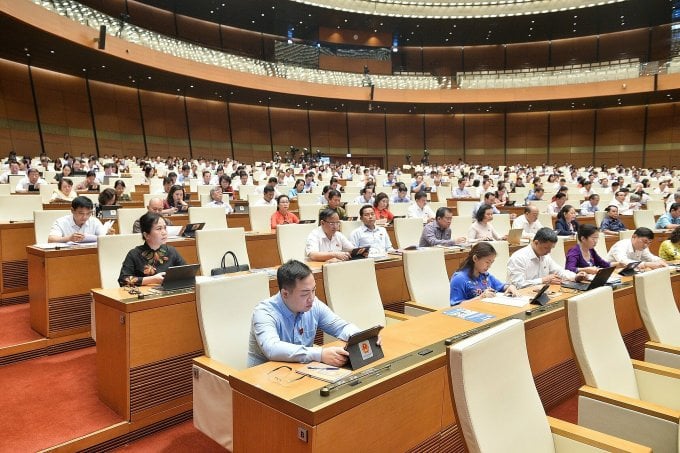
Members of the National Assembly in the Dien Hong meeting room. Photo: National Assembly Media
According to regulations, the National Assembly conducts a vote of confidence for the President, Vice President; the Speaker of the National Assembly, Deputy Speakers of the National Assembly, members of the Standing Committee of the National Assembly, Chairman of the National Ethnic Council , Chairmen of National Assembly Committees, Secretary General of the National Assembly; the Prime Minister, Deputy Prime Ministers, Ministers, and other members of the Government; the Chief Justice of the Supreme People's Court, the Prosecutor General of the Supreme People's Procuracy, and the State Auditor General.
The People's Council conducts a vote of confidence for the Chairman and Vice-Chairman of the People's Council, the Heads of the People's Council's Committees; the Chairman, Vice-Chairmen of the People's Committee, and the Members of the People's Committee. If a person simultaneously holds multiple positions subject to a vote of confidence, the vote of confidence is conducted once for all positions.
The confidence vote will be conducted by secret ballot. The ballot will clearly state the names and positions of those being voted on, along with the levels of confidence: "high confidence," "confidence," and "low confidence." According to the draft, officials who receive a "low confidence" rating from more than half but less than two-thirds of the total number of delegates must resign within 10 days of the announcement of the confidence vote results.
Thus, the new draft has more clearly stipulated the timeframe for implementing the consequences for those subject to the confidence vote, and the results of the confidence vote are used to evaluate officials, rather than just for "reference in evaluating officials" as before.
The National Assembly's resolution aims to institutionalize the policy on votes of confidence and no-confidence votes as defined in Party documents and laws, ensuring the principle of unified Party leadership in personnel work. On June 9th, the draft resolution will be discussed in the National Assembly's plenary session and voted on for adoption on the afternoon of June 23rd.
Source link


![[Image] Close-up of the newly discovered "sacred road" at My Son Sanctuary](/_next/image?url=https%3A%2F%2Fvphoto.vietnam.vn%2Fthumb%2F1200x675%2Fvietnam%2Fresource%2FIMAGE%2F2025%2F12%2F13%2F1765587881240_ndo_br_ms5-jpg.webp&w=3840&q=75)
















































































Comment (0)