

Researchers are working to overcome the technological challenges to make fusion plasma engines a reality.
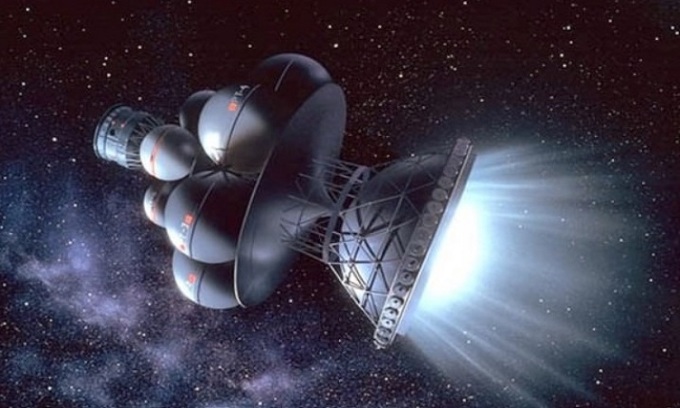
Simulation of a magnetic fusion plasma drive (MFPD). Photo: Shigemi Numazawa/ Project Daedalus
Florian Neukart, assistant professor at the Leiden Institute for Advanced Computer Science (LIACS) at Leiden University and board member of Swiss quantum technology developer Terra Quantum AG, believes that one of the emerging technologies that could make intergalactic travel a reality is the magnetic fusion plasma drive (MFPD), Interesting Engineering reported on October 8. For example, the Pulsar Fusion engine design could reach speeds of 804,672 km/h.
MFPD, also known as thermonuclear propulsion system, is a technology being researched and developed for the potential of space exploration and interplanetary travel in the future. This propulsion system has a much higher energy density and efficiency than conventional chemical rockets because it is based on thermonuclear reactions, the mechanism that provides power to the Sun and stars. For expeditions to distant planets or even intergalactic travel, thermonuclear motors can provide stronger and faster thrust.
MFPDs rely on nuclear fusion, the process of combining light atomic nuclei (usually hydrogen isotopes such as deuterium and tritium) to release enormous amounts of energy. This process is different from the fission reaction used in nuclear power plants and atomic bombs. Nuclear fusion is used to create a fast-moving, high-energy plasma in MFPDs, which provides thrust for the vehicle.
Compared with chemical engines, fusion propulsion systems have many advantages such as fast travel time, low fuel consumption and higher efficiency, allowing travel within and outside the Solar System.
"MFPDs harness the enormous energy of a fusion reaction, typically involving hydrogen or helium isotopes, and create a jet of high-speed particles that generates thrust according to Newton's third law," Neukart explained. "The plasma from the fusion reaction is confined and controlled by magnetic fields. At the same time, the MFPD design aims to convert some of the fusion energy into electricity to sustain the spacecraft's systems."
However, a major technological challenge that researchers need to overcome is creating a working fusion propulsion system. On a spacecraft, it is very difficult to achieve and maintain the high conditions necessary for fusion reactions. Researchers are still studying several methods of controlling the plasma from the reaction.
An Khang (According to Interesting Engineering )
Source link
![[Photo] National Assembly Chairman Tran Thanh Man attends the VinFuture 2025 Award Ceremony](/_next/image?url=https%3A%2F%2Fvphoto.vietnam.vn%2Fthumb%2F1200x675%2Fvietnam%2Fresource%2FIMAGE%2F2025%2F12%2F05%2F1764951162416_2628509768338816493-6995-jpg.webp&w=3840&q=75)


![[Photo] 60th Anniversary of the Founding of the Vietnam Association of Photographic Artists](/_next/image?url=https%3A%2F%2Fvphoto.vietnam.vn%2Fthumb%2F1200x675%2Fvietnam%2Fresource%2FIMAGE%2F2025%2F12%2F05%2F1764935864512_a1-bnd-0841-9740-jpg.webp&w=3840&q=75)





























































































Comment (0)