


Resilience in the resistance war
From the center of Tra Tan commune, we rode our motorbikes upstream for about 3km along a winding mountain road to reach the Cay Cho Resettlement Area. Nearly 30 houses are built on a flat area next to a concrete road. Near the resettlement area stands a century-old chò tree, a silent witness to the vicissitudes of time, protected by generations of villagers. This season, the tree is in full bloom with vibrant yellow flowers, emitting a fragrant aroma. About 100 meters above the chò tree is the provincial-level historical and cultural relic, the T30 Medical Station.
According to the elders in the village, during the resistance war against the US, the Tra Ot hamlet area in Tra Tan commune had many caves and high mountains, making it convenient for our troops and people to hide and build revolutionary bases. Responding to historical demands, in early 1964, the T30 Medical Station was established under the Ta Na cave, in the Ong Cay and Mang Ri mountain areas of Tra Ot hamlet. The station carried out the task of caring for and providing medical services to the people, cadres, and soldiers in the western Binh Son, western Son Tinh, and southern Tra Bong areas; at the same time, it prepared manpower, resources, medical equipment, and medicines to serve the major battles of the local troops and the armed forces of Military Region 5 in coordination with the fighting in the northern battlefield of the province.
 |
| A memorial plaque commemorating the martyrs who died at the T30 Medical Station, Tra Ot village, Tra Tan commune. |
The T30 medical station also served as an important bridge, contributing to building the relationship between the revolutionary armed forces and the people in the region. Knowing this, the enemy used tactics to extract information about the T30 medical station; they frequently surrounded and bombed it, but were unable to detect the unit's existence in the Tra Tan area. Wounded soldier Ho Van Danh, from Tra Ot village, shared that the war in this area was very fierce back then. Not only did the Americans bomb and sweep through, but they also used airplanes to spray chemical weapons over the forests and trails to destroy our military bases. However, our army and the people in the region persevered, increasing production and finding ways to fight the enemy.
On the evening of October 14, 1964, heavy rain and flooding caused a landslide that swept away five medical staff members of the T30 Medical Station along with 30 wounded and sick soldiers receiving treatment there. This was a tremendous loss and sacrifice for the Quang Ngai health sector during that period. In 2007, the T30 Medical Station site was recognized by the Provincial People's Committee as a provincial-level historical and cultural relic. In 2015, to commemorate the sacrifices of the martyrs who died at the T30 Medical Station; and to promote the value of the historical site and educate the revolutionary traditions for medical staff and the people, the Provincial People's Committee allocated funds to build and complete the memorial monument for the martyrs who died at the T30 Medical Station.
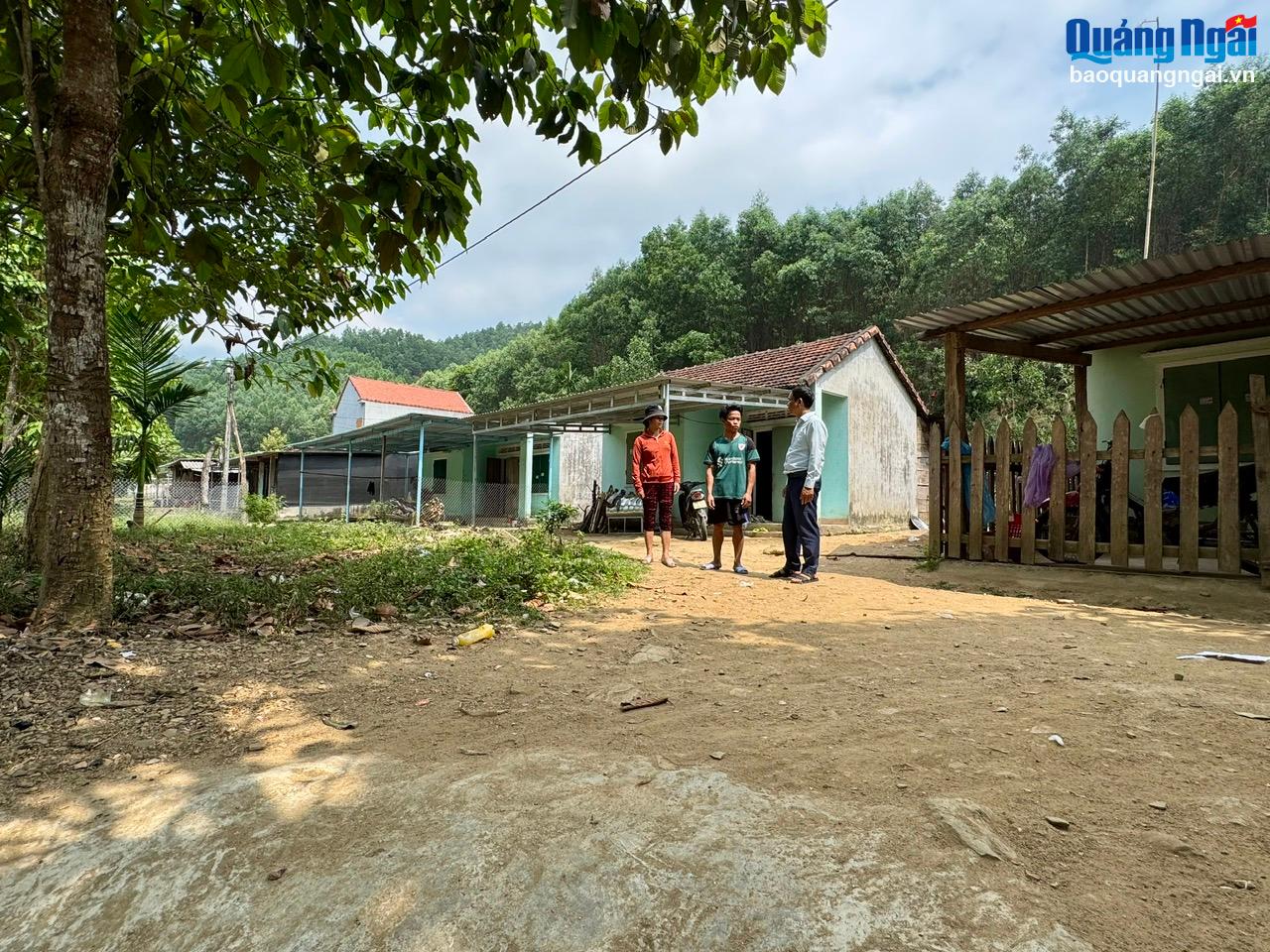 |
| Many households living in mountainous areas at risk of landslides have been relocated to the Cay Cho resettlement area in Tra Ot village. |
After liberation, with the country reunified, the people of Tra Ot village rebuilt their houses along the mountainous areas of Ong Cay and Mang Ri mountains and lived off the forest. Life was extremely difficult at that time, but they always trusted in the leadership of the Party and believed that the efforts of each individual would transform this bomb-ridden land into a place of blossoming and fruitfulness.
Let's work together to build our homeland.
In the atmosphere of those historic April days, the people of Tra Ot village, Tra Tan commune, enthusiastically go to the fields to tend to their rice crops and to the plantations to harvest acacia, cinnamon, and tea. The rice fields at the beginning of the village are entering their final stage, with heavy ears of rice swaying in the wind. Along both sides of the road, more and more houses with bright red tiled roofs are being built, a testament to the prosperity and abundance of the people here.
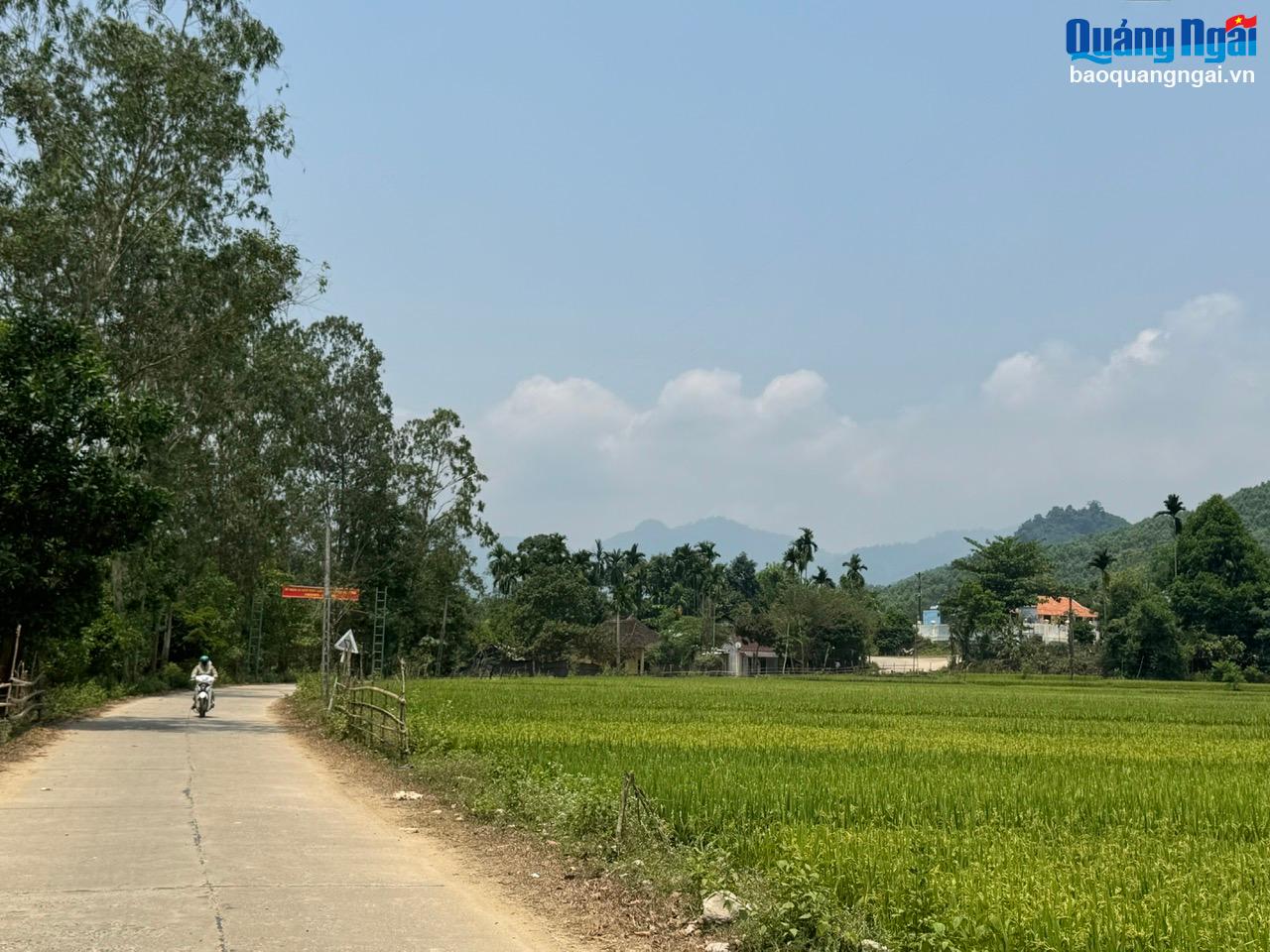 |
| The road to Tra Ot village, Tra Tan commune (Tra Bong district) has been paved with clean concrete, facilitating travel for residents and enabling children to go to school. |
Nearly 30 households in the high-risk landslide area of Nuoc Lat hamlet have been relocated by the local government to the Cay Cho Resettlement Area for over a decade. Besides having a place to live, the villagers have also received support from the government in the form of seedlings, livestock, and policy loans, creating conditions for them to develop their economy and increase their income. The road from the commune center to the resettlement area, about 3km long, has been paved with concrete, making travel easier for residents and allowing children to happily go to school.
Mr. Ho Van Thao (39 years old), from Tra Ot village, shared: "Previously, my house was located high up in the mountains, making it very difficult for my children to go to school. Since moving to the resettlement area, I feel much more at ease. Currently, my two children attend kindergarten at a school near our house, so I don't need to take them to and from school like before. Moreover, in recent years, the government has invested in rebuilding the roads, making it much easier for everyone in the village to travel back to their old homes for production. Before, it took half a day's walk, but now it only takes 40 minutes by motorbike. Thanks to this, the products we produce, such as acacia, cinnamon, and tea, are also bought by traders at higher prices."
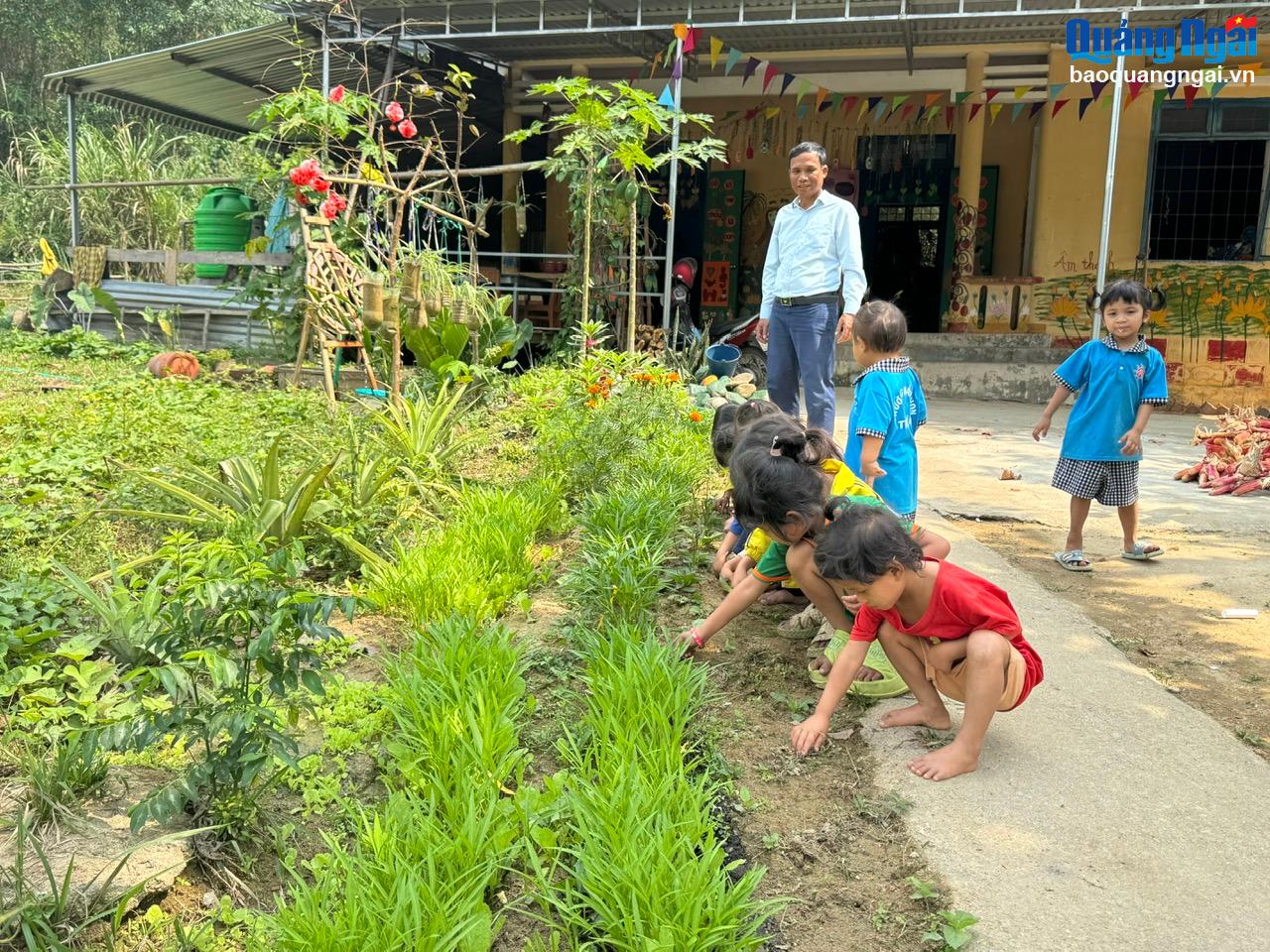 |
| Preschool students at Cay Cho school branch, Tra Ot village. |
The entire village of Tra Ot has 174 households with 749 inhabitants. For generations, the villagers have lived in unity, helping each other to improve their lives. “Now, the villagers no longer worry about the ‘lean season,’ working during the dry season to save for the rainy season, and many have accumulated wealth. People have learned to apply science and technology to production, increasing the productivity of wet rice cultivation instead of dry rice farming. The villagers are also increasingly concerned about their children's education. Many students from the village have passed university and college entrance exams; the rest have been sent by their families to vocational schools or, after graduating from high school, have found work as factory workers in industrial zones in the province,” said Mr. Ho Minh Son (86 years old), a respected figure in Tra Ot village, with enthusiasm.
According to Ho Van Huynh, Vice Chairman of the People's Committee of Tra Tan commune, in recent years, with support from the State, the people of Tra Ot village have strived to improve their livelihoods, develop the economy, and increase their income. Thanks to the unity and joint efforts of the villagers in donating land and contributing labor, many roads in the village have been widened and paved with clean concrete, especially the more than 3km long road from the commune center to the Cay Cho resettlement area. In addition, the district has invested in building a road connecting Huong Tra commune with Tra Tan commune, more than 11km long, with about 3km remaining to be completed. Once this road is completed and put into use, it will create momentum for the economic and social development of Tra Tan.
We left Tra Ot village as the afternoon sun began to set. The villagers were starting to herd their buffalo and cattle back home from the mountains after a day of grazing. Children from the resettlement area gathered at the edge of the village to play and dance. In the joyful and exhilarating atmosphere of the great victory day of April 30, 1975, the people of Tra Ot village were competing in labor and production, working together to build an increasingly prosperous and beautiful life.
Text and photos: HONG HOA
Source: https://baoquangngai.vn/tin-noi-bat/202505/duoi-chan-nui-mang-ri-f0e0242/
![[Photo] Soldiers return home to celebrate Tet (Lunar New Year) with the people of Yang Mao remote commune.](https://vphoto.vietnam.vn/thumb/1200x675/vietnam/resource/IMAGE/2026/02/13/1770972833933_img-0360-8494-9922-jpg.webp)




































































Comment (0)