

This document also serves as concrete evidence of the pioneering contributions of the Nguyen Canh family in Cuu An.
During our survey of ancient written heritage , we discovered that Gia Lai still has one site preserving documents from the Tay Son period. This is also the largest archive in the province, containing nearly 500 pages of Han Nom script, mainly related to land ownership from the time of King Canh Thinh to the time of King Bao Dai. These documents are of particular importance in understanding and researching the history and culture of the Kinh people in eastern Gia Lai over more than two centuries.
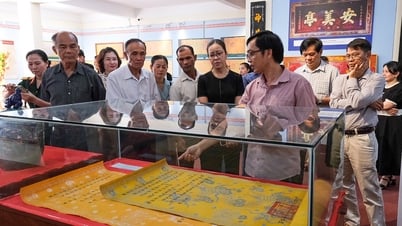
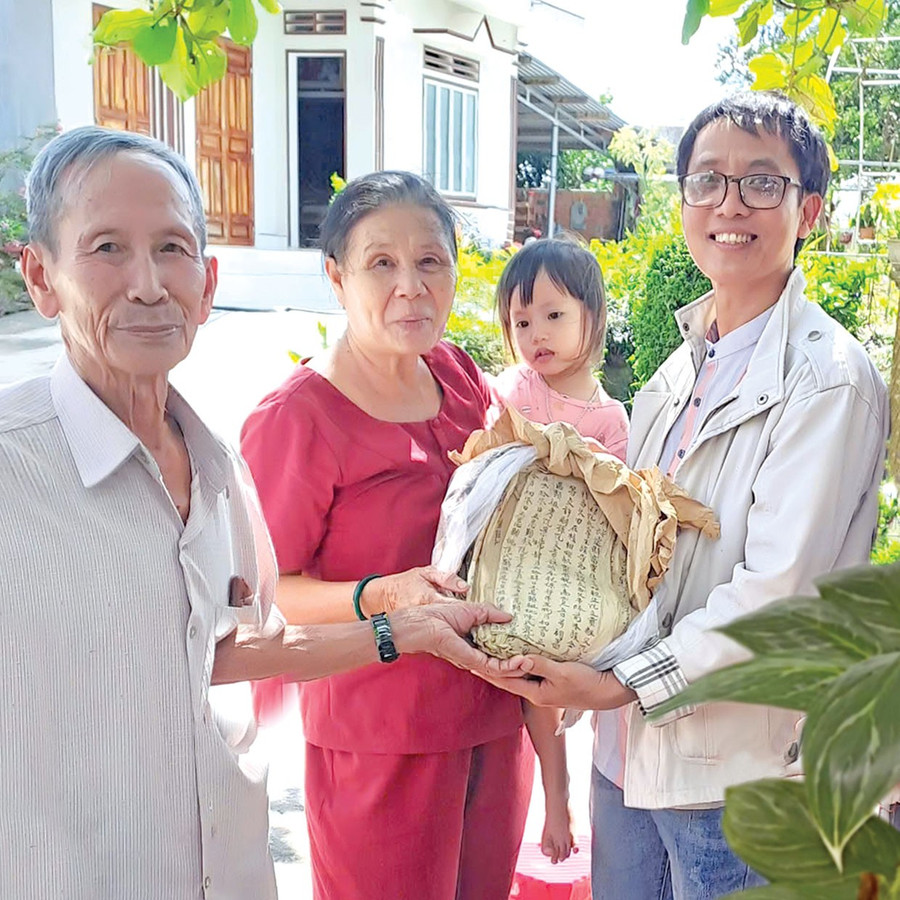 The family of Ms. Ly Thai Lan donated the archive of Nguyen Canh family heritage documents in Cuu An to the Provincial Museum (photo courtesy of LHS).
The reason we call it a "discovery" is because, besides the fact that this treasure had never been known to any researcher before, even the family keeping the documents could not determine the age or content of the texts. The person who provided us with the information was Mrs. Ly Thai Lan (born in 1955, An Dien Bac village, Cuu An commune), whose house is right next to the Lady's Shrine. She said: "These are documents left behind by my grandparents. After my husband passed away, I kept them for a long time. I don't know exactly when they came from, only that it's been a very long time. No one in the family can read them, not even the children know that we have these documents."
According to our preliminary statistics and classification, this massive collection of documents comprises approximately 480 pages written on traditional Vietnamese dó paper, divided into two groups by dynasty: the Tây Sơn period documents and the Nguyễn period documents. The documents are generally in relatively good condition. However, appropriate preservation techniques are urgently needed to extend their lifespan, as many of these texts have begun to deteriorate due to their long historical passage.
Of these, the Tây Sơn period documents consist of only 3 texts from the 8th year of the Cảnh Thịnh reign (i.e., 1800). Remarkably, all 3 texts share the same content. The Nguyễn period documents cover 11 emperors: Gia Long, Minh Mạng, Thiệu Trị, Tự Đức, Kiến Phúc, Hàm Nghi, Đồng Khánh, Thành Thái, Duy Tân, Khải Định, and Bảo Đại.
The largest number of documents in this archive are from the reign of Emperor Tự Đức, with approximately 180 pages, or more than one-third of the total; followed by documents from the reigns of Emperors Minh Mạng, Thành Thái, Thiệu Trị, and Khải Định. Looking at this proportion, we can tentatively infer that the policies of migration, land reclamation, and land management in the Tây Sơn region during the Nguyễn dynasty began to be strongly promoted from the reigns of Emperors Minh Mạng and Thiệu Trị, reaching their peak during the reign of Emperor Tự Đức, before gradually weakening with the decline of the Nguyễn dynasty.
The collection of documents from the Tay Son period includes three texts written with ink on a folded sheet of Do paper. One text, the largest in size and with the most characters, is severely decayed, while the other is bound together with documents from other dynasties (Ham Nghi, Tu Duc). Remarkably, the content of all three texts is identical, all bearing the reign name “Canh Thinh eighth year fifth month eighth day,” meaning “the 8th day of the 5th month of the 8th year of Canh Thinh (1800).” (“Canh Thinh” in Vietnamese history refers to the reign name of King Nguyen Quang Toan, son of King Quang Trung Nguyen Hue). However, considering the size of the paper and the style of writing, they are three different styles. Thus, only one text is original; the others are copies.
This document describes a woman named "Mrs. Thien" from Team 1, Kien An Van Khu, Tay Son village, Thoi Hoa commune, Phu Ly district, Quy Nhon prefecture, who owned three plots of land inherited from her grandparents. Because she needed money for a task but lacked funds, she sold them to relatives, "Old Tam and his wife," for 60 dong. The document concludes with the seller's fingerprint, "Mrs. Thien," the signature of the person who wrote the deed, "Da," and the signatures of two witnesses: "Commander" named Lanh and "Bien Cuu" (Bien's name is Cuu). In contemporary terminology, this document was called a "deed" (meaning a contract or agreement, a written document used as proof, commonly referred to today as a contract).
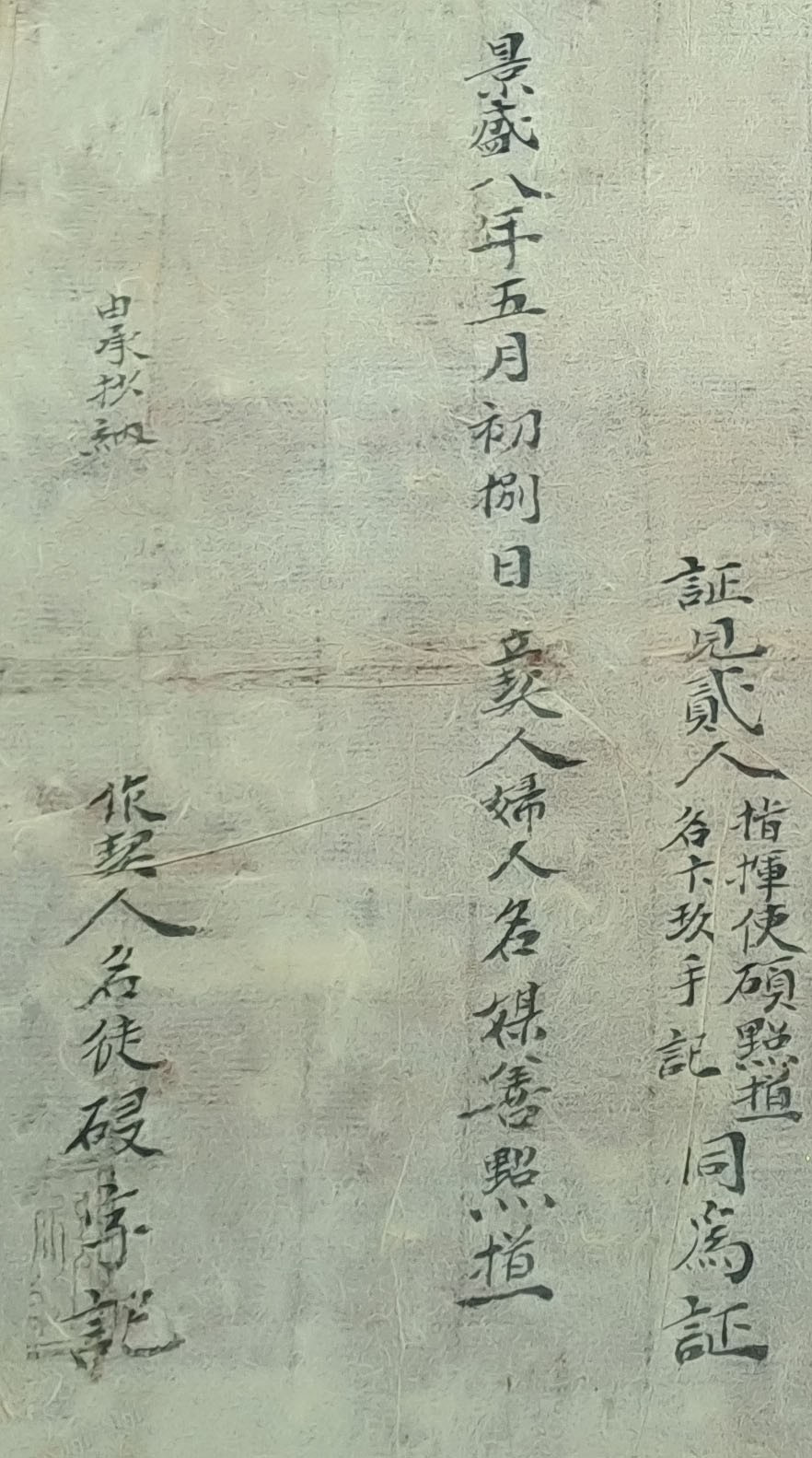 One page recording the reign name Canh Thinh, year 1800 (archival photo of LHS).
When we first saw the document bearing the "Canh Thinh" era name, we were overjoyed. It was something we had been longing for and searching for for years, and it had finally appeared. For Mrs. Lan's family, these land documents are now worthless and are considered heirlooms left behind by their ancestors.
However, for those working in museums as well as those researching local history and culture, this is a priceless treasure, because from here we can decode many things that are still open due to lack or failure to exploit information from Han Nom documents in the field.
The Nguyen Canh family in Cuu An is a typical example in Gia Lai of the process of land accumulation through buying, selling, and reclaiming land from the Tay Son dynasty to the Nguyen dynasty, from the Tay Son Ha to Tay Son Thuong regions over a period of more than two centuries. In the inscriptions of the oldest temple in Cuu An, Dinh Ba (also known as An Dien/An Dien Bac temple, part of the Tay Son Thuong Dao Special National Monument Complex), the Nguyen Canh family is also recognized by the local villagers as their founding ancestors.
Therefore, without knowing where this family originated from or when they arrived in Cuu An, just based on the land documents and worshiping documents at the Lady's palace, it is enough to confirm that this family has been present in Cuu An since the early period and has contributed to reclaiming and establishing the village here since ancient times.
By expanding the exploitation of this source of documents, we will know specifically about the migration and land accumulation, and the change of place names of the Kinh people in the border area between Binh Dinh and Gia Lai during the Tay Son and Nguyen dynasties.
When we saw these lines in the huge volume of documents, we expressed our wish to Mrs. Lan's family to bring some of the original documents to the Provincial Museum for storage and display. Only after 3 years did Mrs. Lan's family feel secure enough to decide to hand over these valuable documents.
But what surprised us was that Mrs. Lan's family gave us all the documents they were keeping in the spirit of selfless donation. The Provincial Museum is currently in the process of receiving the donated artifacts to acknowledge the kindness of Mrs. Lan's family.
Mr. Nguyen Canh Do (born 1940, An Dien Bac village), Mrs. Lan's brother-in-law and former caretaker of the Cuu An communal temple, was the one who guided us to meet Mrs. Lan and request access to this valuable archive. He expressed: "Our family only hopes that you will preserve and utilize this valuable information about the Cuu An area, which the Nguyen Canh family has contributed to for generations in terms of exploration, construction, and development."





















![[Photo] Urgently help people soon have a place to live and stabilize their lives](/_next/image?url=https%3A%2F%2Fvphoto.vietnam.vn%2Fthumb%2F1200x675%2Fvietnam%2Fresource%2FIMAGE%2F2025%2F12%2F09%2F1765248230297_c-jpg.webp&w=3840&q=75)













































Comment (0)