

With its long and winding shape, the Vatnajokull ice cave hidden under Iceland's largest glacier is nicknamed the "Anaconda Ice Cave".
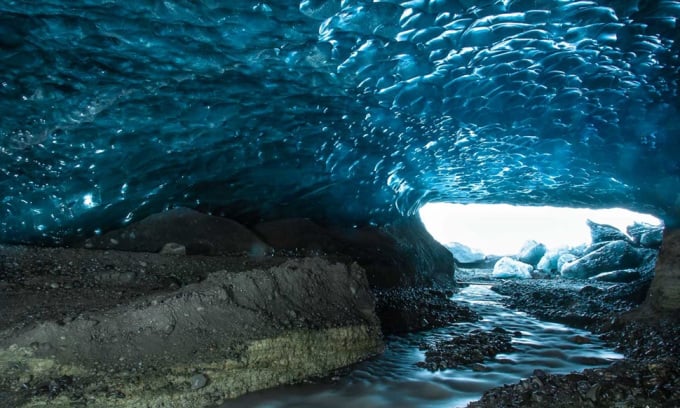
Anaconda ice cave under Vatnajokull glacier, Iceland. Photo: Arctic Adventures
Located within Vatnajokull National Park, the Anaconda Ice Cave boasts an impressive beauty with its smooth, blue ice. Glacial caves have a unique blue color due to the pressure exerted on the ice. This process pushes all the air out of the ice, a factor that normally makes ice white instead of blue.
"This is the result of hundreds of years of snowflakes falling, compressing, and recrystallizing into ice. During this process, air bubbles trapped in the ice are pushed out," says Arctic Adventures, the company that organizes tours of Vatnajökull National Park.
"When a block of ice is too dense to contain air inside, light travels deeper. The deeper the light travels, the more of the red spectrum is lost along the way, making the ice appear blue to the human eye. That's why the ice of glaciers in Iceland has such a magical blue color," Arctic Adventures further explains.
The blue color can become more vibrant on the cave ceiling when light shines through, making the ice appear to glow. The non-bubbled blue ice sometimes mixes with gray, white, and black volcanic ash deposits, creating complex color combinations that swirl along the cave walls.
Anaconda ice caves are glacial caves, distinct from true ice caves (caves filled with ice). They form when the ice of a glacier melts and the water creates smooth tunnels. This is why glacial caves like Anaconda have such uniquely smooth walls.
Visitors can take guided walks right inside the "belly of the python" with the help of local expedition companies. Traditionally, the visiting season runs from November to March because the weather is cold enough to ensure the glacial caves remain stable. In the summer, warmer weather can make the caves dangerous as the ice continues to melt, although some caves remain frozen year-round.
The volatile nature of Iceland’s glacier caves means they constantly change shape and structure, making each visit unique. This also makes it exciting for guides who return later in the summer to look for new caves or tunnels to form.
Thu Thao (According to IFL Science )
Source link



































![[Video] The craft of making Dong Ho folk paintings has been inscribed by UNESCO on the List of Crafts in Need of Urgent Safeguarding.](https://vphoto.vietnam.vn/thumb/402x226/vietnam/resource/IMAGE/2025/12/10/1765350246533_tranh-dong-ho-734-jpg.webp)























































Comment (0)