

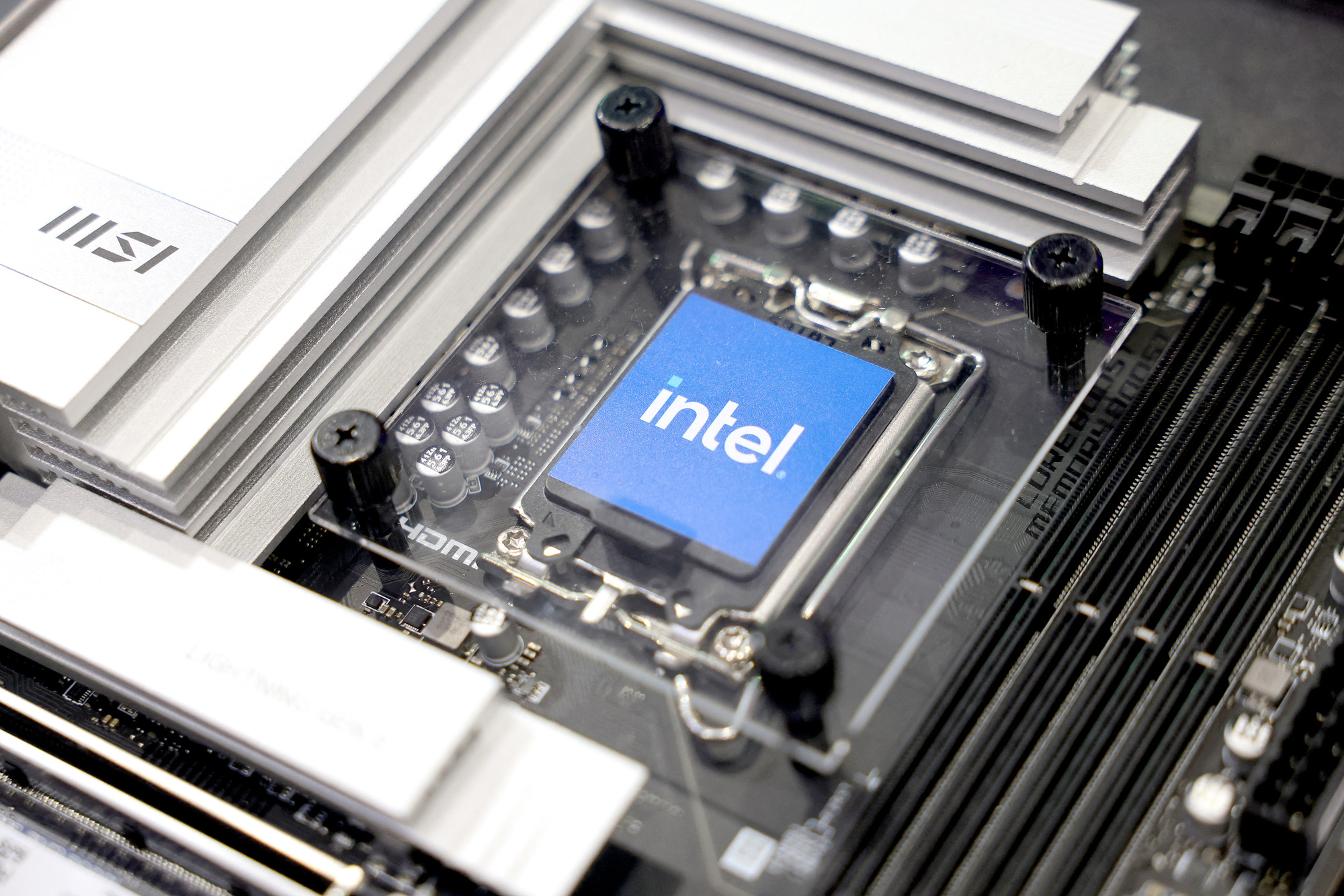
Once a giant in the chip industry, Intel is now facing the risk of being acquired - Photo: AFP
But the question is whether Intel's new technologies can change the market or if it's simply a move that's too late for Intel? Once a company that specialized in "hunting" smaller companies, Intel has now become a takeover target after the Wall Street Journal revealed that Qualcomm wants to acquire Intel.
Intel's efforts
The new Xeon 6 CPU and Gaudi 3 AI accelerator promise improved performance and power efficiency, representing Intel's attempt to prove it has the capability to become a major competitor in the AI field.
Intel says the new Xeon 6 chips, with cores offering double the performance of the previous generation, are built for AI, while the Gaudi 3 processors are specifically designed for generative AI applications and will compete directly with Nvidia's H100 series and AMD's MI300X.
Intel boasts that IBM is using the Gaudi 3 accelerator in its IBM Cloud system. The company claims that the Gaudi 3 accelerates AI training and runs AI processes 1.5 times faster than Nvidia's NV100 GPU. Additionally, its competitive pricing will give Intel an advantage over its rivals' more expensive chips.
Currently, Intel chips are no longer as sought after as they once were. Instead, companies like Meta, Microsoft, and Google are competing to buy Nvidia's AI chips, causing the company's stock price to skyrocket.
While Intel suffered losses and its stock price dropped by as much as 52%, Nvidia's stock has surged an incredible 142% this year, and AMD's stock has also increased by 12% over the same period.
Both of Intel's rivals are planning significant upgrades to their chip lines, and earlier this year Qualcomm even announced the Snapdragon X Plus AI chip for computers, encroaching on a market dominated by Intel, according to CNBC.
However, Kevin Surace, known as the "father" of virtual assistants and voice user interfaces, and also the chairman of the technology company Token, believes that the AI market will change.
"The market is hungry for alternatives to Nvidia's $40,000 H100 chip. Nvidia has a solid lead and a monopoly on GPUs for AI. That's about to change drastically, and Intel's product is surprisingly powerful," he stated on Techopedia.
Meanwhile, Michal Oglodek, chief technology officer and co-founder of Ivy.ai, a leading provider of conversational AI chatbots, also believes that the challenge to Nvidia was inevitable. "It's no surprise that Intel is acting. The competition is now on a full-blown level," he said.
Why was Intel targeted?
Of course, Qualcomm has also taken action, as the Wall Street Journal recently reported that the tech giant is considering acquiring Intel to strengthen its own chip business.
Although no figures have been released, given the positions of the two companies in the chip market, this could be the largest merger in many years and the most impactful in the history of the global technology industry.
Unlike its competitors, Intel not only designs but also manufactures chips and was the world's number one company in this field for many decades. However, this manufacturing segment of Intel is facing many difficulties, incurring billions of dollars in losses and losing its position to its Taiwanese rival TSMC in recent years.
However, Intel is the only American company capable of large-scale chip production, while rivals Nvidia, Qualcomm, and AMD rely on suppliers in Taiwan.
Intel is currently hoping to revive its manufacturing business thanks to the Chips Act passed under President Joe Biden, which considers chips not just as a technology but also as a matter of national security.
This year, the company has received $8.5 billion and may be eligible for an additional $8.5 billion under the legislation. In mid-September 2024, Intel announced it would spin off its struggling chip manufacturing division into a subsidiary to handle orders such as producing custom AI chips for Amazon.
Will Intel's Gaudi 3 AI chip be a market-changing technology, or will it be just a small, too late addition? Time will tell, but Intel's history of innovation and business scale are clearly formidable. "It's still too early in the AI chip race; this is only the first round," Surace stated.
Intel is facing difficulties.
In its latest quarterly earnings report in August 2024, Intel reported worse-than-expected revenue and earnings per share. The company lost more than $30 billion in market value after the report, raising concerns about its ability to catch up with rivals like TSMC, according to Reuters.
In addition, the company also plans to cut 15,000 jobs and reduce its global real estate holdings by about two-thirds by the end of this year.
Source: https://tuoitre.vn/intel-muan-but-pha-trong-cuoc-dua-chip-ai-20240926075542979.htm



![[Photo] Hanoi is ready for the "National Festival"](https://vphoto.vietnam.vn/thumb/1200x675/vietnam/resource/IMAGE/2026/03/12/1773305846167_ndo_br_z7612336508628-14627dc7d18cc27532ffea5d4089713b-4105-jpg.webp)
![[Photo] Trial run of the election process at polling stations in Dong Da ward (Hanoi)](https://vphoto.vietnam.vn/thumb/1200x675/vietnam/resource/IMAGE/2026/03/12/1773306146728_ndo_br_van-hanh-thu-to-bau-cu-4070-755-jpg.webp)































































































Comment (0)