

"Every training program needs revision, every curriculum needs to be changed."
The seminar "Developing digital transformation solutions in schools and organizing teaching and learning in foreign languages at colleges, vocational schools, and continuing education centers" organized by the Hanoi Department of Education and Training took place this afternoon (November 4th).
Mr. Tran The Cuong, Director of the Hanoi Department of Education and Training, emphasized: "Digital transformation and international integration through foreign language proficiency are two parallel and inseparable pillars for improving the quality of human resources in the capital city."
The Department identified three key issues requiring input from vocational schools in the city: resolving bottlenecks in data management, system operation, and digital learning resource development; proposing feasible models and solutions for building effective digital training processes and organizing foreign language teaching; and determining mechanisms for connecting and integrating technological solutions to build model examples.
According to Pham Xuan Khanh, Principal of Hanoi High-Tech College, in order to provide vocational training in the digital age, all programs, curricula, and lectures must be digitized synchronously.
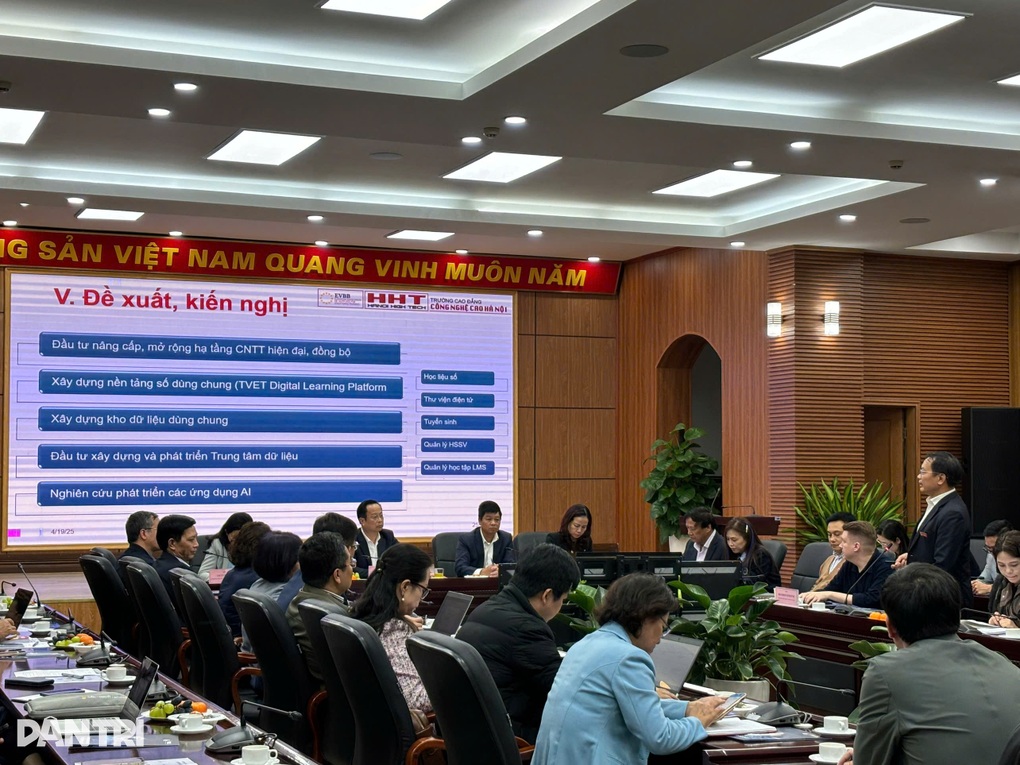
Pham Xuan Khanh, Principal of Hanoi High-Tech College, proposed solutions for digital transformation in vocational education (Photo: Hoang Hong).
Mr. Khanh stated that Hanoi High-Tech College currently offers training in 45 different fields. Digital transformation requires the simultaneous revision of all training programs, from electronic curricula, electronic textbooks, electronic lesson plans, electronic lectures, electronic tests, simulated experiments, and other digital learning materials…
Based on this reality, Mr. Khanh proposed solutions such as: investing in upgrading information technology infrastructure; creating a shared digital platform; proposing a shared data warehouse; building and developing a data center; and researching and developing AI applications.
Regarding the issue of teaching and learning in foreign languages, Ms. Dao Thi Thu Huong, Head of the Foreign Language Departmentat FPT Polytechnic College, believes that technology and artificial intelligence (AI) are opening up opportunities to make English an essential skill for the general workforce.
At FPT Polytechnic, 100% of students study using laptops, and exams are conducted entirely online. Virtual conversation tools help students practice listening and speaking skills and develop effective communication reflexes. Simultaneously, 99% of lecturers are proficient in creating complete digital lectures.
However, according to Ms. Huong, for digital transformation and teaching and learning in foreign languages to be truly applicable, in addition to solutions like those proposed by Mr. Nguyen Xuan Khanh, there needs to be more opportunities for students in vocational schools to participate in AI and foreign language activities. These activities will also help form a strong digital vocational college community.
Ms. Huong also expressed her wish for education leaders to pay more attention to teaching English to vocational school students, so that even those with average skills can communicate effectively in English with foreigners.
"We need to find a way to train a worker who can install screws and repair cars so they can speak English as well as taxi drivers in the Philippines, Thailand, and other countries," Ms. Huong expressed.
Digital transformation in vocational schools still faces many obstacles.
According to a report by the Hanoi Department of Education and Training, there are currently 68 colleges, 85 vocational schools, and 29 vocational training centers/continuing education centers in the city, out of a total of 352 vocational education institutions.
This is one of the two largest vocational training networks in the country, providing technical human resources for the capital and the key economic region of Northern Vietnam.
Since 2025, the Department has issued a series of plans and official documents to implement the "Digital Literacy Movement," digital school records, and digital transformation programs across the entire sector.
To date, over 70% of colleges and vocational schools have implemented Learning Management Systems (LMS) and online training management systems. Several pioneering institutions, such as Hanoi College of Electrical Engineering, Hanoi College of High Technology, Hanoi Polytechnic College, and FPT Polytechnic College, have applied AI in course design and assessment.
However, digital infrastructure and capabilities remain uneven, investment is limited, licensing and security costs are high, many teachers lack in-depth digital skills, and there is a lack of shared databases to connect the entire sector.
Regarding foreign language teaching and learning, some schools have initially organized bilingual programs, partnered with FDI enterprises, and opened foreign language classes based on professional needs. However, the general situation of these schools is a shortage of qualified English teachers, a lack of practice environments, and a lack of policies to encourage students to learn foreign languages.
Representatives from FSEL – a provider of online language learning platforms that won the Sao Khue Award for science and technology – provided survey figures showing that only 5% of Vietnamese students currently learn English according to international standards. This means that a large percentage of the remaining students have not yet learned standard English.
To effectively introduce English, and foreign languages in general, to vocational school students, the challenge is to create a digital transformation and foreign language training ecosystem for vocational education institutions.
FSEL proposed that the Department allow the unit to conduct free English proficiency assessments for 140,000 teachers in Hanoi, and also support the development of a roadmap to achieve B1 and B2 levels.
This unit also proposed a legal framework for vocational schools to share a common digital platform. With data interconnection, all vocational schools can learn, teach, and evaluate on the same transparent and efficient system.
Source: https://dantri.com.vn/giao-duc/lam-sao-de-nhan-vien-lap-oc-vit-sua-o-to-cung-noi-tot-tieng-anh-20251104170203492.htm


![[Photo] Prime Minister Pham Minh Chinh presides over a meeting on private sector economic development.](/_next/image?url=https%3A%2F%2Fvphoto.vietnam.vn%2Fthumb%2F1200x675%2Fvietnam%2Fresource%2FIMAGE%2F2025%2F12%2F20%2F1766237501876_thiet-ke-chua-co-ten-40-png.webp&w=3840&q=75)








































































Comment (0)