Being playful by nature, on those warm, sunny days after the rain, anticipating the arrival of spring, a friend invited me to visit the Ba Long war zone. I suddenly remembered a few lines of poetry by Luong An: “My boat goes up and down Ba Long / Carrying cadres across the war zone (...) Whoever goes to Tram wharf, get on board. Go early, the night rain makes rowing difficult” (The Boatwoman).

The Thach Han River section flowing through Quang Tri town - Photo: V.LAN
These verses, laden with love for the land and people of Quang Tri, flowed through two wars of resistance and, even today, half a century after peace and reunification, still resonate on the rivers and waterways of a region rich in rivers, docks, and numerous riverbanks. This is also Luong An's most famous poem, to the point that when his name is mentioned, people immediately think of "The Boatwoman," and many mistakenly believe that this is the only poem he wrote, calling him "the poet of one poem."
In fact, although he was a political /cultural and artistic official, he also had a literary career deeply marked by the culturally rich countryside where he was born and raised: Nắng Hiền Lương (poetry, 1962), Vè chống Pháp (research, 1984), Thơ Tùng Thiện Vương Miên Thẩm (research, 1994), Thơ Mai Am và Huệ Phố (research, 2002), and Tuyển tập Lương An (2004).
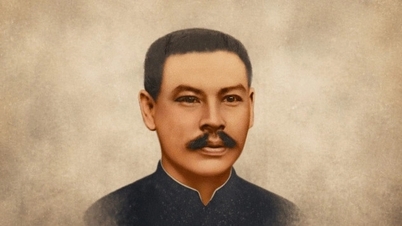
Luong An, whose real name was Nguyen Luong An, was born in 1920 in Trieu Tai, Trieu Phong, Quang Tri. He studied in his hometown before attending Hue National School, graduating with a high school diploma. While still studying for his high school diploma, he joined the Viet Minh (May 1945) and participated in the August Revolution. He worked at the Central Administrative Committee and then at the Quang Tri Provincial Administrative Committee.
From then on, he held many positions such as working in cultural and artistic activities in the Provincial Party Committee, the Viet Lien Front of Quang Tri province, then the 4th Inter-regional Party Committee (1949), Head of the editorial board of the newspapers Sinh Hoat Van Hoac and Thong Nhat (1958-1972), Deputy Head of the Quang Tri Department of Culture (1973), Standing Member of the Binh Tri Thien Provincial Union of Literature and Arts (1983) until his retirement (1984).
Some people say: "Before the August Revolution around 1941, he worked as an administrative civil servant and began writing poetry, but without much success" (Tran Manh Thuong, Vietnamese Literary Authors, Volume 1, Culture and Information Publishing House, 2008, p. 1045). In fact, Luong An came to poetry from the days he left his hometown to study at Quoc Hoc High School and began publishing his first poems in the Trang An newspaper ( Spring in the Homeland, By the Perfume River, In the Past, Knitting a Sweater...).
Of course, within the general trend of the New Poetry movement at that time, the poetry of a young man of nineteen or twenty like him also blended in with the romantic tone of poetry: "Spring in my homeland is like blossoming flowers / Winding roads bustling with people passing by / Thin mist hangs over warm feet / Branches and leaves calmly wait for the fading sunlight" (Spring in My Homeland, composed in Hue, 1939).

After completing his secondary education, he continued his studies for a few months, but due to poverty and having many siblings, he lacked the funds to continue his education. Therefore, in 1941, Luong An participated in the civil service examination in the Southern Dynasty and was appointed as a "secretary"—a daily clerk responsible for recording official documents in the Ministry of Personnel.
It was during these years, thanks to living in a region that was home to many of the country's most talented poets, and also due to his free time, that Luong An published his first poems in the Trang An newspaper, a publication he regularly collaborated with as a "sports reporter" (Nguyen Khac Phe, Preface, Luong An Anthology, Thuan Hoa Publishing House, 2004, pp. 568-569). And, it was in this capacity that he provided information beneficial to the Viet Minh, through his fellow countryman and classmate, the journalist Hong Chuong.
During his lifetime, the poet Luong An wrote a poem titled "The Village," with the dedication "To the villages of Quang Tri," in which he recognized the rebirth: "Rice plants revive the bomb crater land / Sweet potato vines cover the layer of ash / And as everything turns green again / With the refreshing laughter of the village / In my heart, the village suddenly feels so young / Each name sounds so proud / As if nothing has been lost / As if it will grow even more beautiful in the future." |
Besides the epic poem "A Drop of Shared Blood ," over a thousand lines long (first published in the Luong An Anthology, 2004), which depicts the struggle of the Kinh Thuong people in the Central Highlands, it can be said that Luong An's entire writing career of over sixty years has been deeply rooted in the land and people of Binh Tri Thien, where he was born and where he spent his working life, including in the three literary genres he was involved in: poetry, research, and portraiture. This is a rich aesthetic region, the birthplace of his aesthetic sensibilities and content, the author's creative homeland.
Just glancing at the titles of the works reveals this. With poetry, there are sparkling poems like "Sunshine of Hien Luong," "Returning to Hien Luong," "The Banks of Hien Luong," "The Road to Vinh Kim," "Waves of Cua Tung," "Remembering Cua Viet, My Homeland," "On the Sa Lung River," "Listening to the Legend of the Dakrong River," "The Song of the Thach Han River," "Night in Hai Lang," "Tam Giang," "Beside the Perfume River," "Oh, Hue, 16 Years Away "... and then there are the people – those who once sacrificed for the resistance, simple and kind like potatoes and rice grains, hardworking yet intelligent and resilient around the border region. Just reading the titles, one can imagine these people shining brightly amidst the smoke and bombs: "The Boatwoman," "The Old Soldier," "The Old Man of the Upstream Water," "The Old Man by the River," "The Girl by the River," "Sending a Letter to My Sister Crossing the Line," "Meeting a Young Mountain Doctor on the Bus," "Eleven Girls from Hue"...
His poetry is narrative in nature, telling stories about people and the land, rivers and streams, expressing aspirations for peace and unity, reflecting the feelings of people in poor, suffering, and resentful rural areas due to division and the ravages of bombs: “When speaking about his homeland in the South, Luong An doesn't express agonizing sorrow, nor does he shout empty hatred. He tries to listen and choose events that resonate with the reader's heart” (Hoang Minh Chau, Poems about the Struggle for Unification , Literature Magazine, 207).
In prose, his meticulous and valuable scholarly works of collection and research, with pioneering significance, also revolve around the land and people he cherished, such as "Vè chống Pháp" (also mainly collected in the Binh Tri Thien area and the former Zone 4), "Tung Thien Vuong Mien Tham," "Poems of Mai Am and Hue Pho," which are works that are no less impressive than those of any professional researcher with academic degrees and titles.
In addition, he also provided vivid portraits, such as biographical sketches of famous figures, authors, and those who contributed to the country, full of insightful discoveries closely linked to the history and culture of his homeland, such as Dương Văn An, Nguyễn Hàm Ninh, Lê Thanh Phán, Dương Tường, Trần Xuân Hòa, Nguyễn Đức Đôn...
He even had a relatively complete and comprehensive view throughout the history of authors from Quang Tri province before 1945, such as Dang Dung, Bui Duc Tai, Nguyen Huu Than, Nguyen Cong Tiep, Nguyen Van Hien, Nguyen Cuu Truong, Tran Dinh Tuc, Phan Van Huy, Hoang Huu Xung, Nguyen Nhu Khue, Nguyen Trung, Le Dang Trinh, Nguyen Huu Bai, Hoang Huu Kiet, Le The Tiet, Phan Van Hy, Phan Van Dat, with the unceasing concern and sense of responsibility of an intellectual towards his homeland: “Just during the Nguyen dynasty, Quang Tri had 4 imperial scholars, 11 doctors, 10 vice-scholars, and over 165 graduates in classical Chinese studies, but to this day, the number of authors whose names are accurately identified seems insufficient. Surely, besides the losses due to natural disasters, fires, and wars, our incomplete research is also a reason” (Luong An Anthology, op. cit., p. 375).



In addition, as an insider, he also introduced literary and artistic organizations during the resistance war in Quang Tri, such as the Nguon Han group (Not inside, but also in the source of the Han River), and offered opinions or debated some topical literary issues, such as "Some opinions through the compilation and translation work in some recently published books related to Thua Thien Hue," "Further discussion on the authorship of the poem 'Bite the Tongue'," "Upon reading the exchange with Mr. Nam Chi..."; or in another direction, he delved into the geographical research of the land, rivers and mountains of his homeland, such as "Legend of the Dakrong River," "Literature of Xuan My," "Mountains and Rivers of Mai and Han River," "A River Flowing Forever..."
His research and biographical essays are brimming with reliable facts and documents, rich in discoveries and critical analysis, logically reasoned, and vividly portrayed, thus compelling the reader. Above all, behind the pages, one can hear the breath of each word, beneath the rich cultural layers of the Quang Tri countryside, and more broadly, the undulating spiritual life stretching from Deo Ngang Pass to Hai Van Pass.
Meeting the beautiful, youthful girls, the grandchildren of the old ferrywoman who used to ferry people up and down Ba Long, on these bright spring days, my heart was filled with nostalgia, and I wished for something that could never be realized: that if Luong An were still alive today, he could witness firsthand the changes in his beloved homeland. Indeed, Quang Tri is now as vibrant as spring, much bigger and more beautiful, with the Trans-Asian Highway, industrial zones, seaports... and even the airport construction project. The whole of Quang Tri is joyfully welcoming spring with its dazzling yellow apricot blossoms.
Pham Phu Phong
Source





























![[Photo] Thousands of people participate in a run to show their support for the campaign "Sharing a common determination to build drug-free communes, wards, and special zones".](https://vphoto.vietnam.vn/thumb/1200x675/vietnam/resource/IMAGE/2026/06/27/1782554475933_0673e2a3df7b5e25076a-8283-jpg.webp)