

Melissa Lewis and her husband have four children and currently live in Sydney, Australia. She previously worked as a nurse. In 2011, she discovered her first skin cancer lesion on her leg, according to the Daily Express (UK).
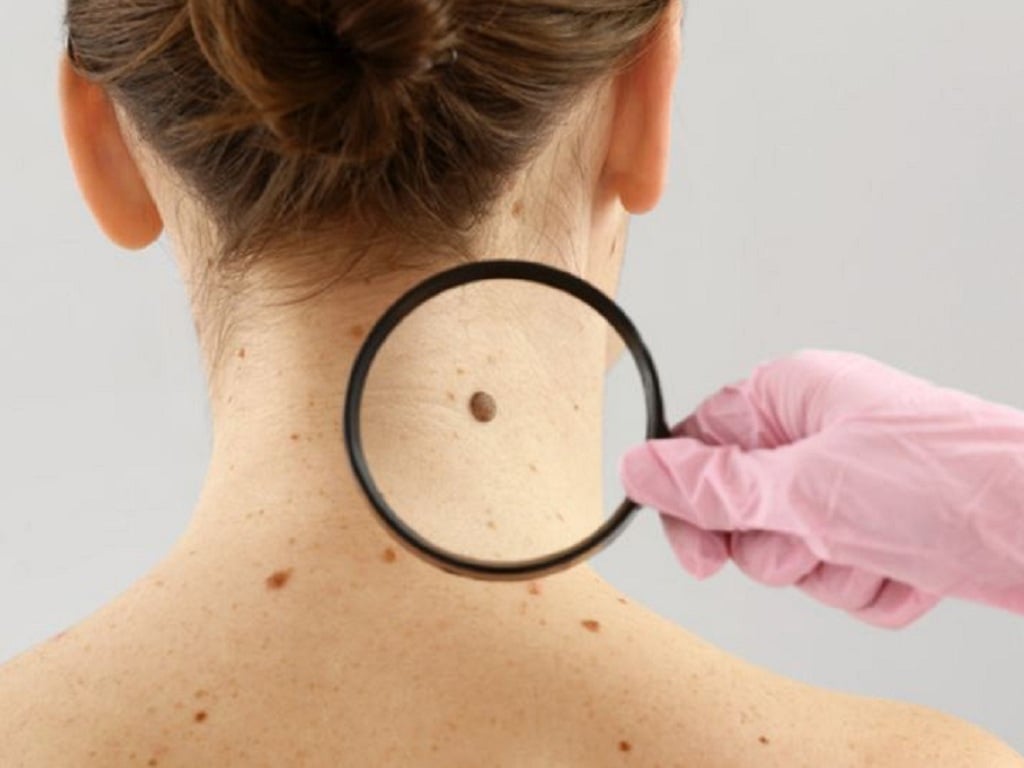
Melissa Lewis has had to undergo regular cancer treatment every year for over 10 years due to a rare form of skin cancer.
Doctors diagnosed her with Bowen's disease, a rare type of squamous cell carcinoma. Symptoms of this type of cancer include the formation of red, scaly patches on the skin.
Later, other cancerous lesions appeared on her forehead, nose, chest, and back. She had to have them completely removed, and underwent a combination of treatments including chemotherapy and radiation therapy.
Because the disease has a high recurrence rate, Ms. Lewis has to undergo annual treatment. Doctors will use photodynamic therapy to prevent and control the spread of skin cancer. This therapy works by using a photosensitive drug combined with a light source to destroy abnormal cells in the skin.
However, in 2018, she noticed a cluster of freckles appearing on her earlobe. Upon examination, the doctor discovered it was skin cancer and required immediate treatment.
"It was fortunate to find it. The thought of the cancer recurring terrified me," Lewis recounted.
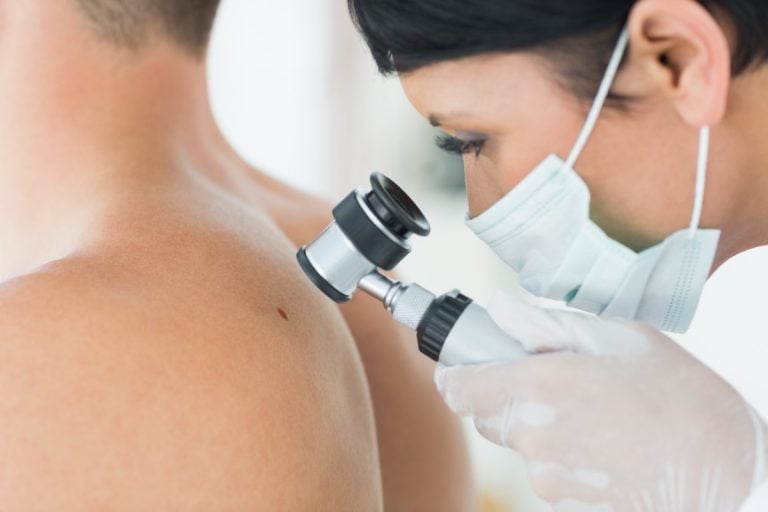
You should get checked early if you suspect skin cancer.
Since discovering her first cancerous lesion, Ms. Lewis has developed numerous other cancers. She has lost count of how many she's had throughout her life.
Because she underwent skin cancer treatment for many years, her skin is covered in pitted scars from surgery, chemotherapy, and radiation therapy. She often advises her children to apply sunscreen when going outside because it significantly reduces the risk of skin cancer from ultraviolet rays.
According to the UK National Health Service (NHS), most people with Bowen's disease develop only one cancerous patch on their skin, with only a few developing several. In its early stages, this type of skin cancer usually does not cause any serious symptoms.
To identify Bowen's disease, the cancerous skin scales will be flat, wider than 1 cm, brittle, oozing, itchy, and may even ulcerate. Doctors say that if the cancerous scales appear on the genital area, it will be more serious, according to the Daily Express.
Source link


![[Image] Vietnam's colorful journey of innovation](/_next/image?url=https%3A%2F%2Fvphoto.vietnam.vn%2Fthumb%2F1200x675%2Fvietnam%2Fresource%2FIMAGE%2F2025%2F12%2F14%2F1765703036409_image-1.jpeg&w=3840&q=75)






























































![[Image] Vietnam's colorful journey of innovation](https://vphoto.vietnam.vn/thumb/402x226/vietnam/resource/IMAGE/2025/12/14/1765703036409_image-1.jpeg)





















![[Infographic] Portrait of the Standing Committee of the Dong Nai Provincial Farmers' Association for the 2025-2030 term](https://vphoto.vietnam.vn/thumb/402x226/vietnam/resource/IMAGE/2025/12/14/1765708210139_thumbnail_ban_thuong_vu_sua_20251214164836.jpeg)












Comment (0)