


According to specialists, ear, nose, and throat diseases are increasingly common in both children and adults. One of the main causes of this is weather changes, especially during transitional seasons, increased air pollution with fine dust, and the prolonged effects of epidemics that weaken the immune system.
Associate Professor, Doctor Le Tran Quang Minh, Director of the Ho Chi Minh City Ear, Nose and Throat Hospital, stated: “These factors not only increase diseases of the nose, throat, sinuses, and middle ear, but also make hearing disorders more common.” Among these, hearing loss due to nerve damage in children is a worrying issue, affecting approximately 1-2 children per 1,000 births. If not detected and treated promptly, children risk speech delays, intellectual developmental delays, and difficulty integrating into society. This reality necessitates innovation in treatment methods and the strong application of science and technology.
Cochlear implants are considered one of the outstanding achievements of modern medicine in the treatment of severe and profound hearing loss. Unlike hearing aids, which only amplify sound, cochlear implants convert sound into electrical signals, directly stimulating the auditory nerve and giving patients a chance to regain their hearing.
The Ho Chi Minh City Ear, Nose, and Throat Hospital has successfully implanted 800 cochlear implants. However, according to Associate Professor Minh, the success of the surgery depends not only on modern equipment but also on the pre-operative assessment process.
"For safe and effective surgery, we need to have a very thorough understanding of each patient's ear structure, and CT scans of the temporal bone are indispensable," he shared.
One of the major challenges of cochlear implant surgery is precisely accessing the electrode placement site within the cochlea. To achieve this, the surgeon must open the facial sulcus and expose the round window membrane—a small but crucial structure.
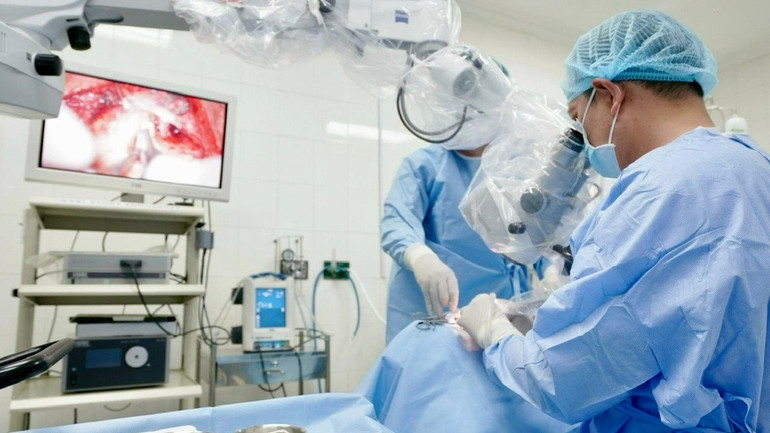
Based on surgical practice, the hospital's doctors conducted a study surveying CT scan images of the facial sulcus to identify factors that could predict the difficulty of the surgery. The results showed that several anatomical features were closely related to the ability to expose the round window membrane.
Associate Professor Minh stated: “We identified nine indicators to comprehensively assess the relationship in facial recess surgery, of which the three most important are the width of the facial recess, the distance between the nerves, and the distance from the facial nerve to the round window membrane. Based on these, doctors can predict the difficulty level of the surgery.”

Notably, all these parameters can be accurately measured on a preoperative CT scan. This allows surgeons to proactively develop a comprehensive treatment plan for each patient, reducing risks and improving treatment effectiveness.
Regarding this digital transformation story, Associate Professor, Doctor Nguyen Anh Dung, Deputy Director of the Ho Chi Minh City Department of Health, stated that if the software can automatically analyze these indicators, combined with clinical experience, it is entirely possible to build a model to predict the likelihood of preoperative exposure of the round window membrane. If feasible, the Department of Health is ready to commission the hospital to implement it, as this is a very valuable scientific and technological innovation," Mr. Dung emphasized.
This perspective suggests that technology does not replace doctors, but rather supports them in making more accurate, faster, and safer decisions.
Source: https://nhandan.vn/dieu-tri-benh-ly-tai-mui-hong-trong-thoi-ky-chuyen-doi-so-tai-thanh-pho-ho-chi-minh-post930093.html




























































































Comment (0)