

(Dan Tri Newspaper) - The Sun is entering its most active phase of its 11-year cycle, known as the solar maximum. However, the question is: Are we still in this phase, or has it already passed?
Beyond scientific expectations
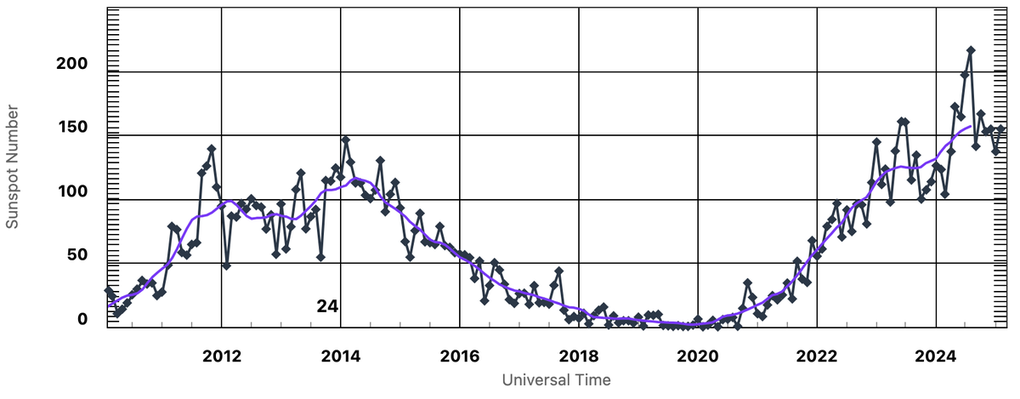
The number of sunspots recorded by NOAA from 2010 to the present shows the evolution of solar cycles 24 and 25 (Image: NOAA).
To answer this question, it's first necessary to understand that the Sun is not a static celestial body. Therefore, intense activity is constantly occurring on the Sun, including phenomena such as eruptions, material spills, and magnetic field changes.
There, concentrated magnetic fields create a series of sunspots, which constitute flares, also known as coronal mass ejections (CMEs).
These phenomena have a significant impact on space weather, potentially affecting Earth. Solar activity varies in 11-year cycles, fluctuating from minimum to maximum. During the minimum phase, there may be consecutive months without sunspots. At the maximum, the number of sunspots, solar flares, and CMEs increases significantly.
Since Solar Cycle 25 began in December 2019, scientists have been closely monitoring the Sun's activity.
Initial predictions from NOAA's Space Weather Prediction Center indicated that the solar maximum could occur in July, with the number of sunspots ranging from 101.8 to 125.2 per month.
However, reality has far exceeded scientists' predictions. In August 2024, the average number of smoothed sunspots over 13 months reached 156.7 – much higher than initially predicted. And this number continues to rise. This raises the question: Has the solar maximum passed?
"Double peaks" and many unexpected variables
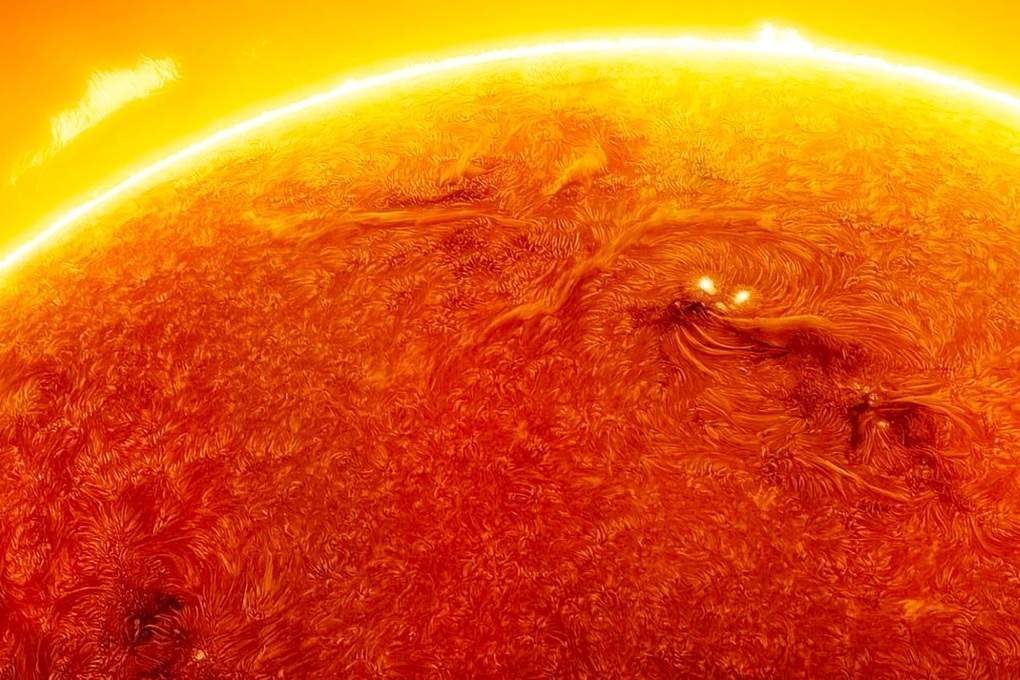
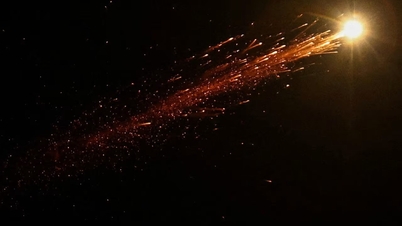
Scientists warn that a double solar maximum could occur in July with multiple intense flares (Photo: Getty).
According to the chart of sunspots in August 2024, the number of sunspots reached a record high of 216. From then until March, this number fluctuated between 136 and 166 each month, indicating a slight decrease in activity.
Some experts believe that the solar maximum passed sometime between August and November 2024. However, this prediction is not entirely certain.
History shows that some previous solar cycles have featured double maxima. For example, Solar Cycle 24 had two peaks, occurring in 2012 and 2014. If Solar Cycle 25 follows a similar pattern, it's possible the solar maximum hasn't ended yet and could extend until the end of 2025.
As mentioned, periods of intense solar activity are often accompanied by significant phenomena such as solar flares and CMEs. Solar flares release large amounts of radiation and high-energy particles, which can cause radio signal disruptions on Earth.
Meanwhile, CMEs are massive launches of plasma from the corona into interstellar space, sometimes heading directly toward Earth. When these plasma bursts collide with Earth's magnetosphere, they can trigger powerful geomagnetic storms, affecting power grids, satellites, GPS systems, and even human health due to increased cosmic radiation.
Furthermore, intense solar activity affects the Earth's ionosphere, causing HF radio signal loss, impacting aviation and military communications.
In particular, increased geomagnetic storm intensity can weaken Earth's natural defenses against solar radiation, creating effects such as brilliant auroras at lower latitudes than usual. Scientists have also observed that solar maximums can contribute to temporary climate change due to an increase in overall solar radiation.
Even after the solar maximum has passed, that doesn't mean solar activity will immediately decline. In fact, sunspots, CMEs, and geomagnetic storms can still be intense for the next one or two years.
This could combine with global warming and continue to affect the Earth in various ways.
Source: https://dantri.com.vn/khoa-hoc/mat-troi-co-the-dat-cuc-dai-kep-chuc-cho-bung-no-vao-thang-7-20250328115350678.htm

![[Image] Hanoi's urban life under the challenge of a "scorching hot" environment](https://vphoto.vietnam.vn/thumb/1200x675/vietnam/resource/IMAGE/2026/05/25/1779706979265_nang-nong-t5-2026-minh-duy-7-4636-jpg.webp)



![[Image] Close-up view of the interchange connecting the two expressways and Long Thanh Airport.](https://vphoto.vietnam.vn/thumb/1200x675/vietnam/resource/IMAGE/2026/05/25/1779703378210_ndo_br_z7863716673926-224453a31600126cce10622af6290afd-4549-jpg.webp)






![[E-Magazine]: Listening in silence to the changing seasons](https://vphoto.vietnam.vn/thumb/402x226/vietnam/resource/IMAGE/2026/04/17/1776436870717_e-magazine-lang-w1200t0-di2615d199d5160004t11920l1-lynkgm-017.webp)

















































































Comment (0)