

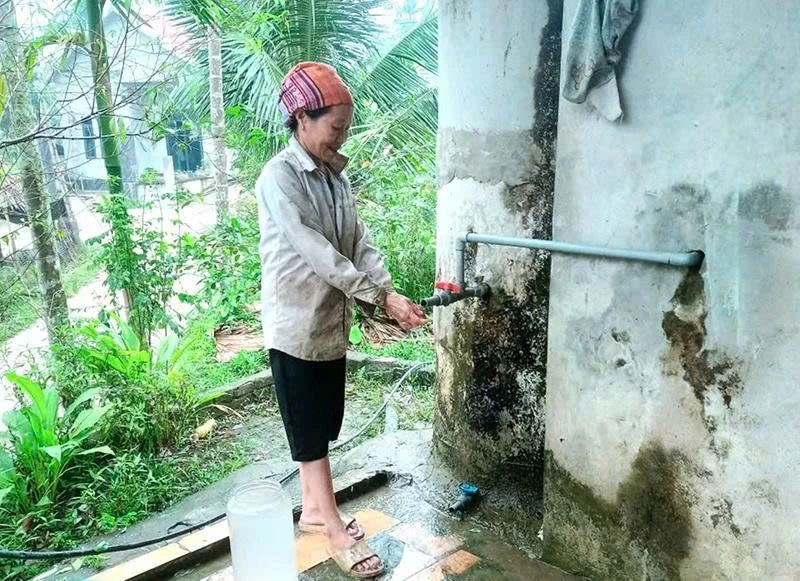
The water source for the household of Ms. Le Thi Quang, Giang Vin village, Linh Son commune, is inconsistent.
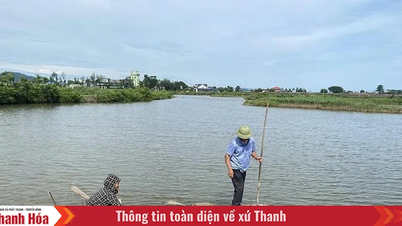
According to residents of Linh Son commune, most people are currently using water from dug wells, drilled wells, or water piped from springs and streams. However, these water sources are of poor quality and are scarce during the summer months. With a rapidly increasing population, the need for clean water is more urgent than ever, while the commune currently lacks a centralized water supply system.
Previously, many centralized water supply systems were invested in using funds from Programs 134, 135, etc., but they have now deteriorated, become damaged, and are no longer usable. Giang Vin village has 157 households with 568 inhabitants. For many years, to ensure daily life, the villagers have been drawing water from springs and streams. However, this water supply is entirely dependent on nature; the water is muddy and dirty during the rainy season, and dries up during the dry season. The unstable water quality causes many difficulties in the daily lives of the people.
Mr. Ha Duc Chung, head of Giang Vin village, said: "The village used to have some centralized water supply systems, but most of them are now broken. To have a water source, many households have built large tanks to collect rainwater, installed additional rough filtration systems, and invested in RO water purifiers for drinking water. Especially after each storm, the water pipeline system of the households is washed away or damaged, forcing them to invest again."
According to Ms. Le Thi Quang, residents of Giang Vin village have reported that the unstable water supply has disrupted their daily lives. The villagers have repeatedly petitioned the provincial authorities, but to date, no water supply project has been implemented.
Similarly, a shortage of clean water is also occurring in many villages and hamlets in Linh Son commune. The domestic water supply project in Oi village was built in 2012 with funding from Program 134, with a total investment of 1 billion VND. However, the project is now unusable and abandoned due to the depletion of water sources from streams and springs.
To obtain water for daily use, households in the village are forced to use both dug wells and drilled wells interchangeably, but both sources are unreliable. In some cases, households are forced to use water from streams, posing significant hygiene risks. They also build sedimentation tanks before use, but these are only temporary solutions. For households engaged in food service and cooking businesses, the need for clean water is even more critical. The lack of access to standard water negatively impacts their operations, leading to reduced income.
It is known that Linh Son commune has repeatedly included the issue of investing in clean water projects in its work program. However, building a clean water plant requires a large amount of funding, while the local budget is limited. The option of socializing investment in the water plant is also difficult to implement, as businesses are not enthusiastic about projects with low potential for return on investment.
The lack of clean water in Linh Son is not just a matter of daily life, but also directly affects the quality of life, public health, and socio-economic development of this central commune after the merger. The question of when the people of Linh Son commune will have access to clean water remains a difficult one. Hopefully, relevant authorities will soon find feasible solutions to invest in a centralized water supply system to meet the essential needs of the local people.
Text and photos: Tien Dat
Source: https://baothanhhoa.vn/mong-moi-cong-trinh-nuoc-sach-cho-nguoi-dan-xa-linh-son-271490.htm


![[Photo] Prime Minister Pham Minh Chinh holds a phone call with the CEO of Russia's Rosatom Corporation.](/_next/image?url=https%3A%2F%2Fvphoto.vietnam.vn%2Fthumb%2F1200x675%2Fvietnam%2Fresource%2FIMAGE%2F2025%2F12%2F11%2F1765464552365_dsc-5295-jpg.webp&w=3840&q=75)

![[Photo] Closing Ceremony of the 10th Session of the 15th National Assembly](/_next/image?url=https%3A%2F%2Fvphoto.vietnam.vn%2Fthumb%2F1200x675%2Fvietnam%2Fresource%2FIMAGE%2F2025%2F12%2F11%2F1765448959967_image-1437-jpg.webp&w=3840&q=75)




![[Infographic] Preventing students from making their own firecrackers: 7 things parents need to know](https://vphoto.vietnam.vn/thumb/402x226/vietnam/resource/IMAGE/2025/12/11/1765466656703_img_0320_20251211183542.jpeg)




























![[OFFICIAL] MISA GROUP ANNOUNCES ITS PIONEERING BRAND POSITIONING IN BUILDING AGENTIC AI FOR BUSINESSES, HOUSEHOLDS, AND THE GOVERNMENT](https://vphoto.vietnam.vn/thumb/402x226/vietnam/resource/IMAGE/2025/12/11/1765444754256_agentic-ai_postfb-scaled.png)











































Comment (0)