

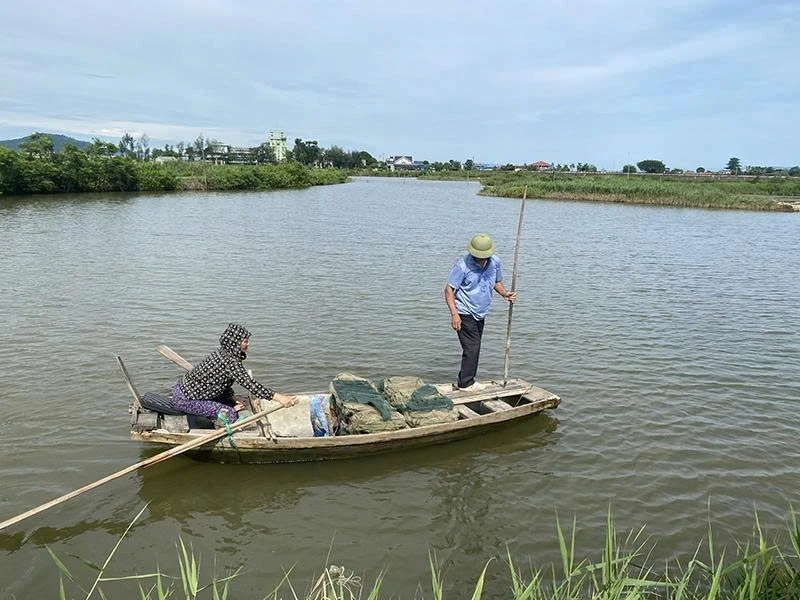
The aquaculture area of Mr. Nguyen Van Nam's family in Quang Chinh commune, where mixed farming is practiced, yields high economic value.
Having just harvested his shrimp crop, Mr. Nguyen Van Nam from Quang Chinh commune is releasing new stock of striped catfish, spotted mullet, and crabs, and continuing with a new shrimp crop for the market at the beginning of next year. Mr. Nam said: “Previously, the extensive farming area of the people only focused on monoculture of shrimp or fish. However, in recent years, most pond owners in the area have implemented mixed farming, which has shown immediate effectiveness. Monoculture only yields two shrimp crops a year, while mixed farming allows for three crops, even during the rainy season. Although not as profitable as monoculture shrimp farming, the harvests are consistent, providing a stable income throughout the year. The biggest advantage of mixed farming is that the different species support each other's growth, eliminate diseases, and keep the farming environment clean, preventing excess feed from accumulating at the bottom of the pond.”
In Quang Chinh commune, most households engaged in extensive aquaculture choose tiger shrimp as their primary species. However, most households have focused on diversifying their aquaculture species and have initially achieved positive results in terms of both economic benefits and environmental impact.
Surveys in coastal areas show that over-reliance on a single species of aquaculture makes people vulnerable to disease outbreaks or price fluctuations. Therefore, farmers have shifted to mixed farming, rotational farming, or replacing a portion of their area with other species such as whiteleg shrimp, crabs, tilapia, gobies, oysters, clams, etc., which yield higher and more stable economic returns. In Hai Binh ward, to enhance the production value of aquaculture areas, the ward People's Committee has guided households with concentrated farming areas to develop aquaculture by selecting suitable species and farming methods based on weather, climate, technical expertise, and infrastructure. Simultaneously, they have invested in infrastructure for aquaculture areas. Notably, the ward has been focusing on shifting from extensive to intensive farming, diversifying the species raised in a way that promotes safety and biodiversity. For cage farming areas, instead of only using traditional species, the ward has guided people to intercrop various species such as sea bass, grouper, red snapper, and snapper. For raft farming areas and tidal flats along the river, species such as Pacific oysters and green mussels are used. Diversifying the species and farming methods has brought outstanding economic value to the local aquaculture industry. In addition, some high-economic-value species, such as abalone and giant freshwater prawn, are also encouraged to develop.
Mr. Nguyen Nhu Dung, Vice Chairman of the Hai Binh Ward People's Committee, said: "To improve the economic efficiency of the aquaculture industry, the Ward People's Committee has guided people to diversify the species raised, implement mixed farming practices, utilize surplus feed, save costs, and minimize environmental impact. At the same time, we focus on finding and selecting species suitable for market trends and local characteristics for production."
According to expert assessments, in recent years, the increasingly complex climate situation, stringent consumer market demands, and rising input costs have made diversifying aquaculture species and farming methods considered the "key" to breaking the monoculture pattern, minimizing risks, and improving economic efficiency for farmers. Along with focusing on developing key aquaculture species, Thanh Hoa's fisheries sector is encouraging people to invest in diversifying species and farming methods to maximize water surface area and utilize the ecological conditions of each region to select suitable species. Combining the farming of multiple species with different biological characteristics helps limit disease outbreaks, reduce industrial feed costs, increase production efficiency, and protect the ecological environment.
Mr. Vu Van Ha, Deputy Director of the Thanh Hoa Agricultural Extension Center, said: "In the context of current climate change, the weather is extremely complex, so crops and livestock must adapt. People should choose breeds that can withstand high temperatures and salinity, such as sea bass, white shrimp, tilapia, etc. Alongside diversifying the species, relevant agencies also need to strengthen the management of seed quality to ensure long-term effectiveness for production."
Text and photos: Le Hoa
Source: https://baothanhhoa.vn/da-dang-hoa-doi-tuong-hinh-thuc-nuoi-trong-thuy-san-271481.htm
![[Photo] Closing Ceremony of the 10th Session of the 15th National Assembly](/_next/image?url=https%3A%2F%2Fvphoto.vietnam.vn%2Fthumb%2F1200x675%2Fvietnam%2Fresource%2FIMAGE%2F2025%2F12%2F11%2F1765448959967_image-1437-jpg.webp&w=3840&q=75)
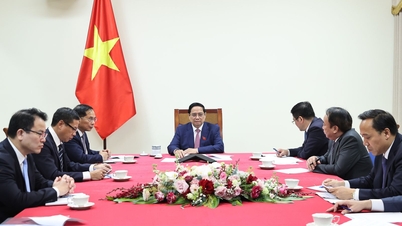
![[Photo] Prime Minister Pham Minh Chinh holds a phone call with the CEO of Russia's Rosatom Corporation.](/_next/image?url=https%3A%2F%2Fvphoto.vietnam.vn%2Fthumb%2F1200x675%2Fvietnam%2Fresource%2FIMAGE%2F2025%2F12%2F11%2F1765464552365_dsc-5295-jpg.webp&w=3840&q=75)





































![[OFFICIAL] MISA GROUP ANNOUNCES ITS PIONEERING BRAND POSITIONING IN BUILDING AGENTIC AI FOR BUSINESSES, HOUSEHOLDS, AND THE GOVERNMENT](https://vphoto.vietnam.vn/thumb/402x226/vietnam/resource/IMAGE/2025/12/11/1765444754256_agentic-ai_postfb-scaled.png)











































Comment (0)