

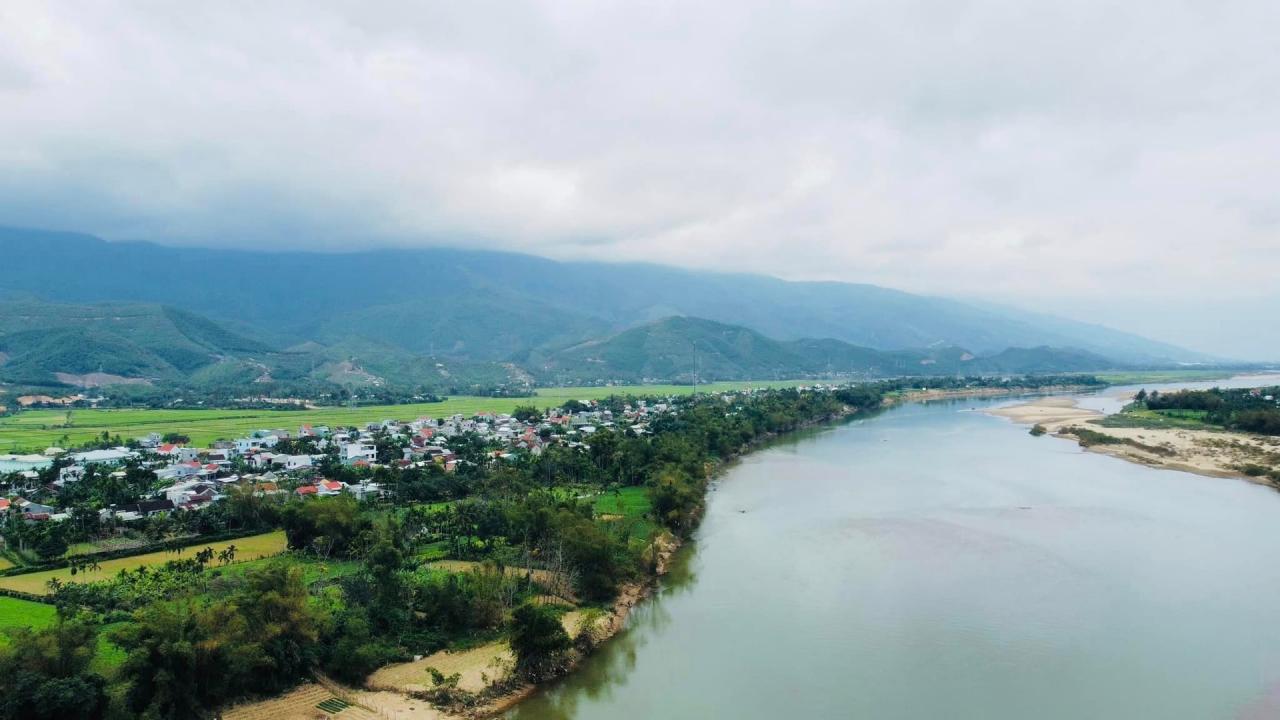
Riverside market
The stories my grandmother told me when she was alive are now etched somewhere in the hazy depths of my mind. From my grandmother's house in Phiếm Ái village, a curved path led to the sand dunes. They cultivated crops like chili peppers, tobacco, watermelons, and even flowers to feed their seven children. The sand dunes were a flat area along the Vu Gia River. After liberation, this entire region was still a vast expanse of white sand dunes.
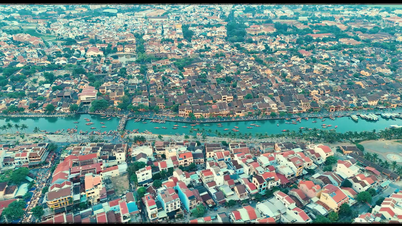
The Vu Gia River splits into two branches: one flows towards Giao Thuy, and the other passes through Ai Nghia, connecting with the Yen River before emptying into Cam Le and then the Han River ( Da Nang ). The advantage of waterways and fertile land is what cultural researchers believe determines the quick wit and adaptability of the people in this region.
The story of Mr. Tran Dinh in Ha Song - the place where the Con River branches off in nine directions, as mentioned in the folk song "Whoever goes to the nine branches of the Con River/Ask if Tu Dinh still exists?" - is passed down in folklore and historical records, and is often recounted by the elderly. It serves as an example of a person from this land who was deeply concerned about the fate of the nation.
My aunt used to make countless trips upstream, bringing produce back to Ai Nghia to sell wholesale. She visited every market and dock in the area: Ha Nha, Ben Dau, Phu Thuan, Ai Nghia, Phuong Dong… there wasn't a single market or dock she didn't buy and sell. Tired of agricultural products, she went to Hoi Khach dock at the headwaters of the Vu Gia River to trade timber. After liberation and later the province's separation, many docks received investment in ferries and bridges. The old ferryboat became a story told by those who had spent their lives working on the river.
Ferry crossings in Vietnam, not just in Dai Loc, are often associated with riverside markets. Strangely, in my hometown, there are both long-distance and short-distance ferries. So along the long stretch of water, not counting the large, bustling docks (the docks where, after each trip lasting several months, my grandmother would return and tell stories of battles fought by people from all over the country), there are countless docks used by farmers like my grandmother to get on and off the river.
Maintain a family tradition.
The alluvial soil of Vu Gia nurtured people and preserved hundreds of genealogical records, because the village of Phiếm Ái was first mentioned in the book "Ô Châu cận lục" by Doctor Dương Văn An, written in 1553. By my maternal grandparents' generation, and by my generation, that milestone had receded far into the 20th century. The village still exists, its name still remains. Only the riverbanks have shifted due to erosion and sedimentation by the water.
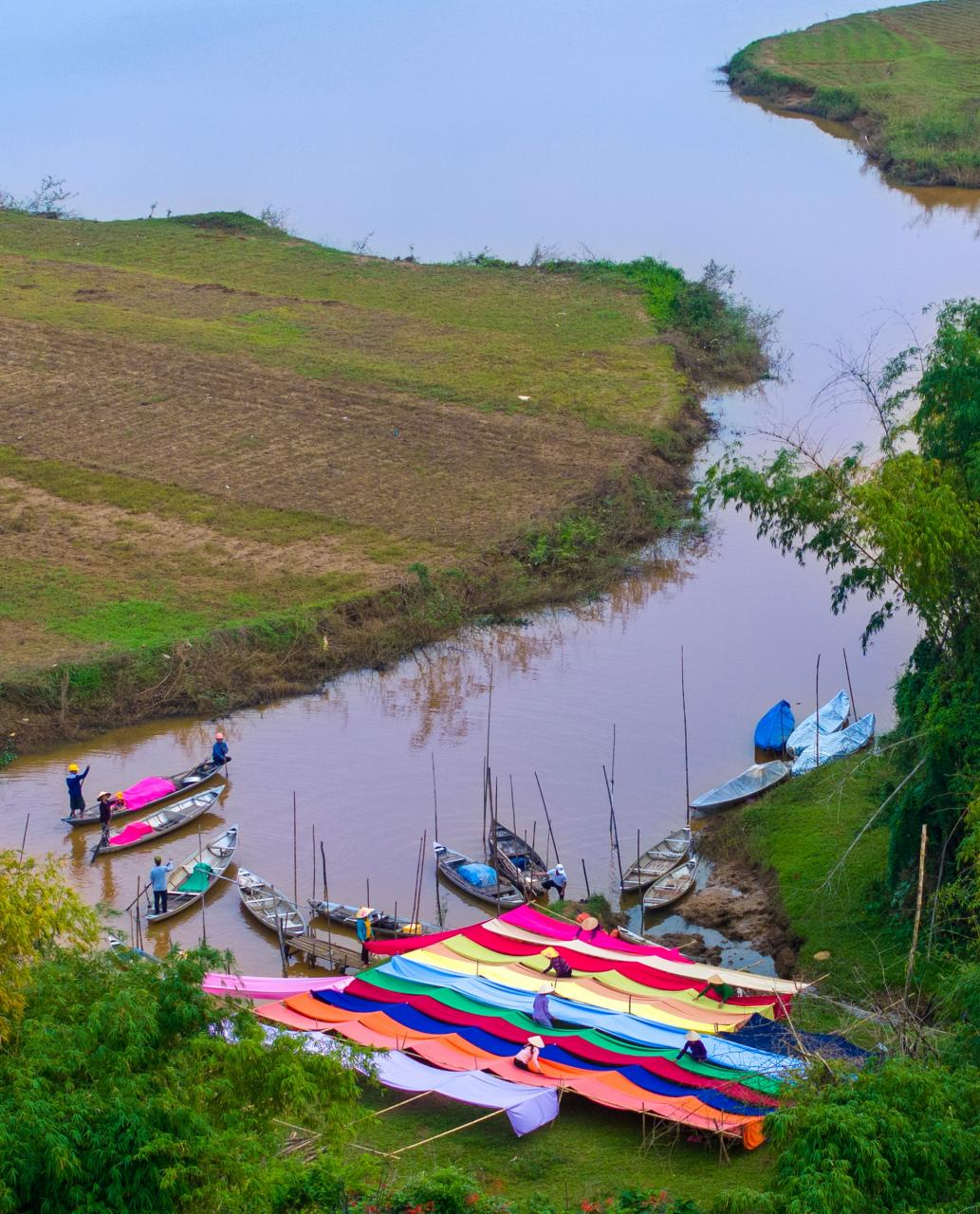
Like the riverbank near Nghia Nam hamlet several decades ago. When my mother first came to live with us as a daughter-in-law, the riverbank was just a few dozen steps from our house.
Traditionally, on the 27th or 28th of Tet (Lunar New Year), my mother would cook and prepare the offerings for my father-in-law to take to the riverbank. She prayed for peace and safety from the flowing water and a bountiful harvest along the river. During those times of scarcity, what my mother remembered most wasn't the chicken or the sticky rice and sweet soup on the offering, but the bunch of chrysanthemums left at the riverbank. She said she regretted it, but the flowers couldn't be brought back home. Many people went to the river to make offerings, and the fragrant smoke of incense filled the entire village riverbank.
About ten years later, the riverbank eroded violently, and the foundation of that house is now probably in the middle of the river. The entire village moved further inland.
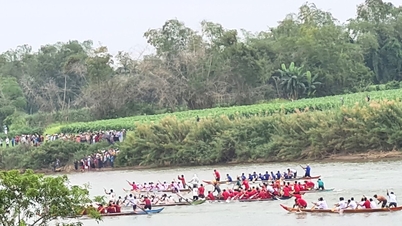
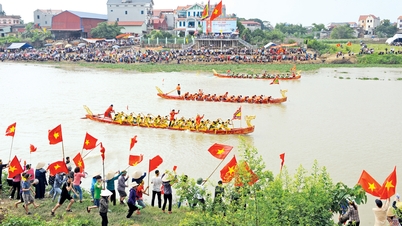
Forty years ago, it was the landing where the whole village carried water to irrigate their vegetables in the fields, brought home for drinking and cooking, and used it for bathing and washing clothes. The landing has eroded, and during times of scarcity and hard work, the villagers stopped worshipping at the landing, only maintaining the custom of worshipping the local deity. The remnants of the old landing are now a canoe landing at the widest section of the river embankment. Laughter, chatter, and people coming and going are rare, except during the boat races in January.
After the 23rd day of the tenth lunar month, the villagers prepared the land for planting chrysanthemums. At the end of the twelfth lunar month and the beginning of the first lunar month, many riverside fields, where my aunt worked, burst into the vibrant red of the chrysanthemums. The flowers came in purple, white, red, and pink – all colors – but it seemed that this dazzling display, as my grandmother told me, was usually only seen along the road down to the riverbank.
Back then (and even now), mulberry trees were planted to mark the boundaries between rice paddies. Many of the mulberry trees were large and old, having withstood countless floods. Chrysanthemums were gathered around the base of the mulberry trees before being loaded into baskets and transported to the market by bicycle or ox cart. Perhaps remembering the pungent smell of damp dew and the sweet, delicate scent of chrysanthemums from the fields, my aunt always set aside a few plots of land each year to grow them. The chrysanthemums on the road to the riverbank when she was a young girl are now patches of flowers in her garden.
Half a century ago, my maternal grandmother would gather beans, potatoes, vegetables, and pickles, and tear up bunches of betel nuts to sell at the Tet market. On her way back, she would always set aside some money to buy a bunch of chrysanthemums to place on the ancestral altar. Now it's my paternal grandmother's turn. When Tet comes, she always buys a few dozen flowers, or if she remembers early, she asks the neighbors to reserve a patch for her. "To display for the days the ancestors are here and to offer to the ancestors on the third day of Tet," she says, as if giving instructions to maintain a family tradition…
Source: https://baoquangnam.vn/mua-ngang-ben-cu-3148316.html


![[Photo] General Secretary and President To Lam presides over a working session with the Central Policy and Strategy Committee on the development of the materials industry.](https://vphoto.vietnam.vn/thumb/1200x675/vietnam/resource/IMAGE/2026/05/21/1779359935432_a3-bnd-3129-1412-jpg.webp)

























































Comment (0)