

A senior U.S. Space Force official said that China and Russia are testing stealth technologies aimed at making their satellites more difficult for radar and telescopes to detect.
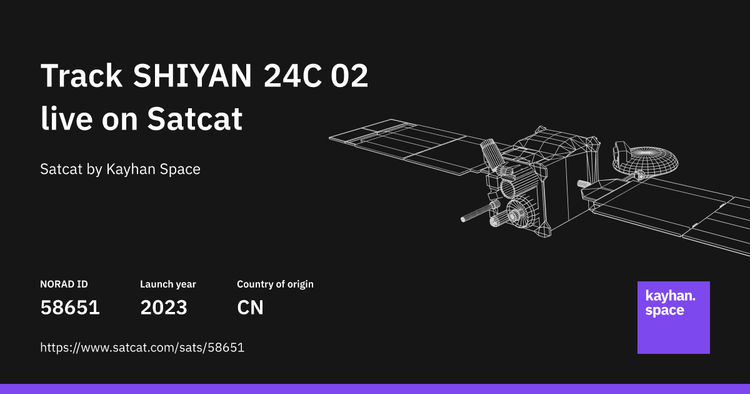
The Shiyan 2C satellite, launched into orbit in 2023, has an extremely low radar cross-section. Photo: Satcat
“In previous years, we often talked about the cat-and-mouse game taking place in geostationary orbit (GEO) — Chinese, Russian, and American satellites stalking each other. But this past year, we’ve seen more than just a game of hide-and-seek in low Earth orbit (LEO),” said Sergeant Ron Lerch, senior advisor to the Deputy Chief of Staff for Intelligence of the Space Force, today.
The official also expressed concerns regarding the inability or difficulty in detecting these satellites.
He said, for example, that the three Shiyan-24 satellites (Shiyan A, B, and C) located at LEO performed synchronized maneuvers that the Deputy Commander of the Space Force, Lieutenant General Michael Guetlein, had called "dogfighting" in space in March, each satellite having a different radar cross-section — the second satellite being smaller than the first, and the third even smaller.
This suggests, as Lerch stated at the Spacepower 2025 conference organized by the American Space Force Association, that "China is making progress with decades-long plans and research to apply stealth technology in space."

Screenshot simulating an encounter between a US satellite and a Chinese satellite in space. (COMSPOC)
Since 2012, the Chinese military has also been experimenting with designs for nanosatellites aimed at making them more difficult to detect, Lerch added in response to a question from Breaking Defense on the sidelines of the conference.
The People's Liberation Army (PLA) published a 2022 research paper showing the results: a tiny metallic satellite, called "Olive-B," shaped like "a sphere," had "been in a soundproof chamber" for laboratory testing, he said.
"Not only is it difficult to detect with the naked eye, but that shape, according to them, is also extremely advantageous in terms of reducing radar cross-section," Lerch said at the conference.
Meanwhile, Russia “very recently” launched a highly stealthy experimental satellite called Mozhayets into medium orbit (MEO), Lerch said.
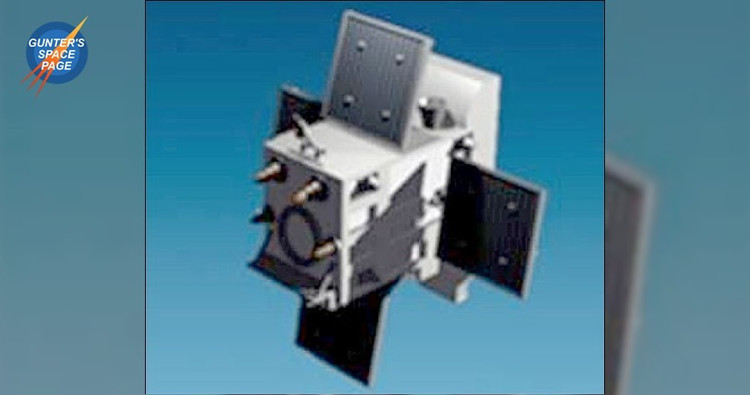
The Russian Mozhayets satellite wandered in orbit for five weeks before being detected by US systems. Photo: Gunter's
“The interesting thing about Mozhayets is that it has a very, very low apparent magnitude. The sun has an apparent magnitude of -26.74. The larger the positive number, the lower the visibility. GPS satellites in the MEO have an apparent magnitude of about 6.5. The Mozhayets satellite that Russia launched into the MEO has an apparent magnitude of about 16, making it very difficult to observe.”
Mr. Lerch acknowledged the role of commercial companies in assisting the Space Force in identifying and tracking these increasingly stealthy satellites, while emphasizing that without commercial data, it would be impossible to discuss these operations in a non-classified environment.
According to Lerch's presentation slides, LeoLabs provided information on the Shiyan satellites, while Slingshot provided data on Mozhayets. In fact, Slingshot discovered Mozhayets even before the Space Force, according to the company's press release dated November 17th.
Mozhayets-6, built by Russia's Mozhaisky Military Space Academy, was launched on September 13 along with a new Russian GLONASS navigation and timing satellite, the statement said.
However, the satellite had been "drifting" in space for five weeks, at least according to the Space Force's publicly available database of orbital objects, according to Slingshot.
Source: https://khoahocdoisong.vn/my-canh-bao-moi-lo-trung-quoc-nga-thu-nghiem-ve-tinh-tang-hinh-post2149075266.html


![[Image] Close-up of the newly discovered "sacred road" at My Son Sanctuary](/_next/image?url=https%3A%2F%2Fvphoto.vietnam.vn%2Fthumb%2F1200x675%2Fvietnam%2Fresource%2FIMAGE%2F2025%2F12%2F13%2F1765587881240_ndo_br_ms5-jpg.webp&w=3840&q=75)







































































Comment (0)