

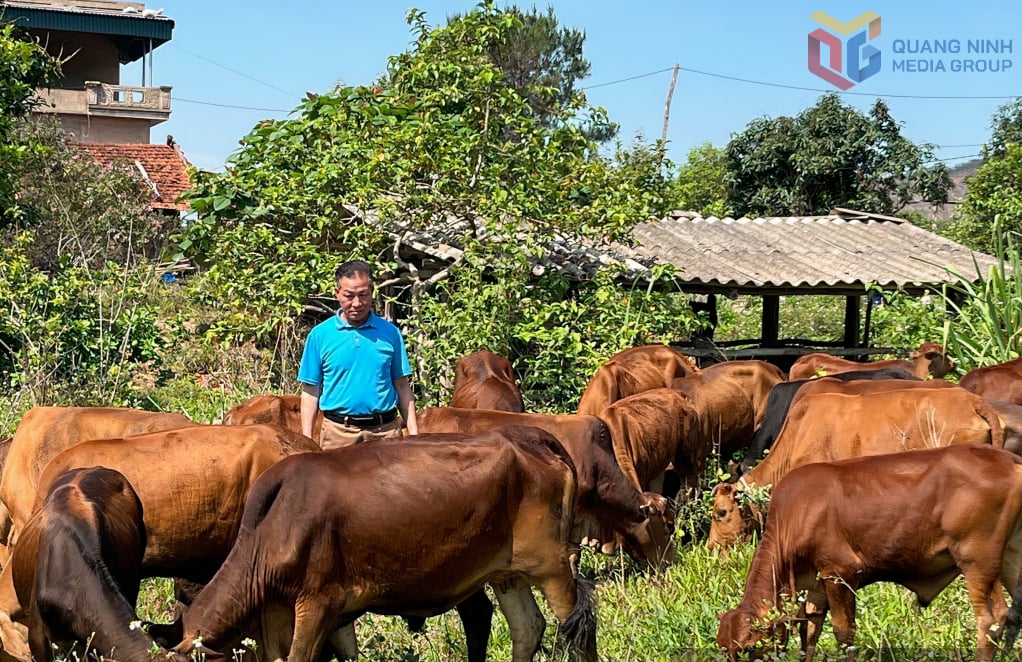
Mr. Chìu Văn Năm (Kỹ Thượng commune) is taking care of his family's herd of cattle.
Starting from a poor household in Thanh Lam commune (now Ky Thuong commune), Mr. Chiu Van Nam now earns hundreds of millions of VND per year from his cattle farming model. Mr. Nam shared: "Previously, my family faced countless difficulties. We worked year-round but still couldn't make ends meet; poverty clung to us constantly. Determined to escape poverty, I always pondered and sought new ways to develop our economy ."
Inspired by the Party and State's specific policies on socio-economic development in ethnic minority and mountainous regions, Mr. Nam boldly borrowed capital to buy two breeding cows. At that time, the two cows were extremely valuable assets to him, so he took very careful care of them, hoping that this was the right path for his family to escape poverty.
Thanks to his diligence and hard work, along with the support of the Thanh Lam (formerly) Commune Farmers' Association, Mr. Nam was able to participate in training courses on livestock farming, production development, and scientific and technical skills. Thanks to his knowledge in livestock farming and proactive disease prevention, his family's cattle farming model has now expanded to over 40 head. Mr. Nam shared: "To be able to take good care of my herd, I actively participated in training courses on livestock farming techniques. From there, I grasped the techniques as well as how to prevent diseases in my livestock. I can now vaccinate my family's cattle myself."
After years of persistent farming, Mr. Nam's family's herd of cattle produces 15-17 calves each year, helping them escape poverty. Each year, Mr. Nam's family sells 12-15 commercial cows, earning 150-200 million VND. Since the beginning of the year, he has sold 8 breeding cows at 16-17 million VND each. Currently, Mr. Nam's family is also proactively planning and planting 2,000 square meters of grass to ensure a food source for their herd. In addition, after each harvest, his family also stores straw and hay to feed the cows during the winter.
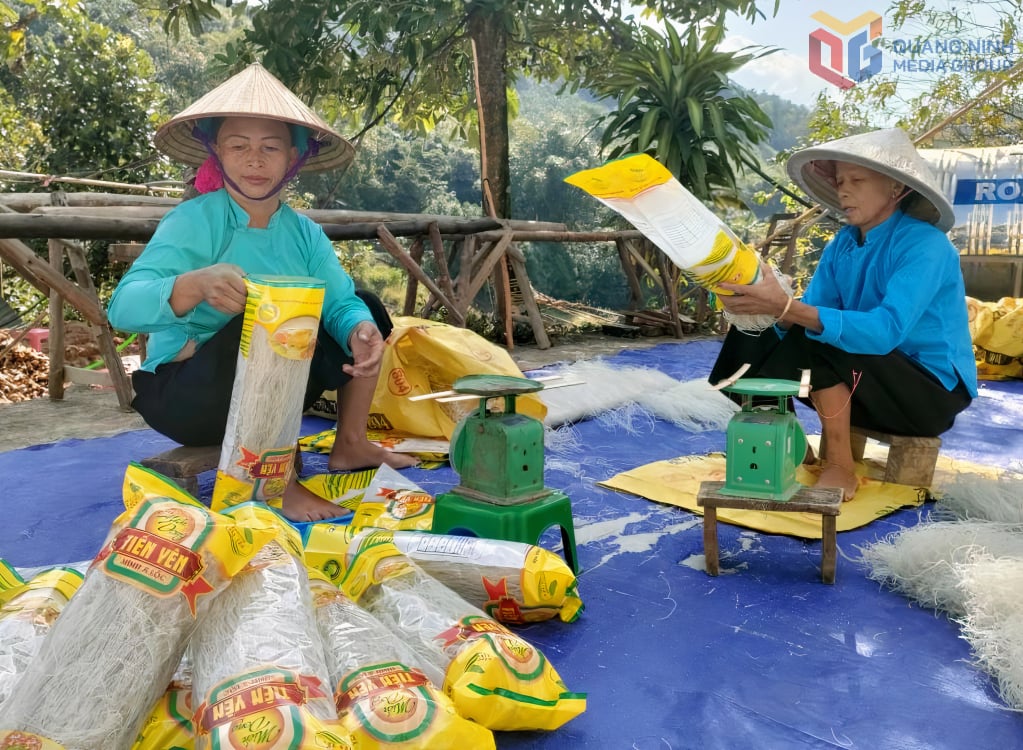
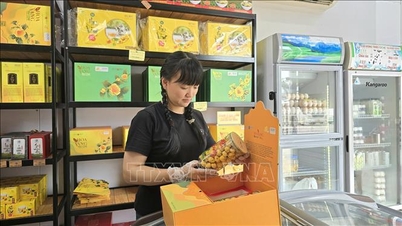
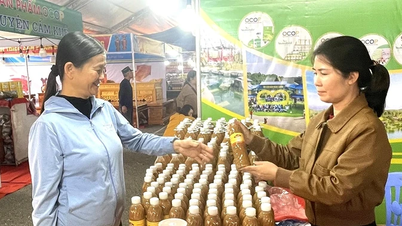
People in Tien Yen commune are packaging vermicelli products.
In recent years, the ethnic minority areas of Quang Ninh province have experienced comprehensive development, and the lives of the people have continuously improved. In particular, the implementation of Resolution No. 06-NQ/TU of the Provincial Party Committee on socio-economic development in ethnic minority, mountainous, border, and island areas for the period 2021-2025, with a vision to 2030, has created a strong impetus for people to rise out of poverty sustainably. Thanks to investment resources from various programs and projects, many households have received support for production development, access to preferential loans, and the transformation of crop and livestock structures to suit local conditions.
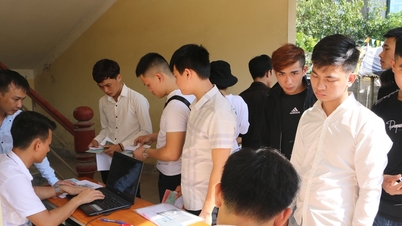
Along with that, the province also focuses on vocational training for rural laborers, especially those from ethnic minority communities, considering this a fundamental solution to sustainably increase income. Some localities have applied effective methods in addressing employment for ethnic minorities, such as: coordinating with educational and vocational training institutions to provide career counseling and guidance to enhance job placement services for ethnic minority youth; providing support in terms of capital, production equipment, production techniques, development orientation, product consumption forecasting, and job placement for laborers after vocational training... As a result, people have gained a deeper understanding of the purpose of vocational training, shifting from learning as a trend or for financial support to learning to grasp scientific and technical knowledge to apply to production, thereby increasing productivity and product value, and achieving sustainable poverty reduction.
In 2024, the entire province provided training support to 1,165 people, achieving 99.15% of the annual plan. Of these, 643 were ethnic minority workers, accounting for 55.19% of the total number of workers supported with basic vocational training. This significantly contributed to increasing the rate of trained workers and creating jobs for local laborers.
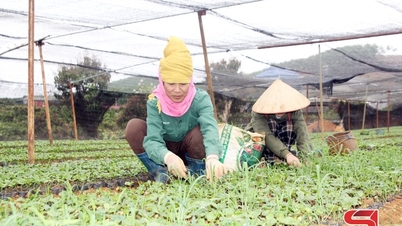
People in Quang Duc commune plant production forests. Photo: Huu Viet
The average per capita income in ethnic minority, mountainous, border, and island communes in the province reached VND 83.79 million in 2024, an increase of over VND 40 million compared to 2020. Collective economic models, cooperatives, and enterprises in the highlands have developed strongly. The province has 768 agricultural cooperatives and 432 OCOP products achieving 3-5 stars. Sustainable forest development, ecological agriculture, livestock farming, and coastal aquaculture in a modern direction are also being implemented synchronously.
The province has achieved the National Target Program for Sustainable Poverty Reduction (2021-2025) three years ahead of schedule and no longer has any poor or near-poor households according to the provincial poverty standard (1.4 times higher than the central government's poverty standard in terms of income criteria); at the same time, it continues to focus on improving quality and supplementing criteria/indicators to meet the standards of New Rural Development (NRD) according to the NRD criteria set for the 2021-2025 period for communes in ethnic minority areas, mountainous, border, and island regions. Quang Ninh has also been recognized by the Prime Minister as having completed the task of building NRD in 2024.
The achievements clearly demonstrate the effectiveness of sound policies, creating momentum for people in the mountainous areas of Quang Ninh not only to escape poverty sustainably but also to rise to prosperity, contributing to building an increasingly prosperous and beautiful homeland.
Van Anh
Source: https://baoquangninh.vn/nang-cao-thu-nhap-cho-dong-bao-dan-toc-thieu-so-3381507.html


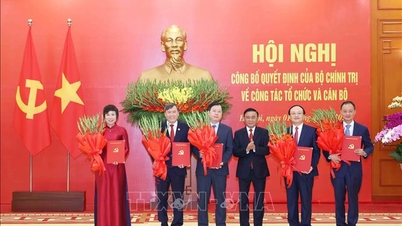
![[Photo] Conference announcing the Politburo's Decision on organizational and personnel matters](https://vphoto.vietnam.vn/thumb/1200x675/vietnam/resource/IMAGE/2026/04/01/1775017881825_bnd-2410-1472-jpg.webp)

![[Photo] Conference on the transfer and reception of Party organizations and Party members between the Party Committee of the Government and the Party Committees of the Central Party Agencies](https://vphoto.vietnam.vn/thumb/1200x675/vietnam/resource/IMAGE/2026/04/01/1775036784472_ndo_br_bnd-2620-jpg.webp)

































































Comment (0)