

Citizens of countries to which Vietnam unilaterally waives visa requirements will be granted temporary residence for 45 days instead of the previous 15 days, and will be considered for visa issuance and extension of temporary residence according to regulations.
National Assembly delegates voted to approve the Law amending and supplementing a number of articles of the Law on Exit and Entry of Vietnamese Citizens and the Law on Entry, Exit, Transit, and Residence of Foreigners in Vietnam. (Photo: DUY LINH).
On the morning of June 24th, with 470 out of 475 participating delegates voting in favor (equivalent to 95.14% of the total number of National Assembly delegates), the National Assembly passed the Law amending and supplementing a number of articles of the Law on Exit and Entry of Vietnamese Citizens and the Law on Entry, Exit, Transit, and Residence of Foreigners in Vietnam.
Enhancing Vietnam's competitiveness in attracting tourists.
Accordingly, the temporary residence period for citizens of countries unilaterally exempted from visas by Vietnam is extended to 45 days, an increase of 30 days compared to the period prescribed in the 2014 Law on Entry, Exit, Transit and Residence of Foreigners in Vietnam.
Clarifying the basis of the 45-day regulation, Le Tan Toi, Chairman of the National Assembly's Committee on National Defense and Security, stated that currently, the trend for tourists from distant markets such as Europe to visit Vietnam is often for longer vacations of 15 days or more, choosing cross-Vietnam and international leisure travel programs.
The tourism industry is oriented towards attracting beach vacationers and long-term stays to gradually compete with countries in the region in beach tourism, while countries such as Thailand, Singapore... are applying visa exemption policies with temporary stays of up to 45 days and 90 days.
Extending the unilateral visa exemption period to 45 days is in line with the regional average, thereby enhancing Vietnam's competitiveness in attracting tourists; further facilitating international tourists and allowing them to proactively plan their time and itineraries for extended stays in Vietnam.

Chairman of the National Assembly's Committee on National Defense and Security, Le Tan Toi, reports on the explanations, feedback, and revisions to the draft law before the National Assembly votes to approve it. (Photo: DUY LINH).
Some suggestions include granting multiple-entry temporary residence permits to facilitate foreigners, especially experts and scientists ; researching and supplementing regulations to grant 30-day temporary residence permits to citizens of countries whose citizens are unilaterally exempted from visa requirements by Vietnam, for tourists visiting certain special types of tourism; and clarifying the number of days of temporary residence permits granted to those entering the country not under the unilateral visa exemption scheme.
Chairman Le Tan Toi clarified that the Law on Entry, Exit, Transit, and Residence of Foreigners in Vietnam stipulates that foreign scientists and experts temporarily residing in Vietnam are one of four cases considered for the issuance of permanent residence cards (foreigners granted permanent residence cards are allowed to reside indefinitely in Vietnam and use the card instead of a visa for entry and exit).
The draft Law amending and supplementing the existing law stipulates that a 45-day temporary residence permit will be granted to citizens of countries to which Vietnam unilaterally grants visa exemptions, and that visa applications and extensions of temporary residence permits will be considered and processed according to the provisions of the Law. This provision has facilitated the process for citizens of countries to which Vietnam unilaterally grants visa exemptions.
Furthermore, the Law on Exit and Entry of Vietnamese Citizens specifies the duration of temporary residence corresponding to each type of visa issued to foreigners.
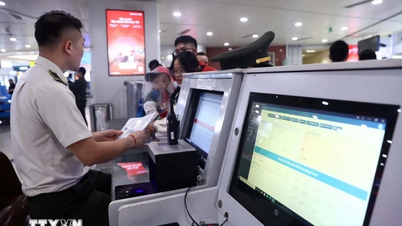
Border guards receive information about the temporary residence of foreigners.
During discussions on the draft law, many National Assembly deputies suggested reviewing and supplementing border guard posts and stations that receive temporary residence declarations from foreigners residing in border areas to comply with relevant agreements on border and land border gate management between Vietnam and neighboring countries, and the provisions of the Vietnamese Border Guard Law regarding the functions and duties of the Border Guard Force.
According to Le Tan Toi, Chairman of the National Defense and Security Committee, under current legal regulations, the Border Guard is responsible for coordinating and maintaining security, order, and social safety in border areas as prescribed by law, and in reality, 433 border guard posts nationwide are carrying out this task.
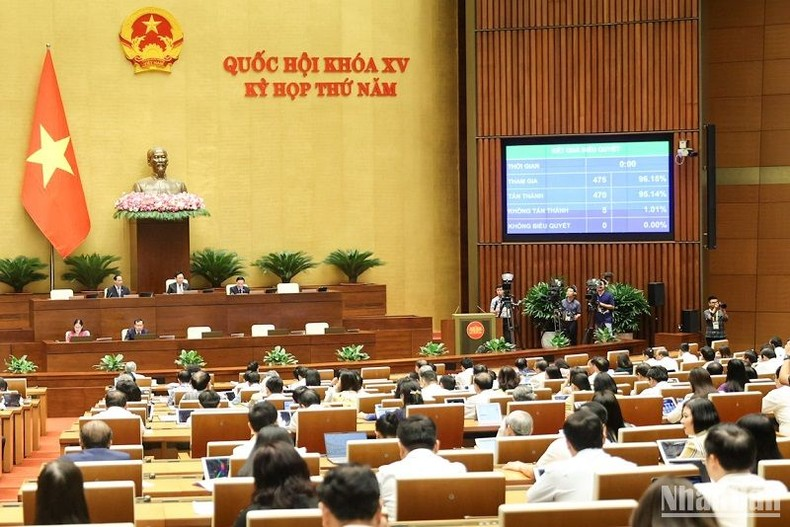
The vote was passed. (Photo: DUY LINH).
Currently, the Border Guard is receiving temporary residence registrations from foreigners in border areas in accordance with Clause 2, Article 27 of the Agreement on the management regime of land borders and land border gates between the Government of the Socialist Republic of Vietnam and the Government of the Lao People's Democratic Republic.
In response to the opinions of National Assembly deputies, the draft Law adds the content: "In case border guards receive temporary residence declarations from foreigners according to the provisions of international treaties to which Vietnam is a member" to ensure compatibility with the above Agreement, creating favorable conditions for accommodation establishments to choose a convenient police or border guard unit to send temporary residence registration.
At the same time, the regulation was added stipulating that "Border guard posts and stations are responsible for immediately notifying the commune, ward, or town police or the police station where the foreigner is temporarily residing" to ensure uniformity in the management of foreign residents in Vietnam by the police.
The Law amending and supplementing a number of articles of the Law on Exit and Entry of Vietnamese Citizens and the Law on Entry, Exit, Transit and Residence of Foreigners in Vietnam will officially come into effect on August 15, 2023.
Source: nhandan.vn
Source link





























![[Video] The craft of making Dong Ho folk paintings has been inscribed by UNESCO on the List of Crafts in Need of Urgent Safeguarding.](https://vphoto.vietnam.vn/thumb/402x226/vietnam/resource/IMAGE/2025/12/10/1765350246533_tranh-dong-ho-734-jpg.webp)
































































Comment (0)