

- Vu Lan Market (0 VND): 700 gifts distributed to people in need.
- The Vu Lan Festival – Spreading filial piety and compassion.
For Vietnamese people, the Vu Lan festival is mainly celebrated at Buddhist temples. However, for the Chinese community in Ca Mau , the festival is not only held at Buddhist temples, but also at most shrines dedicated to deities. Because of this, the Vu Lan festival doesn't necessarily have to take place on the 15th day of the 7th lunar month, but can be celebrated from the beginning of the 7th lunar month; some shrines even hold ceremonies on the 2nd, 12th, 13th, or the last day of the month, making it a unique local festival.
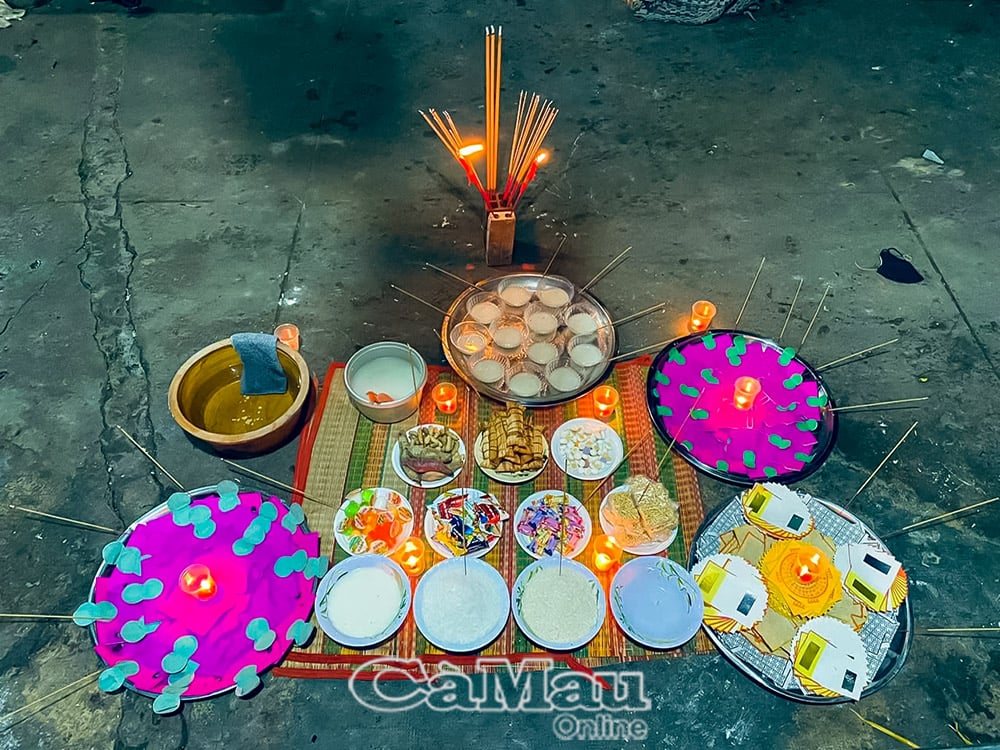
The Vu Lan festival typically has two main parts: holding a vegetarian feast to pray for the souls of the deceased; and organizing a "rice offering" (or "rice snatching") to distribute rice and gifts to the living. Therefore, the Vu Lan festival is also called the "offering to the deceased and giving to the living" festival, combining rituals to pray for the souls of the deceased to attain liberation with charitable giving to the living to accumulate merit.
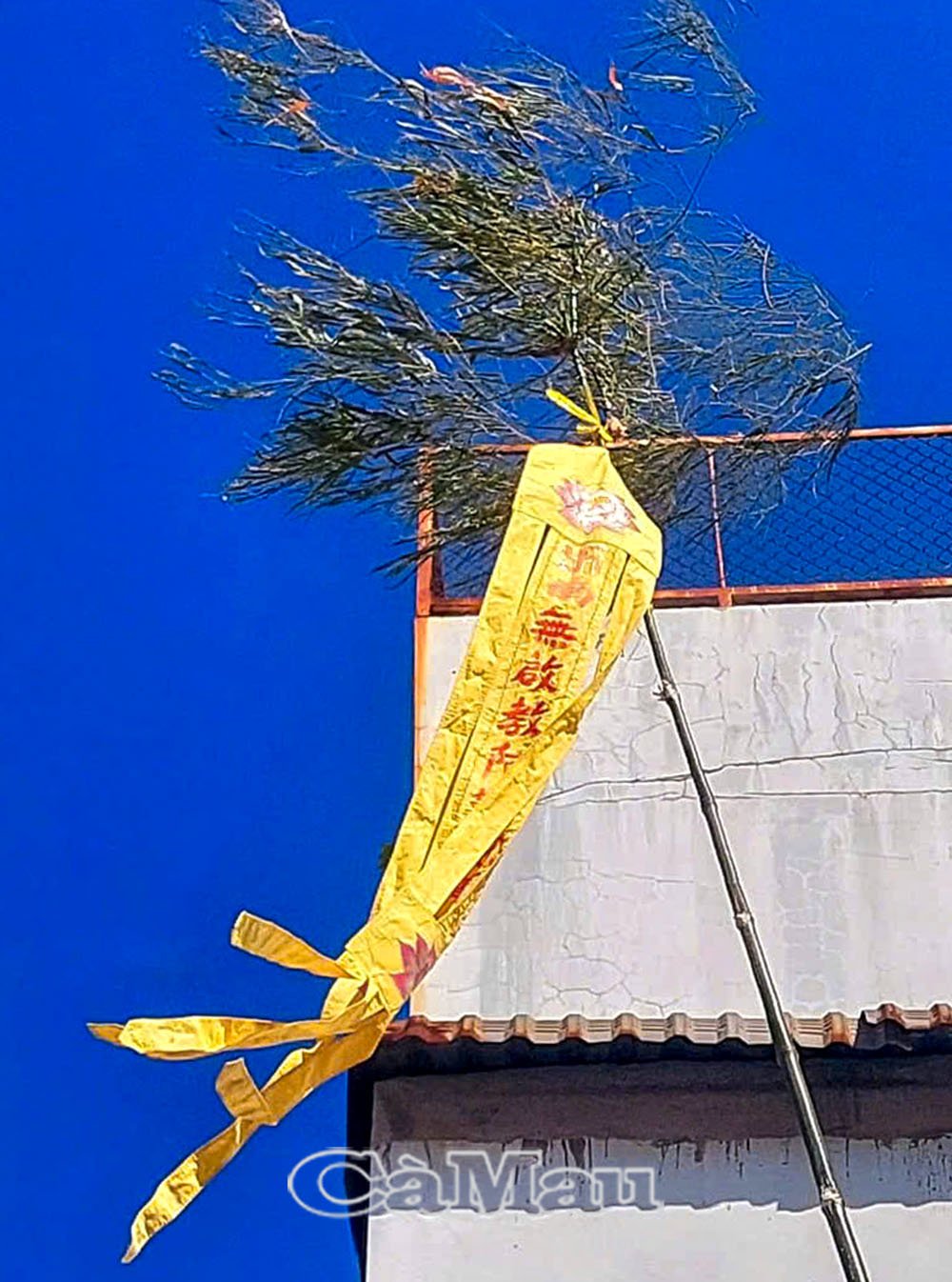
To conduct the Vu Lan festival, one of the important rituals is erecting a banner pole (similar to the New Year's pole of Northern Vietnam), made from a green bamboo trunk with its leaves intact, topped with a banner bearing the inscription "Amitabha Buddha" or "Namo Amitabha Buddha, the guiding teacher." However, the height of the banner pole is not arbitrary; it depends on the scale of the Vu Lan ceremony. If the ceremony is large and the offerings are numerous, the banner pole must be placed high, while for smaller ceremonies, it should be placed low. According to Chinese folklore, a high banner pole attracts more wandering spirits from various places, so more offerings must be made to ensure sufficient food; otherwise, the spirits will cause trouble. Typically, the banner pole is erected in front of a temple or shrine, averaging 5-10 meters in height.
The Vu Lan Festival includes a ritual called "throwing the offering" (or "grabbing the offering"). In the past, along with the memorial service, on the last day of the Vu Lan Festival, temples and shrines would erect a platform 3-5 meters high, on which many offerings were placed. Besides vegetarian food, other offerings were presented to the "throwing the offering" through card tossing. Card tossing involved a person standing on the platform throwing randomly mixed cards down to a crowd to grab. Each card had the name of the winning offering written on it, such as rice, salt, sugarcane, sweet potatoes, candy, betel nuts, and even a red envelope or pork leg. Whoever grabbed a card would receive the corresponding offering.
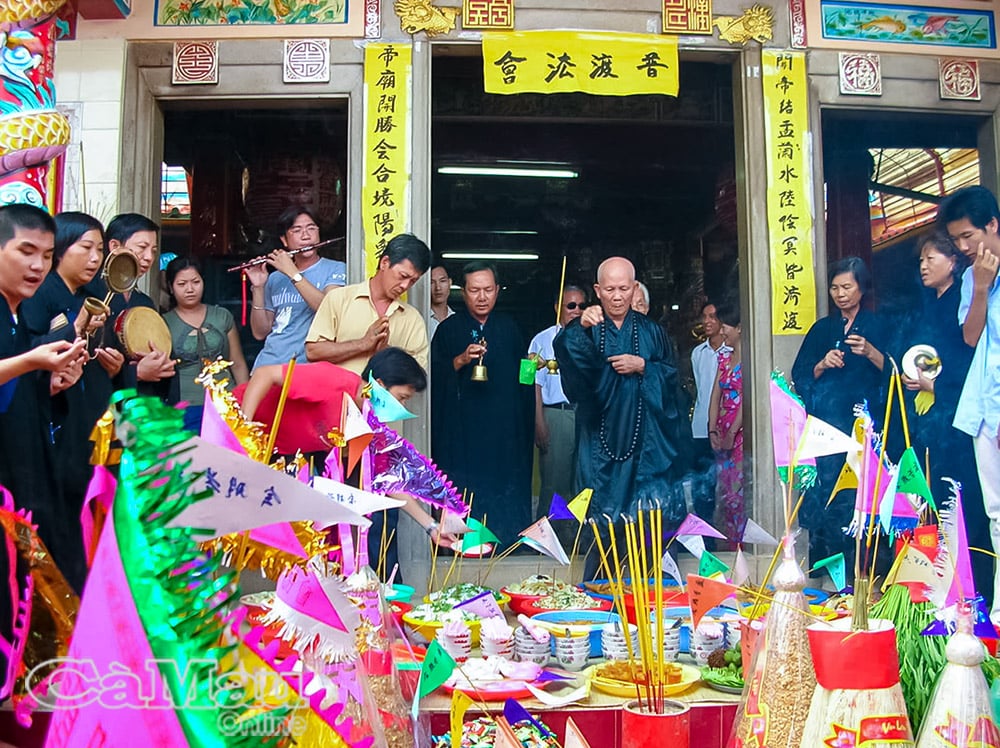
However, this form of offering alms has now been abandoned by many temples and shrines because it creates chaotic scenes of jostling and often causes accidents due to pushing and shoving to grab the alms sticks. Instead, they distribute rice vouchers (5-10 kg/voucher) and completely abandon the practice of offering alms.
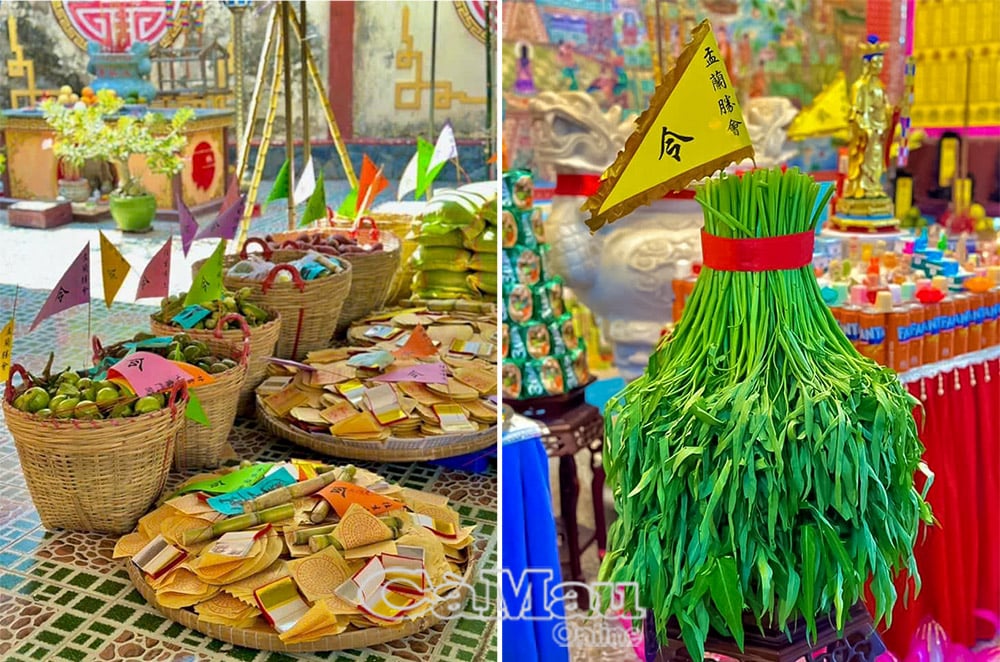
Compared to previous years, the Vu Lan festival of the Chinese community in Ca Mau has changed considerably. Many temples and shrines have boldly shortened the duration of the ceremony and prayers for the deceased from 7 days to 2 days, limiting the burning of votive paper which causes waste, environmental pollution, and safety hazards due to fire risks. At the same time, they allocate the money saved to buying rice for the poor and purchasing fish for release into the wild.
It can be said that the Vu Lan festival is truly a beautiful custom, expressing filial piety, educating about traditional culture, and also an opportunity to spread love in the community.
Lam Kiet Tuong
Source: https://baocamau.vn/net-rieng-le-vu-lan-cua-nguoi-hoa--a122087.html
![[Photo] The General Secretary, President and his wife begin their state visit to the Philippines.](https://vphoto.vietnam.vn/thumb/1200x675/vietnam/resource/IMAGE/2026/05/31/1780230559452_anh-man-hinh-2026-05-31-luc-19-28-11.png)

![[Photo] Solemn bathing ceremony and Buddha procession in Hue](https://vphoto.vietnam.vn/thumb/1200x675/vietnam/resource/IMAGE/2026/05/31/1780228263543_1-jpg.webp)
![[Image] Hanoi Police officially crowned champions of V-League 2025/2026](https://vphoto.vietnam.vn/thumb/1200x675/vietnam/resource/IMAGE/2026/05/31/1780244769054_ndo_br_039d561b692be875b13a-jpg.webp)
![[Photo] Admire the coral "masterpiece" amidst the million-year-old heritage of Dak Lak province.](https://vphoto.vietnam.vn/thumb/1200x675/vietnam/resource/IMAGE/2026/05/31/1780221235105_anh-man-hinh-2026-05-31-luc-16-53-27.png)









![[Video] Sunset at Lap An Lagoon – Where the sun sets over the fishing nets](https://vphoto.vietnam.vn/thumb/340x192/vietnam/resource/IMAGE/2026/05/31/1780192137701_beach-landscape-sea-water-nature-grass-745871-pxhere-com.jpeg)

























































Comment (0)