

|
Faced with a great strategic opportunity and favorable military and political conditions, in October 1974, the Politburo of the Central Committee of the Communist Party met to discuss the strategic plan for the liberation of South Vietnam. (Photo: VNA archives) |
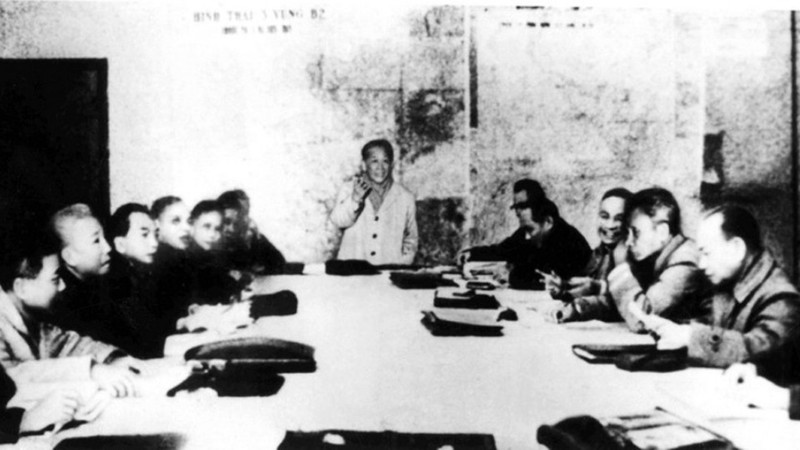
On March 31, 1975, the Politburo met and assessed: “The strategic general offensive has achieved an enormous victory… The strategic opportunity to launch a general attack and general uprising against the enemy's stronghold has matured,” and decided to launch a general offensive and uprising to liberate Saigon as soon as possible, ideally in April, with the guiding principle of “speed, boldness, surprise, and certain victory.”
On the same day, in Hanoi , General Vo Nguyen Giap assigned Comrade Nguyen The Bon - Deputy Commander and Chief of Staff of the 1st Army Corps - the task of organizing an urgent march into the Southeast region to coordinate with other units participating in the campaign to liberate Saigon-Gia Dinh. Within 16 days, the Army Corps had to organize its forces to march and assemble at Dong Xoai.
At 11:00 AM on March 31, 1975, the Politburo issued a directive instructing Comrade Van Tien Dung to go to the South early to meet with Comrade Pham Hung to immediately discuss the plan to capture Saigon, due to "the rapidly changing situation, requiring prompt action."
In Binh Dinh, at 5:15 AM on March 31, 1975, our all-out offensive against the entire enemy defense line simultaneously took place. The 12th and 141st Regiments of the 3rd Division attacked enemy positions. The 95A Regiment attacked the 41st Regiment of the Republic of Vietnam Army from Nui Mot to Phu Phong Bridge. The 968th Division continued its offensive against the enemy at Tra Lam Son Mountain. One thrust of the 968th Division captured and liberated the town of Dap Da, cutting Highway 1.
Also on the morning of March 31, 1975, the Quy Nhon City Party Committee, in coordination with the 93rd Regiment of the provincial army, secretly flanked the southern part of the town, unexpectedly capturing Zone 5, Mount Mot, Doi Bridge, Song Ngang Bridge, controlling the rear base of the 22nd Division of the Republic of Vietnam Army, and the enemy airfield. Our artillery positioned on Mount Mot provided support for the 598th Naval Commando Unit to capture Mui Tan and the Quy Nhon naval port.
In coordination with the army, various organizations mobilized over 11,000 people to seize the Governor's residence, the prison, the Public Security Department, etc. At 8 PM on March 31, 1975, the Quy Nhon commando unit, in coordination with Battalion 50, Special Forces Units D30 and D20, captured and planted the flag on the front lobby of the puppet regime's provincial administrative building and the Binh Dinh Sub-district Center. Quy Nhon town and Binh Dinh province were liberated.
In Phu Yen, on March 31, 1975, Battalion 9 of Regiment 64, Division 320, attacked the Hon Mot stronghold; Battalion 8 captured the section of Highway 1 from Phu Khe to Hoa Xuan wooden bridge.
In northern Phu Yen, local forces captured the Ngan Son bridge, cutting off National Highway 1 south of Tuy An, preventing the enemy from retreating to the town and creating favorable conditions for the main army to attack Tuy Hoa town.
On the same day, the 48th Regiment and the 9th Regiment urgently deployed forces to attack the enemy in Tuy Hoa town.
In Dak Lak, on March 31, 1975, fierce fighting continued at Phuong Hoang Pass. Having received intelligence that the enemy intended to retreat, the commander of the 10th Division deployed forces to occupy advantageous positions east of the pass to block the enemy. The enemy concentrated artillery, heavily bombed with aircraft, and their infantry charged forward in a desperate assault.
Throughout the night of March 31, 1975, C130 aircraft took turns dropping flares and shelling along Route 21, while enemy artillery from Lam Son and Duc My bases heavily bombarded our positions to reassure the remaining troops.
In Ninh Hoa, that same afternoon, the armed working team of Ninh Diem commune mobilized the masses to rise up and liberate the commune, then together with the masses, liberated the entire Hon Khoi area. On the night of March 31, 1975, civil servants and officers in Nha Trang voluntarily evacuated, and soldiers at the Dong De non-commissioned officer school also fled.
At Binh Long, at 5:00 AM on March 31, 1975, the 9th Division of the 4th Corps opened fire and attacked the Chon Thanh sub-district. By 10:00 AM the same day, the 7th Battalion and two tanks captured the security outpost. At 2:00 PM, the enemy deployed the 315th Combat Group from Bau Bang to reinforce Chon Thanh. The 9th Division received orders to switch to engaging the enemy reinforcements.
On the battlefield of Military Region 6, on the morning of March 31, 1975, Regiment 812, with tank support, repelled an enemy counterattack in the Di Linh sub-district. Meanwhile, in Tuyen Duc, that same night, the enemy abandoned Da Lat city and fled to Phan Rang, destroying the Dai Ninh bridge on Highway 20 to slow the advance of our main forces towards Da Lat.
In the southeastern region of Vietnam, by the end of March 1975, we had opened a large liberated zone adjacent to Saigon, stretching from northern Tay Ninh, through Loc Ninh, Dau Tieng, and Chon Thanh; from Mo Vet to La Nga, through Hoai Duc and Tanh Linh; and from Highway 1 to south of Highway 2 in Ba Ria.
In Military Region 9, on March 31, 1975, Regiment 1 destroyed the Ba Ke sub-district, liberated Hau Loc commune, and gained control of a 4km stretch of the Mang Thit River, cutting off the enemy's transportation route on this river.
At the same time, the 3rd Regiment of Military Region 9 annihilated four enemy pacification units in Hoa Binh commune (Tam Binh), threatening the Tam Binh sub-district to the west; the 20th Regiment of Military Region 9 destroyed a company of the 407th Security Battalion, inflicting heavy losses on the Thoi Lai sub-district.
Through nearly a month of general offensive and uprising throughout the South, we destroyed and dispersed two strong enemy military regions and corps, seized and destroyed many of their material and technical facilities, liberated the central and Central Highlands provinces, as well as many areas in the Mekong Delta and Southeast Vietnam, forming a multi-directional encirclement of Saigon-Gia Dinh.
Nhandan.vn
Source: https://nhandan.vn/ngay-3131975-bo-chinh-tri-quyet-dinh-mo-cuoc-tong-tien-cong-va-noi-day-giai-phong-sai-gon-trong-thoi-gian-som-nhat-post868879.html



























![[Image] Close-up of the newly discovered "sacred road" at My Son Sanctuary](https://vphoto.vietnam.vn/thumb/402x226/vietnam/resource/IMAGE/2025/12/13/1765587881240_ndo_br_ms5-jpg.webp)

![[Image] Close-up of the newly discovered "sacred road" at My Son Sanctuary](/_next/image?url=https%3A%2F%2Fvphoto.vietnam.vn%2Fthumb%2F1200x675%2Fvietnam%2Fresource%2FIMAGE%2F2025%2F12%2F13%2F1765587881240_ndo_br_ms5-jpg.webp&w=3840&q=75)
























































Comment (0)