

Grape varieties such as peony, queen, and ruby from China are flooding into Vietnam at increasingly cheaper prices, with some products costing only a few tens of thousands of dong per kilogram.
Five years ago, China mainly exported seedless green and red grapes to Vietnam. In the last two years, the market has become more diversified with grapes ranging from mid-range to high-end. Grape varieties such as peony, queen red grapes, and black grapes – which were previously imported from the US, Japan, and South Korea – are now successfully grown in China and exported to Vietnam at affordable prices.
Ms. Lan Anh (Go Vap) just bought a 5 kg basket of peony grapes for 230,000 VND, which is only 46,000 VND per kg. If bought individually, the price is only 90,000 VND per kg. This is a 30% decrease compared to the same period last year.
She recalled that five years ago, Japanese peony grapes could cost several million dong for a 0.7 kg bunch, but now grapes grown in China, although only 80-90% as good as the Japanese ones, are much cheaper.
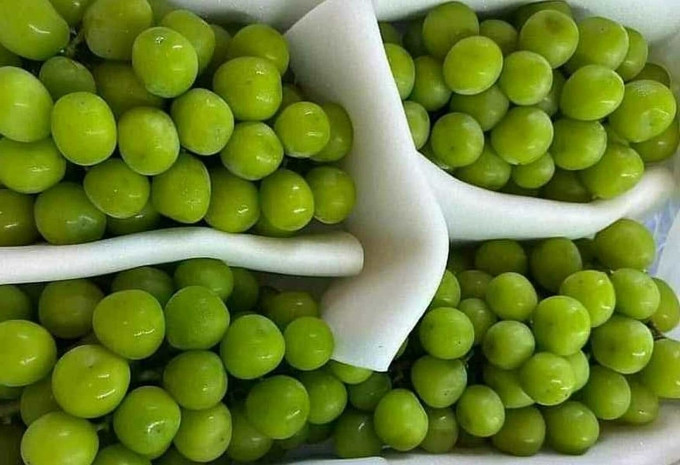
Similarly, Ms. Hanh (Binh Thanh district) also said that she previously didn't dare spend money on Queen grapes because of their high price, but now imported from China, they only cost 300,000 VND per box of 3 packs weighing 1.2kg. Because the grapes are transported quickly, the stems are still fresh, as if they were just cut from the vineyard.
In traditional markets and shops, Chinese grapes of various types are widely available, and even appear in many supermarkets at attractive prices. On online sales channels, dozens of varieties such as milk grapes, ruby grapes, black grapes, red grapes, etc., are advertised for wholesale at prices ranging from just tens of thousands to hundreds of thousands of dong per kilogram.
A 5kg box of peony grapes costs 230,000-270,000 VND, a 1.2kg box of queen grapes costs 300,000-350,000 VND, an 8kg box of ruby grapes costs 280,000-300,000 VND, and a 5kg box of red grapes costs 250,000 VND. If purchased individually, the price is approximately 60,000-300,000 VND per kg (depending on the variety), a decrease of 5-15% compared to the same period last year.
Explaining the reason for the low price of Chinese grapes, Ms. Hong, a fruit importer at Thu Duc wholesale market (Ho Chi Minh City), said that it is because grapes are in harvest season. In addition, importing large quantities allows for high discounts, attracting many wholesalers to import in bulk. Each week, she imports about 10 tons of grapes and always sells them all to her wholesale customers.
Mr. Thanh, an importer in District 12, agrees that this year's market is flooded with Chinese grapes, including many famous varieties from Japan that have been successfully grown there. Their prices are only a quarter of those imported from other countries, making them affordable for Vietnamese consumers. Some Chinese grapes are even cheaper than Vietnamese grapes.
To attract customers, Chinese export businesses divide the produce into smaller baskets or boxes of 2, 3, or 5 kg, making it easier for wholesalers to import and sell to customers.
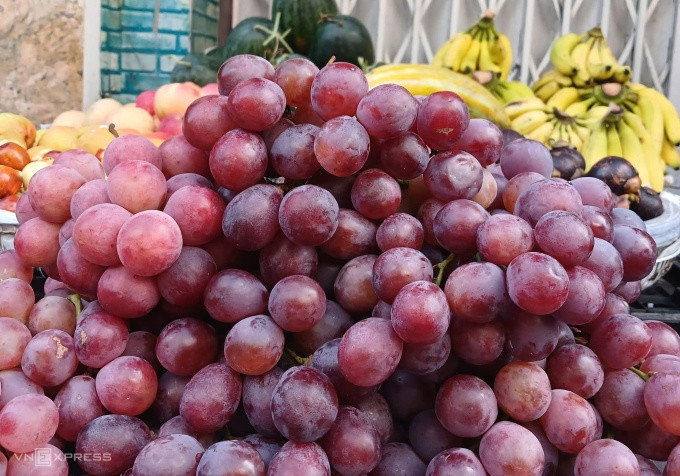
Reports from the Thu Duc wholesale agricultural market show that in the first seven months of the year, the market imported nearly 117 tons of Chinese grapes, a 50% increase compared to the same period last year. The average price of grapes this year ranges from 46,000 to 80,000 VND per kilogram, cheaper than last year.
According to wholesale market leaders, Vietnam has many famous grape-growing regions, but production is increasingly modest compared to domestic consumption needs. In particular, this year's unfavorable weather, with prolonged heatwaves, has caused Ninh Thuan grapes to become soft, resulting in lower yields compared to the same period last year. Ninh Thuan grapes are currently in the early autumn harvest season, so there isn't much available for sale yet. Therefore, Vietnam is significantly increasing grape imports from China, the US, and other countries to meet consumer demand.
According to Customs, China is the largest supplier of fruits and vegetables to Vietnam, with import turnover reaching nearly half a billion USD in the first seven months, accounting for 35% of the market share and increasing by 29% compared to the same period last year. Apples are the most imported item, followed by grapes.
Source
![[Photo] The courage of new recruits of Brigade 144 on the training ground.](https://vphoto.vietnam.vn/thumb/1200x675/vietnam/resource/IMAGE/2026/05/27/1779881651341_anh-man-hinh-2026-05-27-luc-18-32-52.png)


![[Photo] The heat at the fireworks display site on the opening night of the Da Nang International Fireworks Festival 2026](https://vphoto.vietnam.vn/thumb/1200x675/vietnam/resource/IMAGE/2026/05/27/1779889741485_ndo_br_z7872039145157-fecaba5112f39e8352544099d7ef4738-5140-jpg.webp)





























































































Comment (0)