

Online scams are becoming increasingly sophisticated.
In recent times, the Ministry of Information and Communications (MIC) has intensified its efforts to review and detect online fraud. Specifically, in the first six months of 2023, the MIC, in coordination with the Ministry of Public Security, handled numerous cases involving the use of fake mobile base stations to send fraudulent bank messages and advertisements for illicit content in several provinces and cities. The aim was to defraud people of their bank accounts or advertise illicit content such as prostitution and gambling.
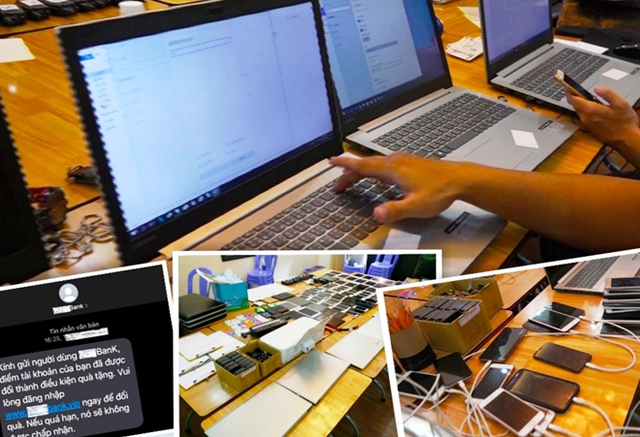
Many common forms of online fraud are emerging. (Illustrative image)
Authorities have detected and handled 15 cases involving the use of counterfeit mobile base station devices. Of these, the Ministry of Information and Communications (MIC) detected and coordinated with the Ministry of Public Security to arrest perpetrators in 11 cases, while the Ministry of Public Security expanded its investigation and arrested perpetrators in 4 cases. In addition, the Cybersecurity Department (MIC) recorded, warned about, and provided guidance on handling 6,362 cyberattacks causing incidents to information systems in Vietnam, a decrease of 4.2% compared to the first six months of 2022 (6,641 attacks).
The Cybersecurity Department also intensified its efforts to review, detect, and handle online phishing websites. It directed and coordinated the blocking of 1,530 websites/blogs violating the law (including 559 online phishing sites). This protected over 2.7 million people from accessing online phishing and illegal websites.
Sended 430 alerts and instructions to fix critical vulnerabilities and flaws that pose a risk to information security in information systems. Monitored and analyzed prominent information in cyberspace.
In many localities, the Departments of Information and Communications of the provinces and the grassroots information systems have been operating at a very high intensity, mobilizing all available means to transmit the most necessary information on preventing fraud on social media and telecommunications networks to the people, especially in some remote provinces where access to information is limited.
However, some forms of fraud still exist on social media and via phone. One common tactic is the "place orders, earn money online" scam. The scammers post advertisements on social media sites. When victims contact them seeking work, the scammers require payment for the order upfront, promising a return of the principal plus a commission.
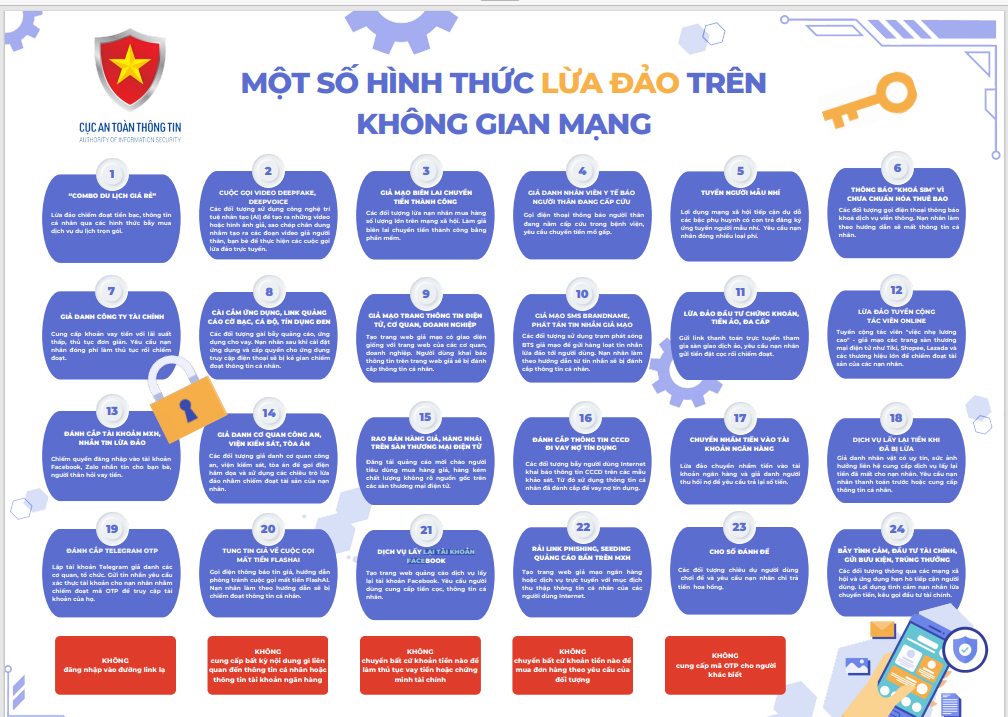
A guide to identifying 24 types of scams.
A successful order will earn a commission of 10% to 20%. For small orders, the victim will initially receive payment along with the promised commission to build trust. As the amount of money from the victim's orders increases, the perpetrators will resort to various tricks and schemes to steal the victim's money.
In addition to this type of online fraud, there are also scams involving online "get rich quick" courses; online rituals to ward off bad luck; charity scams via social media; impersonating telecommunications call centers; bank employees; and various other scams impersonating news organizations and television stations.
Raising awareness about identifying and preventing online fraud.
In recent months, scams have continued to proliferate, with the tactic of downloading a "General Department of Taxation" app from a suspicious link onto a phone. Afterward, the phone suddenly shuts down, and when it's turned back on, the victim discovers all their money has disappeared from their bank account.
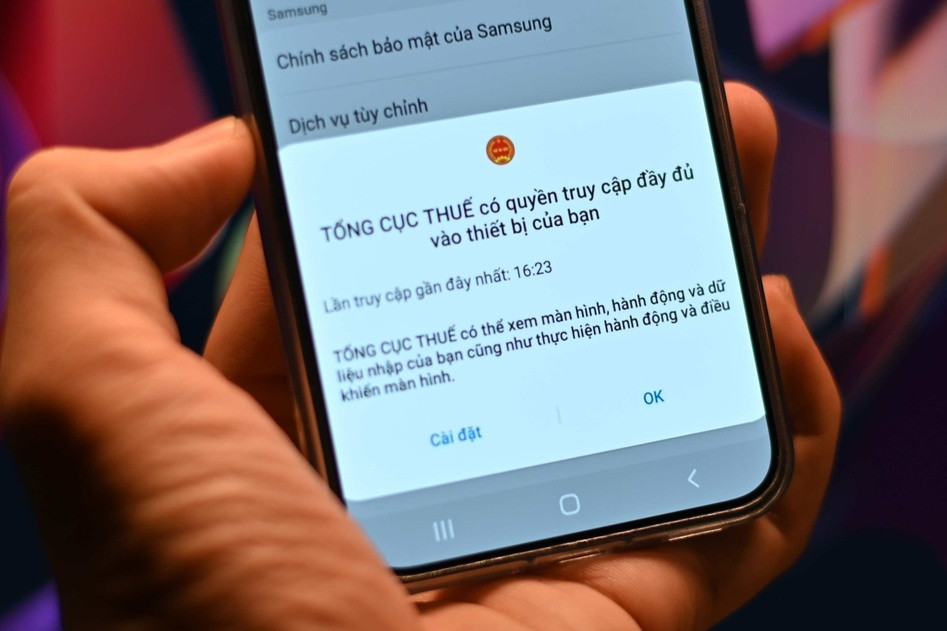
Scams are impersonating government and General Department of Taxation applications.
Ms. Khanh Thu, a business owner in Hanoi, said that after paying her taxes, she received a phone call from someone claiming to be a district tax officer. The caller suggested she download an app to facilitate tax declaration and payment. Since she couldn't go in person, she requested online guidance. She was directed to a strange link to download the app. Afterward, her phone was turned off, and a day later, when she tried to transfer money through her bank's app, all the funds in her account had disappeared. The bank determined that the money was transferred from her phone.
Similarly, a victim in Quang Yen town, Quang Ninh province, also lost 100 million VND from their account after installing the "General Department of Taxation" app via a suspicious link. The Quang Ninh Provincial Police have received the case and stated that they have received many similar reports.
At a press conference held by the Ministry of Information and Communications at the end of July, Mr. Tran Quang Hung, Deputy Director of the Information Security Department, stated that the trend of online fraud groups shifting towards targeting the elderly, children, students, and low-income workers has been quite evident this year.
"With the development of technology and the widespread adoption of smartphones, nowadays children, the elderly, students, and low-income workers all own smartphones. However, their ability to recognize the signs and behaviors of scams is still quite low. Therefore, scam groups have focused heavily on these individuals," Mr. Tran Quang Hung analyzed.
On the other hand, the Cybersecurity Department also noted that online scam groups are no longer limited to Vietnam but have largely formed fraudulent organizations in neighboring countries such as Cambodia, Laos, and the Philippines. These groups also attract many Vietnamese participants, concentrated in facilities in those countries.
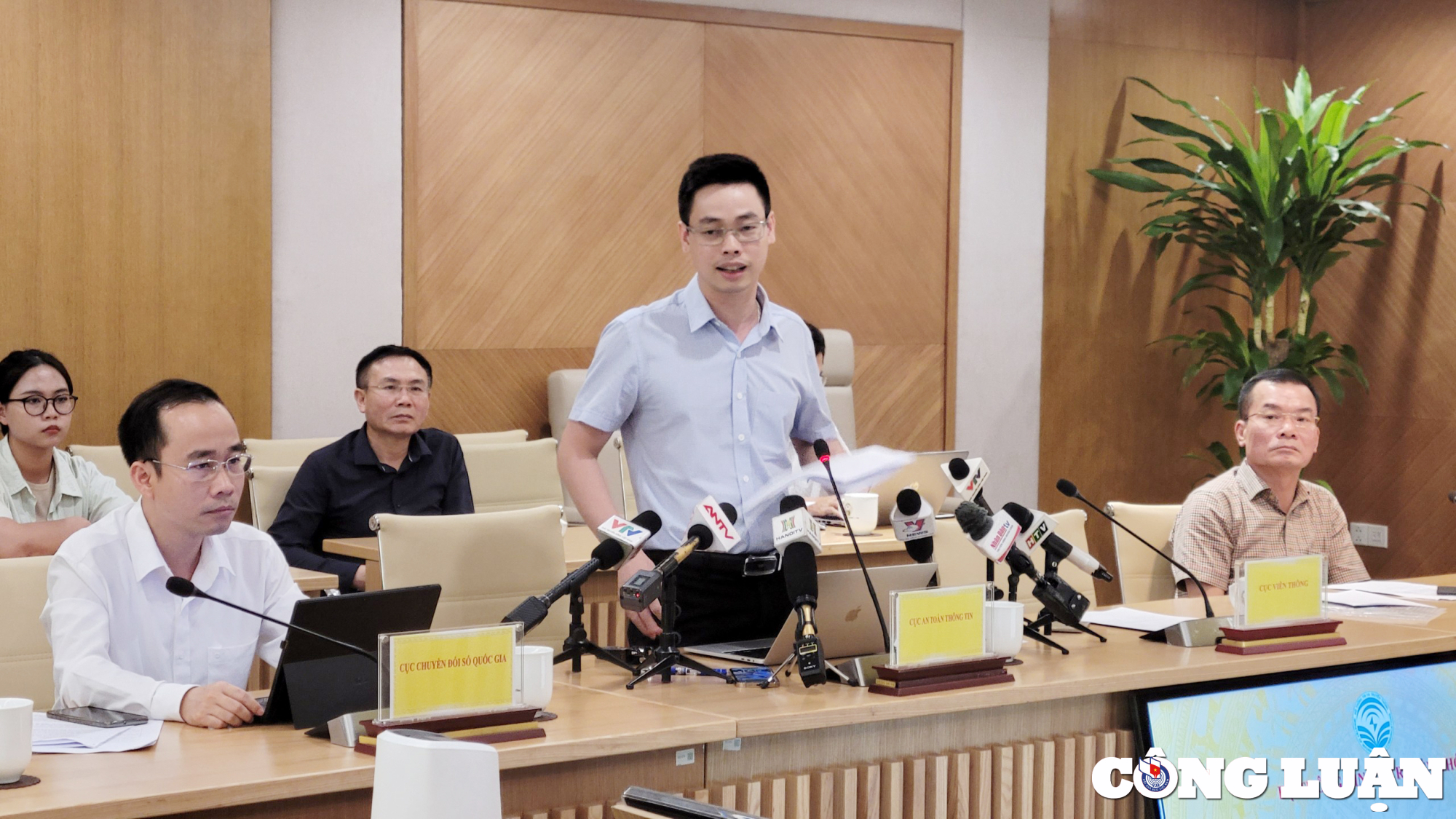
Deputy Director of the Information Security Department, Tran Quang Hung, provided information on the online fraud situation and preventive measures. Photo: Le Tam.
According to the head of the Information Security Department, disseminating information and raising awareness to equip each individual with basic knowledge and skills to ensure information security in cyberspace is a key factor in building a safe cyberspace in Vietnam, contributing to accelerating the digital transformation process and developing a sustainable digital socio-economic infrastructure.
It is known that in the near future, the Ministry of Information and Communications will launch another campaign: "Month of Action to Raise Awareness on Identifying and Preventing Online Fraud." The campaign will be implemented on a wide scale, contributing to raising public awareness through video clips depicting common online fraud scenarios, tips on identifying various forms of fraud, and providing a comprehensive guide to prevent fraud and protect oneself and family in cyberspace.
Source




![[Image] Vietnam's colorful journey of innovation](/_next/image?url=https%3A%2F%2Fvphoto.vietnam.vn%2Fthumb%2F1200x675%2Fvietnam%2Fresource%2FIMAGE%2F2025%2F12%2F14%2F1765703036409_image-1.jpeg&w=3840&q=75)



































































![[Image] Vietnam's colorful journey of innovation](https://vphoto.vietnam.vn/thumb/402x226/vietnam/resource/IMAGE/2025/12/14/1765703036409_image-1.jpeg)
































Comment (0)