

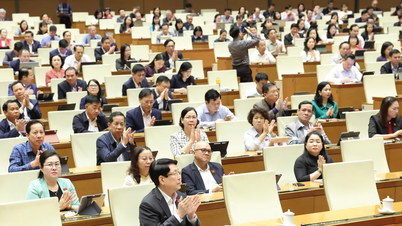
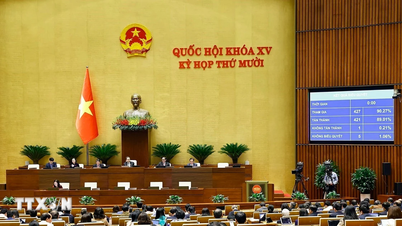
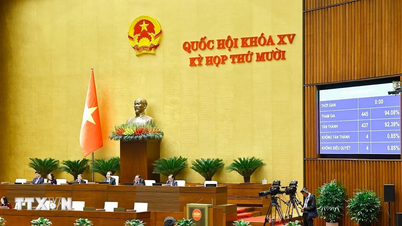
On the morning of December 10, with the majority of delegates voting in favor, the National Assembly passed the Population Law and the Disease Prevention Law.
Encourage having two children.
With 448/450 delegates participating in the vote in favor, accounting for 94.71% of the total number of delegates, the National Assembly passed the draft Population Law.
The Population Law, comprising 8 chapters and 30 articles, marks a shift in policy focus from family planning to population and development. The law contains several notable provisions. Specifically, it abolishes restrictions on the number of children and encourages couples to have two children. The Population Law officially removes the phrase: "Each couple should only have one or two children" from the Law on Protection of Public Health.
Instead, the State implements a policy of maintaining the replacement fertility rate (an average of 2.1 children per woman of childbearing age). The right to decide the number of children, the timing of births, and the spacing between births belongs to each individual and couple.
The law also increases outstanding benefits when giving birth to a second child, such as increasing maternity leave time for female workers giving birth to a second child to 7 months (an increase of 1 month compared to the current regulation of 6 months); male workers are given 10 working days off when their wives give birth to a second child (or twins).
The state will provide financial support for childbirth to women from ethnic minority groups with very small populations; women in provinces and cities with low birth rates; and especially to women who have two children before the age of 35. Women with two or more children will be given priority to buy, rent-to-own, or rent social housing.
The law also tightens regulations to minimize gender imbalance at birth, absolutely prohibiting the selection of fetal sex in any form. Notably, the act of disclosing or revealing the fetal sex to induce abortion is strictly prohibited. Medical practitioners who disclose or reveal the fetal sex to induce abortion will have their practice suspended.
Regarding policies for adapting to population aging and improving population quality, the Law encourages individuals to proactively prepare financially, healthily, and psychologically for old age from a young age; it encourages participation in social insurance, health insurance, and health coverage. The State prioritizes the development of a network of geriatric hospitals and human resources for elderly care.

The law encourages men and women to seek pre-marital counseling and health check-ups. Depending on budget conditions, provincial-level local authorities will decide on financial support for this activity. The cost of screening for certain congenital diseases in pregnant women and newborns will be subsidized by the state budget and health insurance according to a phased schedule. The Population Law will take effect on July 1, 2026. However, regulations on financial support for women in low-birth-rate areas and women who have two children before the age of 35 will take effect on January 1, 2027.
Proactive disease prevention," improving overall health for people
With 440/443 delegates participating in the vote, accounting for 93.02%, the National Assembly passed the draft Law on Disease Prevention.
The Law on Disease Prevention consists of 6 Chapters and 46 Articles, regulating a wide range of issues from infectious diseases to emerging health issues. This law will take effect from July 1, 2026.
The law contains several groundbreaking new points and key contents. Accordingly, the law includes innovative regulations on the financial mechanism for routine health check-ups and screenings. Citizens are guaranteed free routine health check-ups or screenings at least once a year, based on target groups and priority schedules. To ensure feasibility, the law stipulates funding sources including: the state budget, social contributions, and especially from the Health Insurance Fund.
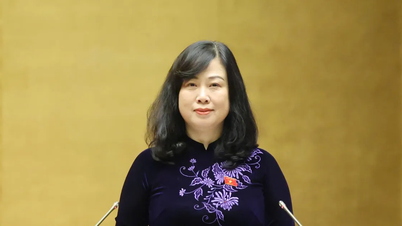
The Law has amended and supplemented the Law on Health Insurance, allowing the Fund to cover the costs of periodic health check-ups and free screenings in accordance with the Fund's ability to balance. Minister of Health Dao Hong Lan emphasized that this is an important breakthrough to institutionalize the Party's Resolutions.
Unlike previous regulations which mainly focused on infectious diseases, the Law on Disease Prevention devotes separate chapters to regulate: Mental health; nutrition.

Responding to the opinions of the National Assembly Standing Committee, the Government has revised the regulations on the Disease Prevention Fund to ensure sustainable financial resources. The "purpose" and "tasks" of the Fund are clearly separated into two distinct components to ensure transparency; the Fund's expenditure for regular health check-ups or free screenings has been added, creating additional resources for implementing this policy. The Fund's revenue includes a mandatory contribution of 2% on the special consumption tax base of tobacco manufacturers and importers.
The law also stipulates specific and superior preferential policies for medical staff working professionally at commune-level health stations and preventive health facilities. In particular, the State has a policy of providing scholarships to encourage learning in preventive medicine and public health, and fully supporting tuition fees and living expenses for students at state-run health education institutions.
Regulations on the prevention and control of infectious diseases have been refined based on the practical experience of the recent COVID-19 pandemic. The law classifies infectious diseases into groups A, B, C, and others according to the recommendations of the World Health Organization, and also specifies response measures in emergency situations.
With these new regulations, the Law on Disease Prevention is expected to create a solid legal framework for transforming the healthcare model from "treating disease" to "proactive disease prevention," improving the overall health of the people.
Source: https://www.vietnamplus.vn/quoc-hoi-khoa-xv-bieu-quyet-thong-qua-luat-dan-so-va-luat-phong-benh-post1082151.vnp

![[Photo] The captivating scenery of the fragrant maple forest in Quang Tri](/_next/image?url=https%3A%2F%2Fvphoto.vietnam.vn%2Fthumb%2F1200x675%2Fvietnam%2Fresource%2FIMAGE%2F2025%2F12%2F10%2F1765353233198_lan09046-jpg.webp&w=3840&q=75)


![[Photo] Explore the US Navy's USS Robert Smalls warship](/_next/image?url=https%3A%2F%2Fvphoto.vietnam.vn%2Fthumb%2F1200x675%2Fvietnam%2Fresource%2FIMAGE%2F2025%2F12%2F10%2F1765341533272_11212121-8303-jpg.webp&w=3840&q=75)





![[Video] National Assembly passes Cybersecurity Law with 91.75% of delegates voting in favor](https://vphoto.vietnam.vn/thumb/402x226/vietnam/resource/IMAGE/2025/12/10/1765354445335_1-1521-png.webp)
![[Video] National Assembly passes the amended Personal Income Tax Law with many changes to tax rates and family deductions.](https://vphoto.vietnam.vn/thumb/402x226/vietnam/resource/IMAGE/2025/12/10/1765353535343_2-2763-png.webp)









![[Video] The craft of making Dong Ho folk paintings has been inscribed by UNESCO on the List of Crafts in Need of Urgent Safeguarding.](https://vphoto.vietnam.vn/thumb/402x226/vietnam/resource/IMAGE/2025/12/10/1765350246533_tranh-dong-ho-734-jpg.webp)






















































Comment (0)