

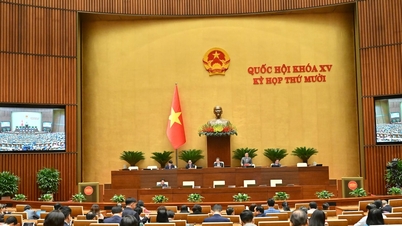
Continuing the agenda of the 10th Session of the 15th National Assembly , on the morning of December 10th, the National Assembly voted to approve the Resolution on "Continuing to improve the effectiveness and efficiency of implementing policies and laws on environmental protection" with 442 out of 444 National Assembly deputies present voting in favor.
Reporting on the draft Resolution before its adoption, the Secretary General of the National Assembly, Head of the National Assembly Office Le Quang Manh - Deputy Head of the Supervisory Delegation, stated that at the 10th session of the 15th National Assembly on October 28th, the National Assembly discussed in the plenary session the report on the results of the thematic supervision of the implementation of policies and laws on environmental protection since the Law on Environmental Protection of 2020 came into effect, and the draft resolution of the National Assembly on this thematic supervision.
The Standing Committee of the National Assembly directed the Supervisory Delegation to coordinate with the Ministry of Agriculture and Environment and other relevant agencies to study, incorporate, and fully explain the opinions of National Assembly deputies, and revise the draft resolution as stated in report No. 1534 dated December 9th.
According to the Secretary General of the National Assembly and Head of the National Assembly Office, Le Quang Manh, regarding the opinions that the process of assessing environmental impact (EIA) and granting environmental permits is still lengthy, and that the criteria for determining licensing authority between ministerial and provincial levels overlap; and that decentralization to the commune level is limited in terms of resources, the 2020 Environmental Protection Law has emphasized the responsibility of businesses. The Government has accelerated decentralization and delegation of authority, cutting 16% and decentralizing approximately 73% of environmental administrative procedures by 2025.
At the 10th session, the Government submitted to the National Assembly amendments to the Law on Environmental Protection to further reduce the number of entities subject to environmental protection regulations and decentralize authority to local governments, resolving nearly 90% of administrative procedures. The draft Resolution included a requirement to streamline the state management apparatus for environmental protection according to a two-tiered local government model, coupled with training and capacity building for grassroots officials.
Regarding the opinion that regulations on the subjects required to fulfill environmental obligations are still inconsistent, especially for expansion projects, capacity upgrades, or projects linking production chains, the Government has submitted to the National Assembly amendments to the Law on Environmental Protection to exempt environmental procedures in some special cases (special investments, Group III and IV minerals). Decree No. 05/2025/ND-CP has clearly stipulated new projects, expansion projects, and simplified environmental permit procedures for small projects (Group III).
Furthermore, regarding the opinion that environmental permits are overlapping and inconsistent, and the proposal for strong decentralization to provincial-level specialized agencies for Group B and C projects, projects in industrial zones, and medium- and small-scale facilities, the Secretary General of the National Assembly and Head of the National Assembly Office, Le Quang Manh, affirmed that the new environmental permit regulations in the 2020 Law on Environmental Protection have integrated six administrative procedures into one permit, helping to reduce administrative procedures and costs. Decree No. 05/2025/ND-CP has simplified the application dossier (from five to three forms) and the appraisal procedure (eliminating the appraisal team form). Strong decentralization has been implemented for localities for Group B and C projects and medium- and small-scale facilities.
According to National Assembly Secretary General Le Quang Manh, in response to concerns that the proportion of budget spending on environmental protection is still low, the Environmental Protection Fund operates inefficiently, and the private sector mobilization mechanism (PPP) is not effective, the draft Resolution has added the task of prioritizing resources from the budget and social mobilization, gradually increasing budget spending on environmental protection in line with economic growth. It also aims to improve economic instruments (green bonds, green credit) and enhance the role of the Environmental Protection Fund. Furthermore, it emphasizes the economic aspects of the environment, establishing a mechanism for valuing resources, paying for ecosystem services, and thoroughly applying the principle that "those who benefit from the environment have an obligation to contribute financially... those who pollute... must pay and compensate."
Regarding the management of household solid waste, special waste, and wastewater, some opinions suggest that household solid waste pollution has not decreased, sorting at source is difficult to implement due to a lack of infrastructure, and priority should be given to modern technology and reducing landfilling.
With this content, the draft Resolution outlines amendments to the roadmap and timeframe for implementing policies on sorting household solid waste to better suit practical needs. It promotes collection, sorting, and conversion to advanced processing technologies, prioritizing recycling and waste treatment combined with energy recovery instead of landfilling. The targets for 2030 are: 95% of urban household solid waste collected and treated, and 85% in rural areas; the rate of direct landfilling reduced to below 50%; and over 30% of generated plastic waste recovered.
There are also opinions suggesting that the rate of urban wastewater collection and treatment is only about 18%, and that priority should be given to public investment to complete the sewer collection network in old urban areas. However, the draft Resolution requires prioritizing budgetary resources and social mobilization to invest in the synchronous development of essential environmental infrastructure projects such as urban wastewater collection and treatment systems. The goal is to achieve a rate of approximately 70% of domestic wastewater collected and treated in Type I cities and above by 2030.
Regarding the suggestion to add a flexible mechanism allowing adjacent industrial parks and clusters to connect to a common centralized wastewater treatment system, the Government has proposed amending the Law on Environmental Protection to allow concentrated production, business, and service areas located close together to combine the use of a common centralized wastewater treatment system to increase investment efficiency.
Regarding the development of the carbon market and climate change response, there were suggestions to pilot a carbon credit exchange in 2026 and finalize the legal framework for official operation from 2027. The draft Resolution identified the task of "Establishing and operating a domestic carbon exchange" and finalizing the legal framework for international carbon credit exchange by the end of 2026.
Regarding the suggestion that spending on the environment should be considered an investment in development; and that the system of indicators on green GDP should be further improved to ensure a balance between socio-economic development and the environment, the Head of the National Assembly Office, Le Quang Manh, affirmed that considering spending on the environment as an investment in development and ensuring environmental security has already been expressed in point a, clause 1, Article 2 of the draft Resolution. As for the green GDP indicator, the draft Law amending and supplementing several articles of the Statistics Law in 2025 (submitted to the National Assembly for approval) does not include this indicator in the national statistical indicator system.
Source: https://vtv.vn/quoc-hoi-thong-qua-nghi-quyet-ve-bao-ve-moi-truong-100251210125044476.htm




![[Video] National Assembly passes the amended Civil Servant Law with 92.39% of delegates voting in favor](https://vphoto.vietnam.vn/thumb/402x226/vietnam/resource/IMAGE/2025/12/10/1765379039932_1-6690-3945-png.webp)














![[Video] The craft of making Dong Ho folk paintings has been inscribed by UNESCO on the List of Crafts in Need of Urgent Safeguarding.](https://vphoto.vietnam.vn/thumb/402x226/vietnam/resource/IMAGE/2025/12/10/1765350246533_tranh-dong-ho-734-jpg.webp)

















































Comment (0)