

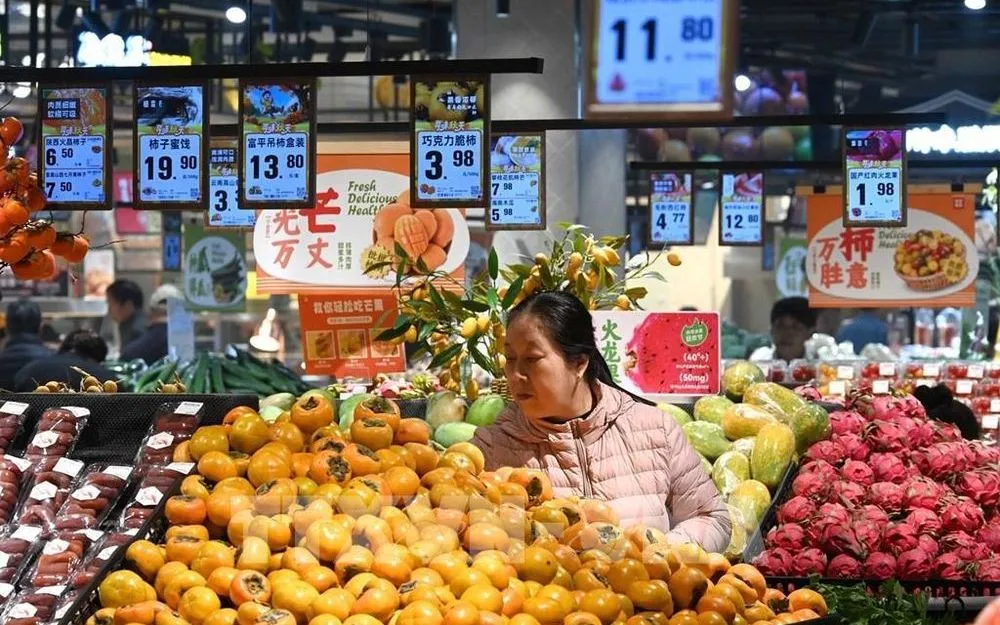
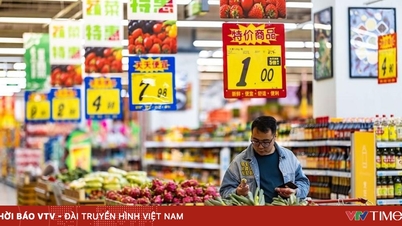
People shop at a supermarket in Hebei province, China. Photo: THX/VNA
This reality further highlights the challenges policymakers face as they strive to revive domestic demand amid persistent trade tensions.
Data released by the National Statistics Bureau (NBS) on December 10 showed consumer prices rose slightly by 0.7% in November compared to the same period last year, the highest level since February 2024. This increase followed a 0.2% rise in October and matched the 0.7% increase forecast in a Reuters poll of economists .
Core inflation – excluding volatile food and energy prices – rose 1.2% year-on-year in November, unchanged from the previous month.
The Chinese government 's consumer-focused stimulus measures continued to push up prices of household goods and clothing by 4.9% and 2%, respectively. Notably, the price of gold jewelry surged by as much as 58.4% year-on-year.
However, compared to the previous month, the CPI in November fell slightly by 0.1%, contrary to the forecast of a 0.2% increase in a Reuters poll, due to a cooling of prices for hotels, airfares, transportation, and travel services after the extended holiday period in October.
Meanwhile, factory gate prices in November fell 2.2% year-on-year, mainly due to a higher base for comparison with last year. This decline was sharper than the forecast of a 2% drop and extended the deflationary streak into its fourth year. Prior to this, the index had fallen 2.1% in October.
Economists warn that deflationary pressures on the world's second-largest economy will persist into next year, as the persistent real estate downturn and weak labor market continue to weigh on household spending. Experts also point to the need for further supportive policies.
Despite a slowdown in economic growth to its weakest pace in a year in the third quarter, China appears to still be on track to meet its full-year growth target of "around 5%" this year. This momentum is supported by sustained export activity as manufacturers ramp up shipments to markets outside the U.S. China recorded a trade surplus of over $1 trillion in the January-November period this year, surpassing the record full-year figure set for 2024.
Investors and economists are closely watching the annual Central Economic Work Conference, scheduled to take place in the coming days, where policymakers will set key growth targets and policy priorities for the coming year.
Source: https://vtv.vn/trung-quoc-lam-phat-tieu-dung-lap-dinh-gia-san-xuat-giam-sau-100251210162512259.htm

![[Photo] Closing Ceremony of the 10th Session of the 15th National Assembly](/_next/image?url=https%3A%2F%2Fvphoto.vietnam.vn%2Fthumb%2F1200x675%2Fvietnam%2Fresource%2FIMAGE%2F2025%2F12%2F11%2F1765448959967_image-1437-jpg.webp&w=3840&q=75)











































![[OFFICIAL] MISA GROUP ANNOUNCES ITS PIONEERING BRAND POSITIONING IN BUILDING AGENTIC AI FOR BUSINESSES, HOUSEHOLDS, AND THE GOVERNMENT](https://vphoto.vietnam.vn/thumb/402x226/vietnam/resource/IMAGE/2025/12/11/1765444754256_agentic-ai_postfb-scaled.png)














































Comment (0)