


Officials will be allowed to work overtime and contribute capital to establish businesses.
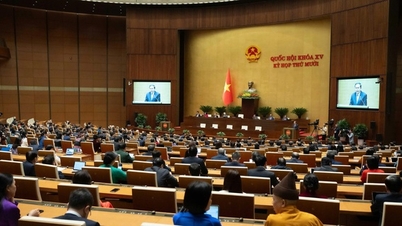
On the afternoon of December 10th, National Assembly delegates voted to approve the amended Law on Public Employees. The law will take effect from July 1st, 2026.
The law recently passed by the National Assembly stipulates the rights of civil servants regarding professional and business activities, in Article 13.
Accordingly, civil servants may sign labor contracts or service contracts with other agencies, organizations, or units if the laws governing their respective sectors and fields do not prohibit it, ensuring there is no conflict of interest as stipulated by the law on preventing and combating corruption, not contradicting the agreement in the employment contract, and not violating professional ethics.
If there is no agreement in the employment contract, written consent from the head of the public service unit is required; for the head of the public service unit, written consent from the directly supervising authority is required.
Public officials may practice their profession individually if the laws governing their sector or field do not prohibit it, ensure there is no conflict of interest as stipulated by the law on preventing and combating corruption, and do not violate professional ethics.
The new law also allows civil servants to invest in and participate in the management and operation of non-governmental enterprises, cooperatives, hospitals, educational institutions, and scientific research organizations, except in cases where the law on anti-corruption, the law on enterprises, or the law on the relevant industry or field provides otherwise.
Officials may exercise other rights in business activities provided they do not violate the law on professional activities and regulations of competent authorities.
In the report explaining, receiving feedback, and revising the draft law, the Government emphasized that allowing civil servants to sign labor contracts and service contracts to carry out their professional activities aims to institutionalize the policy of linking human resources between the public and private sectors, creating conditions for civil servants to increase their legitimate income through their professional activities.
At the same time, the Law stipulates that civil servants are allowed to sign labor contracts or service contracts if specialized laws do not prohibit it. Taking into account the opinions of delegates, the above contents have been revised in detail to ensure the rights of the workforce, build a mechanism to prevent conflicts of interest through agreements in employment contracts, and ensure they do not contradict the provisions of the law on anti-corruption and specialized laws.
At the same time, the regulations clearly state that civil servants are only allowed to engage in professional activities outside their unit if they are responsible for completing their assigned tasks; for managerial civil servants, approval from the managing agency of the public service unit is required.
Earlier, discussing this issue, delegate Ha Duc Minh (Lao Cai delegation) assessed the proposal as an innovative step, expanding professional rights and encouraging the initiative and creativity of the public sector's intellectual workforce. This regulation is consistent with the requirements for linking public and private resources, helping to effectively utilize the capabilities of civil servants in science and technology, education, healthcare, and digital transformation.
However, Representative Ha Duc Minh also noted that the draft law's scope is too broad, easily leading to civil servants engaging in business and commercial activities, causing conflicts of interest, affecting professional ethics, and the quality of service to the people. In addition, the mechanisms for supervision, inspection, and handling of violations are still unclear, easily leading to abuse of power for personal gain or the use of public assets for private purposes.
Representative Pham Van Hoa (Dong Thap delegation) expressed concern that if leaders of public service units both manage internal affairs and have economic interests in external businesses, it could easily lead to favoritism and preferential treatment for the sector or unit in which they have invested capital.
According to Mr. Hoa, only ordinary officials and their deputies should be allowed to sign employment contracts or engage in external economic activities. However, this should be strictly restricted for heads of departments, as their positions are linked to managerial power and are prone to the risk of abuse of power for personal gain.
Source: https://vtv.vn/vien-chuc-duoc-lam-them-va-gop-von-lap-doanh-nghiep-100251210165040056.htm


![[Photo] Closing Ceremony of the 10th Session of the 15th National Assembly](/_next/image?url=https%3A%2F%2Fvphoto.vietnam.vn%2Fthumb%2F1200x675%2Fvietnam%2Fresource%2FIMAGE%2F2025%2F12%2F11%2F1765448959967_image-1437-jpg.webp&w=3840&q=75)











































![[OFFICIAL] MISA GROUP ANNOUNCES ITS PIONEERING BRAND POSITIONING IN BUILDING AGENTIC AI FOR BUSINESSES, HOUSEHOLDS, AND THE GOVERNMENT](https://vphoto.vietnam.vn/thumb/402x226/vietnam/resource/IMAGE/2025/12/11/1765444754256_agentic-ai_postfb-scaled.png)














































Comment (0)