

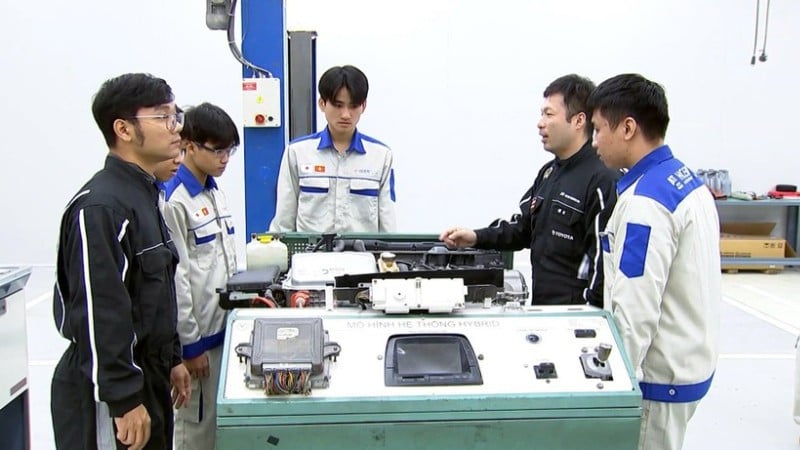
With this strategic perspective, vocational education becomes a pillar, playing a key role in improving the quality of human resources in the new era.
However, that pillar is burdened with too many constraints. The country currently has more than 1,163 vocational training institutions, but most of them are small in scale, of uneven quality, and in many places the training programs are far from practical needs. That is why in September 2025, the Ministry of Home Affairs issued Official Dispatch No. 8150/BNV-TCBC, guiding localities to arrange the network of vocational training institutions in a streamlined, efficient, and modern direction, with the principle: Each province has no more than three public vocational schools (except for autonomous schools) and merge vocational and continuing education centers into vocational high schools.
Many localities have taken the initiative, such as Ho Chi Minh City, which has reviewed and estimated that there will be only 19 public vocational schools left, including two newly established schools in the direction of "upgrading and merging", namely Saigontourist College of Tourism and Hotel Management and High-Tech Agriculture College. Notably, all current public secondary schools will be dissolved or merged. The city also proposed to convert 41 vocational and continuing education centers into 37 regional vocational secondary schools.
Similarly, Ninh Binh province has merged three provincial medical schools and is considering integrating some secondary schools into Hoa Lu University, to ensure there are no more than three vocational schools but still maintain training capacity suitable to local needs.
Streamlining the network is in the right direction, but what is the purpose of the arrangement? That is the fundamental question. Resolution No. 71-NQ/TW sets the target that by 2030, 80% of vocational training institutions will meet national standards; 20% will be invested in modern facilities equivalent to those in developed countries in Asia. The rate of people studying at post-secondary levels will reach 50%. If the arrangement stops at "merging to reduce", it will not be able to create a real leap. On the contrary, if it is considered a step to "clear the ground" for the streaming strategy, then this is an opportunity to comprehensively rebuild the vocational education system according to new criteria: Modern, connected, flexible, and interconnected.
This mindset was set out in 2021 in the Vocational Education Development Strategy for the 2021-2030 period, with a vision to 2045 (Decision No. 2239/QD-TTg), with the view that: Developing vocational education is an important task in exploiting the "golden population opportunity", popularizing vocational training for young people and ensuring priority budget allocation for this field in the overall education and training budget.
In terms of model, Resolution No. 71-NQ/TW proposes important reforms: Adding vocational secondary level equivalent to high school, allowing students to study dual cultural-vocational degrees; at the same time promoting the connection between schools-enterprises-markets. Along with that is strong decentralization to localities to manage vocational education institutions, to link responsibility with authority in ensuring the quality of local human resources.
In terms of content, the Resolution requires “program innovation, digital technology application, and promoting vocational skills training in enterprises”, especially in the fields of engineering and high technology. Financial policies are also redesigned: Prioritizing budgets for technical sectors, supporting training for ethnic minorities, encouraging enterprises to participate in establishing vocational training facilities, and establishing a separate human resource training fund to retrain and improve training for existing workers.
Digital transformation is also a requirement for innovation in vocational education. Vocational institutions need to build digital training platforms, integrate artificial intelligence (AI), and improve digital competency standards for teachers and learners - so as not to be left behind in the process of comprehensive digitalization of the economy.
These orientations show that only when vocational education becomes an attractive “destination” for learners, closely connected to the market, guaranteed resources and operated as an open ecosystem, can the national streaming strategy be successful. Arranging vocational schools is not just a matter of quantity. It is a test of strategic thinking and reform capacity of each locality.
Source: https://nhandan.vn/sap-xep-lai-cac-co-so-giao-duc-nghe-nghiep-tinh-gon-hieu-qua-hien-dai-post929133.html




















![[Video] National Assembly passes the amended Civil Servant Law with 92.39% of delegates voting in favor](https://vphoto.vietnam.vn/thumb/402x226/vietnam/resource/IMAGE/2025/12/10/1765379039932_1-6690-3945-png.webp)





![[Video] The craft of making Dong Ho folk paintings has been inscribed by UNESCO on the List of Crafts in Need of Urgent Safeguarding.](https://vphoto.vietnam.vn/thumb/402x226/vietnam/resource/IMAGE/2025/12/10/1765350246533_tranh-dong-ho-734-jpg.webp)



















































Comment (0)