

The Odyssey spacecraft sent back two images of the lunar surface before ending its mission a few days earlier than planned.
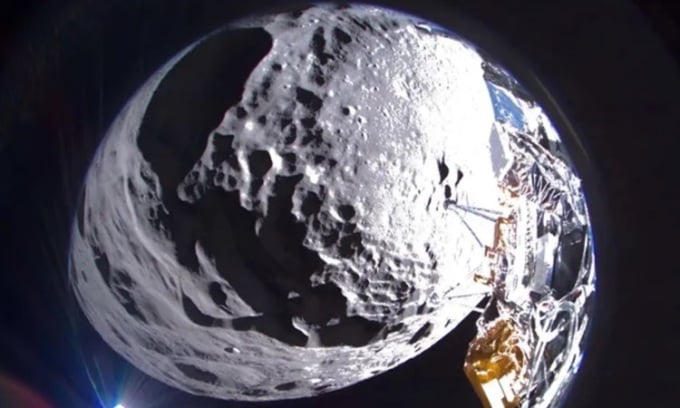
This wide-angle image of the lunar surface was taken by a camera on the Odysseus spacecraft. Photo: Intuitive Machines
On February 26, Intuitive Machines announced on social media that the Odysseus spacecraft was still in contact with ground control despite tipping over after landing on the Moon. Odysseus also sent back two images from the Moon: one taken as the spacecraft approached its landing site, Malapert A, and the other being the first close-up image of the lunar surface, according to Space .
NASA's Lunar Reconnaissance spacecraft, which has been scanning the Moon from orbit since 2009, photographed Odysseus at an altitude of 90 km. Images from the Lunar Reconnaissance's camera confirmed that Odysseus completed its landing at coordinates 80.13 degrees south latitude and 1.44 degrees east longitude at an altitude of 2,579 m. After flying more than 965,606 km, Odysseus landed 1.5 km from its target Malapert A, according to Intuitive Machines. The mission team determined that Odysseus slid and tipped over, landing on a rock, causing some of the onboard antennas to be pointed incorrectly. Based on the positions of the Earth and the Moon, Intuitive Machines calculated that flight controllers could maintain contact with Odysseus until the morning of February 27th, several days earlier than the initial estimate of 9 days.
"We have several antennas pointed toward the lunar surface, and those antennas can't transmit data back to Earth. That's a real limitation. Our ability to communicate and collect data properly is reduced," said Steve Altemus, CEO of Intuitive Machines.
NASA placed seven payloads aboard the Odysseus spacecraft, including a series of cameras designed to study how lunar dust shifts as the spacecraft lands. Even if the spacecraft tips to one side, the camera array can still collect data until the lunar night this weekend.
The Odysseus spacecraft launched on a SpaceX Falcon 9 rocket from NASA's Kennedy Space Center in Cape Canaveral, Florida, on February 15 and entered lunar orbit on February 21. The spacecraft orbited the Moon before gradually slowing down for landing with several engine fires. The lander landed near the Malapert A crater at the Moon's south pole. This area has long been of interest to researchers due to the presence of water ice, which could split into hydrogen and oxygen for future rocket fuel, according to NASA.
The Odysseus mission is part of NASA's Commercial Lunar Payload Services program, which promotes the development of private lunar landers. NASA contracts with companies to transport cargo and scientific equipment to the Moon. Prior to Odysseus, the five most recent attempts to land on the Moon have all failed, including the private Peregrine mission last month.
An Khang (According to Space/Live Science )
Source link


![[Image] Close-up of the newly discovered "sacred road" at My Son Sanctuary](/_next/image?url=https%3A%2F%2Fvphoto.vietnam.vn%2Fthumb%2F1200x675%2Fvietnam%2Fresource%2FIMAGE%2F2025%2F12%2F13%2F1765587881240_ndo_br_ms5-jpg.webp&w=3840&q=75)


























































































Comment (0)