

As the sun set, the women of Rophia's family gathered for a meal to break the fast while the men went to the mosque for service.
"If all the family members gathered together, there wouldn't be enough room," said Rophia. Their house, measuring 4 meters wide and 20 meters long, is home to three generations of their family.
Half a century ago, Rophia's father, Salayman, originally from An Giang province , migrated to live in alley 157, Duong Ba Trac Street, District 8. The alley is one of the 16 most populous Muslim communities in Ho Chi Minh City, with approximately 3,000 people.
Mr. and Mrs. Salayman have 10 children. Except for one who moved to Long Khanh City, Dong Nai Province , the others have all gotten married but do not have the means to live separately.
Mr. Salayman passed away in 2004, and the family currently numbers 40 members. The house has two mezzanines, divided into 10 rooms that serve as sleeping quarters for everyone. They share two kitchens located at the front and back of the house.
"We live together harmoniously and are considerate of each other," said Rophia, Salayman's seventh daughter. "Everyone takes turns working outside, so the house isn't too crowded."
During his lifetime, Salayman taught his children and grandchildren Islamic philosophy. From a young age, his children learned Arabic and performed prayers at the Jamiul Anwar Mosque, located 50 meters from their home.
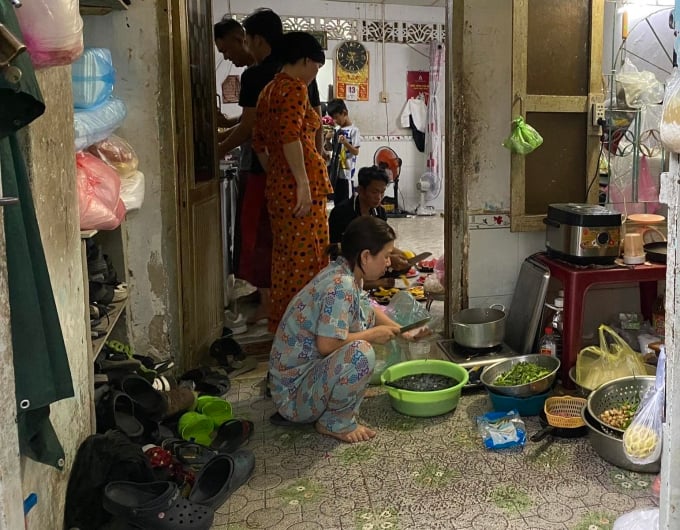
Adam Marryna's family members prepare food for the end-of-fasting meal on the afternoon of March 13th. Photo: Ngoc Ngan.
According to Muslim tradition, the fasting month of Ramadan is the most special occasion. This year, the festival begins on March 11th and lasts for a month.
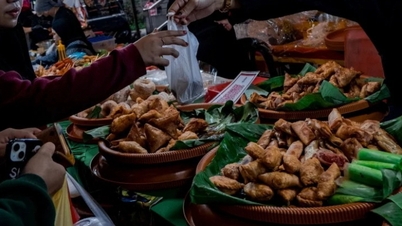
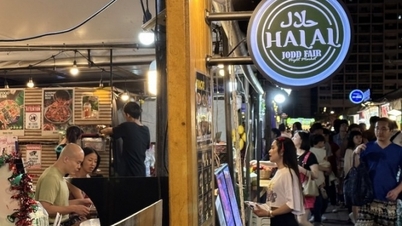
Over one hundred households in alley 157 on Duong Ba Trac Street usually begin preparing for Ramadan from the beginning of March. Muslims decorate the small alleyways with string lights and flags. During this time, the area near the Jamiul Anwar mosque, a center of religious activity for the community, is particularly bustling in the afternoons and evenings. Residents of the alley and Muslims from other areas also flock here to buy Halal food.
Throughout the month-long festival, the family refrains from eating or drinking during the day, even avoiding swallowing saliva as they normally would. All eating and drinking activities only take place after sunset, at 6:10 PM daily.
Adam Marryna, 40, usually prepares meals for the whole family at 3:30 a.m. so they can eat before 4:00 a.m. She uses Halal chicken, lamb, beef, or vegetables purchased from nearby neighbors who are also Muslims.
Marryna said that on normal days, each family cooks and eats their own meals, but Ramadan is an occasion for them to eat together. "If family members go to bed late and don't have time to eat before 4 am, it's considered a missed meal, and they have to go without until evening," she said. "They only eat one or two bowls of rice at a time, not trying to eat too much at once."
The family has nearly a dozen children. During Ramadan, children under 10 years old eat as usual. However, from the age of 13, they begin to fast for half a day, until around midnight, because they have schoolwork and other activities.
Adam Maryna taught her children the meaning of fasting, aiming to express compassion for the poor and hungry, and to cultivate self-control over material temptations.
The main meal of the day, which begins after 6:10 PM, is prepared by the women together two or three hours beforehand. They prioritize soft foods such as porridge, stir-fried vegetables, ripe mangoes, or watermelon. Drinks like tea, grass jelly, and ginseng tea are served in rotation daily.
"We drink water first to soothe our throats, and eat soft foods to help our bodies adjust after a day of fasting," Rophia explained.
The custom has been maintained for decades, since they reached adulthood, so they don't feel tired, hungry, or exhausted. Alcohol is forbidden, so no one in the family gets drunk or fights.
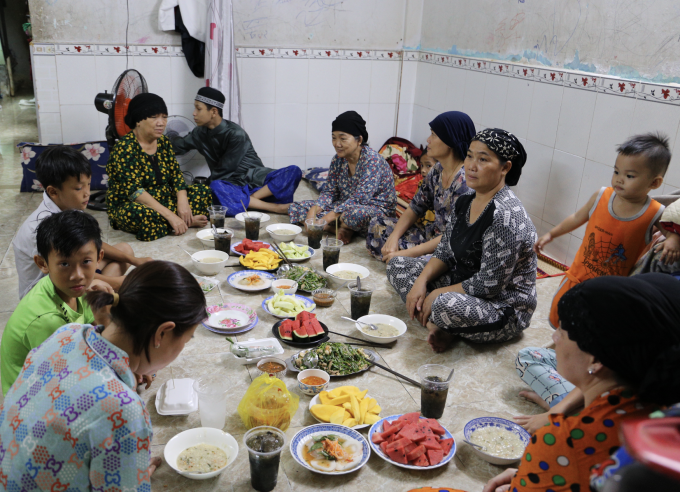
Rophia's family (wearing a white and black floral hat) had their last meal of the day at 6:10 PM on March 13th. Photo: Ngoc Ngan
While the women observe their fasting break, about ten men from the family will go to the Jamiul Anwar Mosque to pray. Wearing kapeaks, shirts, and sarongs, they will recite the Quran together for blessings. Afterwards, they will have a meal at the mosque consisting of cassava bread, porridge, and salad, prepared with ingredients contributed by the people of the parish.
Mr. Haji Kim So, 72 years old, head of the Cham community management board in Anwar district, said that Rophia's family has lived in the area for over 40 years. They are working-class people with difficult economic circumstances , but they live closely together, harmoniously, and lovingly.
Before the break of the fast on the afternoon of March 13th, Rophia reminded her children to quickly clear the plates and bowls, while the grandchildren sat closer together to save space. At exactly 6:10 PM, they raised their glasses as the chanting of prayers echoed from the mosque.
Ngoc Ngan
Source

![[Photo] Prime Minister Pham Minh Chinh holds a phone call with the CEO of Russia's Rosatom Corporation.](/_next/image?url=https%3A%2F%2Fvphoto.vietnam.vn%2Fthumb%2F1200x675%2Fvietnam%2Fresource%2FIMAGE%2F2025%2F12%2F11%2F1765464552365_dsc-5295-jpg.webp&w=3840&q=75)


![[Photo] Closing Ceremony of the 10th Session of the 15th National Assembly](/_next/image?url=https%3A%2F%2Fvphoto.vietnam.vn%2Fthumb%2F1200x675%2Fvietnam%2Fresource%2FIMAGE%2F2025%2F12%2F11%2F1765448959967_image-1437-jpg.webp&w=3840&q=75)












































![[OFFICIAL] MISA GROUP ANNOUNCES ITS PIONEERING BRAND POSITIONING IN BUILDING AGENTIC AI FOR BUSINESSES, HOUSEHOLDS, AND THE GOVERNMENT](https://vphoto.vietnam.vn/thumb/402x226/vietnam/resource/IMAGE/2025/12/11/1765444754256_agentic-ai_postfb-scaled.png)













































Comment (0)