

The Government Inspectorate concluded that the Ministry of Industry and Trade lacked oversight, had lax management, and failed to promptly detect violations in petroleum management.
On the afternoon of January 4th, the Government Inspectorate announced the conclusions of its inspection of petroleum products, highlighting numerous violations by the Ministry of Industry and Trade and several key enterprises in the management and trading of this commodity.
According to the Government Inspectorate, over the past five years, the Ministry of Industry and Trade has issued 37 licenses for the import and export of petroleum products (excluding 4 licenses for aviation fuel) and 347 licenses for retail distribution businesses.
According to Decree 83/2014, one of the conditions for obtaining a license to operate a petroleum distribution business is that they must own or lease petroleum storage facilities from other entities for five years or more. This has led to a situation where businesses and distributors lease storage facilities seasonally in order to obtain licenses. This is one of the reasons for licensing violations by the Ministry of Industry and Trade, according to the inspection report.
In reality, after being granted licenses, many wholesale traders failed to ensure the proper distribution of petroleum products. Many warehouse and storage tank rental contracts did not result in shipments or contract terminations, affecting the market's supply.
"The Ministry of Industry and Trade lacked proper inspection, supervision, and management, and failed to promptly detect violations in maintaining the condition of warehouses, storage tanks, and distribution systems," the inspection report concluded.
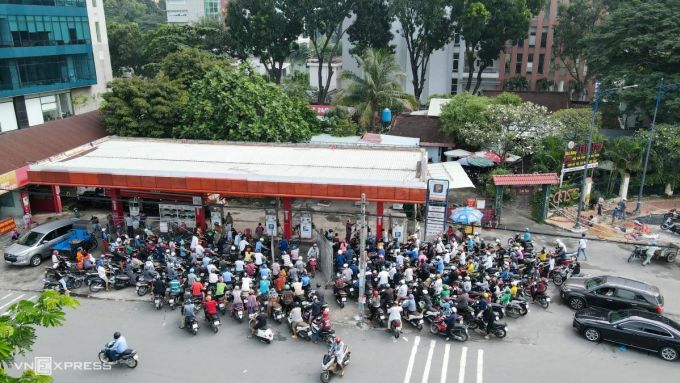
Hundreds of motorbikes and cars surrounded a gas station on To Ky Street, District 12, waiting to refuel, October 2022. Photo: Dinh Van
Besides licensing violations, the management and use of the Fuel Price Stabilization Fund also suffer from many shortcomings . According to the inspection report, the Ministry of Industry and Trade did not promptly suspend business operations or revoke licenses of units that were administratively penalized by the Ministry of Finance, leading to the misappropriation and misuse of the Fuel Price Stabilization Fund by key distributors.
Over the past five years, the Ministry of Industry and Trade and the Ministry of Finance have decided to disburse nearly 1.143 billion VND from the Price Stabilization Fund when fuel prices had not yet increased, and have disbursed over 318 billion VND in stabilization funds exceeding price increases.
Over a period of 1.5 years (from the price adjustment period of January 1, 2017 to April 23, 2018), the price adjustment documents issued by the regulatory agency were unclear, leading to 19 key enterprises incorrectly allocating over 1,013 billion VND to the Fuel Price Stabilization Fund for RON 95 gasoline. These enterprises also misused nearly 680 billion VND from the fund.
According to regulations, the Price Stabilization Fund should only be used in urgent cases, when prices rise unusually high and affect people's lives. However, in reality, the Ministry of Industry and Trade and the Ministry of Finance have been using this fund continuously for extended periods, even when there are no price fluctuations. This has led to a shirking of responsibility and a lack of coordination and division of responsibilities between the Ministry of Finance – the agency in charge of the fund – and the Ministry of Industry and Trade – the coordinating agency in managing the Price Stabilization Fund and inspecting and supervising key petroleum traders.
The Government Inspectorate also pointed out that the State Bank of Vietnam had not issued guidelines for commercial banks to manage the Price Stabilization Fund, leading to seven businesses misusing the fund for price stabilization purposes, totaling over 7,927 billion VND. This money was kept in payment accounts for many periods by the businesses and not transferred to the fund account. Of these, three businesses allocated and spent the Price Stabilization Fund for fuel volumes exceeding their accounting records, resulting in incorrect allocations of nearly 4.8 billion VND and incorrect expenditures of nearly 22.6 billion VND. One business under-allocated funds by over 3 billion VND, and one unit incorrectly implemented accounting principles regarding adjustments to the fund, amounting to nearly 10.3 billion VND.
However, the regulatory authorities (Ministry of Industry and Trade, Ministry of Finance) are unaware of the opening balance, contributions, usage, or interest of this fund at some enterprises, as for three consecutive years, the main enterprises and commercial banks where they opened accounts for the Fuel Price Stabilization Fund have not submitted statements.
2022 was a year of localized supply shortages in the market, with retail stores temporarily closing due to prolonged losses caused by wholesalers cutting their discounts to zero.
In August 2022, when the fuel market was in turmoil and many gas stations displayed "out of stock" signs, the Ministry of Industry and Trade issued a decision to revoke the import licenses of 7 key fuel trading companies for 1-3 months due to violations and failure to meet regulations on the distribution system, and imposed administrative fines of 1.7 billion VND on 11 other units.
The Ministry of Industry and Trade's inspection report at the end of 2022 also pointed out many violations by businesses in the petroleum trading sector, such as not meeting the conditions regarding the distribution system and dealers selling petroleum back to the main distributors. The inspection process at these businesses also revealed that some departments and bureaus under the Ministry had not promptly checked, compared, and reviewed the data, and were slow to detect violations and recommend penalties for businesses within their authority.
Currently, Vietnam has 36 petroleum trading companies (including aviation fuel companies), after the Ministry of Industry and Trade revoked Xuyen Viet Oil's license in August 2023.
* Updates continue
Source link























































































Comment (0)