

The great literary masterpiece of the ages
It's not that later generations are only now honoring the "Proclamation of Victory over the Wu ." Even Confucian scholars after Nguyen Trai had already offered beautiful praise for this timeless masterpiece. In the "Tang Thuong Ngau Luc" by Pham Dinh Ho and Nguyen An, it is written, "His writings possess abundant energy. Around the Thuan Thien era, he composed works such as the 'Proclamation of Victory over the Wu ,' and the inscription on the sacred monument at Vinh Lang in Lam Kinh; all are recorded in the " Thuc Luc" ( Dai Nam Thuc Luc) . - NV ), no need to repeat it again".
After the Lam Son Uprising's complete victory in the year Dinh Mui (1427), following Le Loi's orders, Nguyen Trai composed the Binh Ngo Dai Cao , a heroic and spirited declaration of independence for the nation, "a masterpiece of classical Chinese literature" - according to literary critic Kieu Thanh Que in "The Evolution of Vietnamese Literature" . The proclamation recounted the thousand-year history of Dai Viet's civilization, described the crimes of the Ming invaders, and then summarized the Lam Son Uprising from its hardships and struggles to its triumphant victory. The value of Binh Ngo Dai Cao lies not only in its comprehensive content but also in its national pride and its affirmation of enduring values: "The essence of righteousness lies in ensuring the people's peace," "Using righteousness to overcome brutality / Using humanity to replace tyranny"...
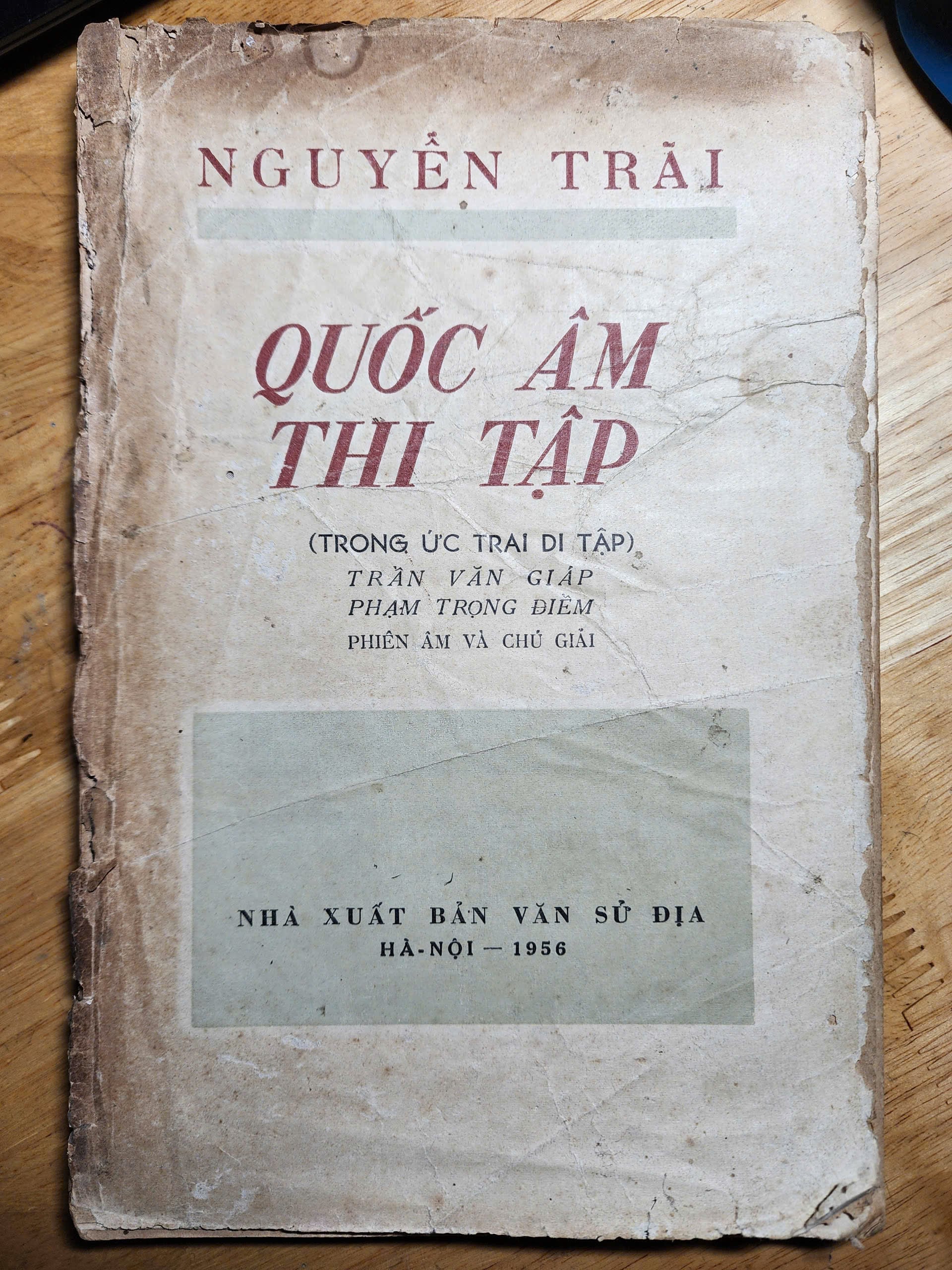
The work Quoc am thi tap by Nguyen Trai, printed in 1956
PHOTO: TRAN DINH BA
The value of the Proclamation of Victory over the Wu (Bình Ngô đại cáo) was highly appreciated by scholar Trần Văn Giáp in his study "Understanding the Collection of Han-Nom Books: Sources of Vietnamese Literary and Historical Materials" : "This proclamation can be considered an epic, clearly recounting the strategies for fighting the enemy, the spirit of the army and people, expressing patriotism, love for humanity, love for peace , and national pride."
Nguyen Trai also left behind a vast body of literary works. Researcher Thanh Lang, in his work "Vietnamese Literature - A Generation of Dedicated and Life-Loving People" (from 1428 to 1505) , compiled a list of his works including: Binh Ngo Dai Cao, Quan Trung Tu Menh Tap, Du Dia Chi, Uc Trai Thi Tap, Uc Trai Di Tap . In addition, there are works that have been lost such as Thach Ban Do, Luat Thu …
Each of his works has received admiration from later generations. For example, the collection of poems by Ức Trai, "the verses are all gentle and virtuous, bringing prestige during the early Lê dynasty. The verses only need to be spirited, not ornate," according to historian Phan Huy Chú in his *Lịch triều hiến chương loại chí* (Historical Records of Dynastic Constitutions ). Or the * Dư địa chí* (Geographical Records) which chronicles the mountains, rivers, territories, products, and tributes of more than a dozen provinces of our country, which writer Trúc Khê Ngô Văn Triện considered "very interesting and informative"...
Insights into the foundations of music
That foremost meritorious official not only devoted himself wholeheartedly alongside General Le Loi and the Lam Son army to drive out the Ming invaders and win independence for the nation. Even when the country was at peace and could have enjoyed leisure, Nguyen Trai remained devoted to the people and the country. He frankly pointed out and named those who were exploiting the people and the nation, such as Nguyen Thuc Hue of the Privy Council and Scholar Le Canh Xuoc, directly rebuking them, saying, "You are the kind of officials who hoard wealth," as quoted in the Complete History of Dai Viet .

Painting of Nguyen Trai, taken at the Temple of Literature - Quoc Tu Giam
PHOTO: TRAN DINH BA
In composing music, he expressed the view that melodious and gentle music is not necessarily good, but that "peace is the root of music"... "I beg Your Majesty to cherish and nurture the people, so that in the villages there will be no more sounds of resentment and sorrow, only then will the root of music not be lost." His message about the "root of music" to King Le Thai Tong in the year Dinh Ty (1437) was truly profound. "Nguyen Trai's words always showed concern for the welfare of the people. King Thai Tong heard it and praised the meaningful advice," Truc Khe noted in his work Nguyen Trai .
Nguyen Trai's view on the "origin of music" also proves another point he once noted about the great role of the people in any dynasty or political regime. In the poem Quan hai ( Closing the sea gate ) of the collection Uc Trai thi tap, Nguyen Trai wrote: "Phuc chu thuy tin dan nhu thuy" , meaning when the boat capsizes, it is clear that the people are like water.
Later, King Le Thanh Tong exonerated him and his family, and in the Quynh Uyen Cuu Ca (Nine Songs of the Royal Garden), there was a verse praising Nguyen Trai: "Uc Trai's heart shines like the Kui star and seaweed." In ancient literature, the Kui star was considered the star of literature, and seaweed was a beautiful aquatic plant. Following this praise, the king also added a note about Nguyen Trai's contributions: "Mr. Uc Trai, from the time when Emperor Thai To first established his dynasty, you came from Loi Giang to help. Internally, you assisted the king in devising strategies and plans. Externally, you drafted edicts and decrees to be issued to the fortresses. These national documents were extremely ornate, which is why the king trusted and valued you so much," as recorded in the Imperial History of Vietnam .
When Le Quy Don wrote about talented and virtuous people in Kien Van Tieu Luc , he still remembered the epitaph of King Le Tuong Duc for Nguyen Trai with the meaning: "When meeting dragons and tigers, remember the old fate, pass on the literary career, to be passed down to future generations." "That sentence is enough to show that the person with the greatest merit in helping the king, cannot be forgotten for a thousand years." ( continued )
Source: https://thanhnien.vn/tinh-tu-dat-viet-hoa-binh-la-goc-cua-nhac-185251209224816177.htm
![[Photo] The captivating scenery of the fragrant maple forest in Quang Tri](/_next/image?url=https%3A%2F%2Fvphoto.vietnam.vn%2Fthumb%2F1200x675%2Fvietnam%2Fresource%2FIMAGE%2F2025%2F12%2F10%2F1765353233198_lan09046-jpg.webp&w=3840&q=75)

![[Photo] Explore the US Navy's USS Robert Smalls warship](/_next/image?url=https%3A%2F%2Fvphoto.vietnam.vn%2Fthumb%2F1200x675%2Fvietnam%2Fresource%2FIMAGE%2F2025%2F12%2F10%2F1765341533272_11212121-8303-jpg.webp&w=3840&q=75)























![[Video] The craft of making Dong Ho folk paintings has been inscribed by UNESCO on the List of Crafts in Need of Urgent Safeguarding.](https://vphoto.vietnam.vn/thumb/402x226/vietnam/resource/IMAGE/2025/12/10/1765350246533_tranh-dong-ho-734-jpg.webp)





















































Comment (0)