

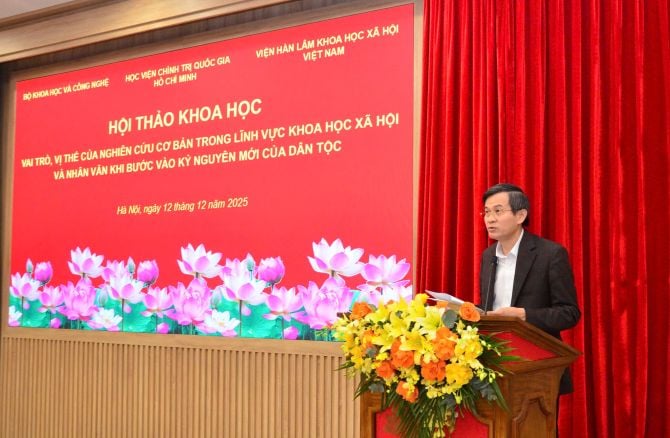
Associate Professor Dr. Doan Minh Huan, Member of the Central Committee of the Communist Party of Vietnam, Permanent Deputy Director of the Ho Chi Minh National Academy of Politics .
Basic research in the social sciences and humanities, therefore, is not only about building knowledge but also about laying the foundation for strengthening values, shaping the future, preserving identity, and proactively adapting to a changing world .
"Operating system" for national policy and strategy
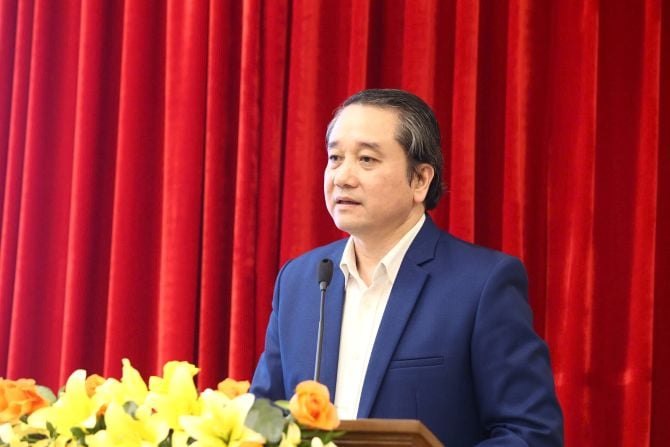
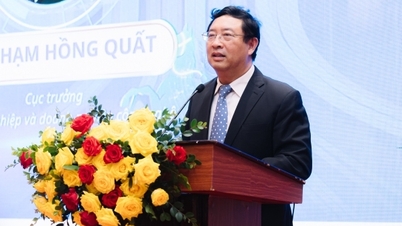
Associate Professor Dr. Dao Ngoc Chien, Director of the National Foundation for Science and Technology Development (NAFOSTED).
According to Associate Professor Dr. Dao Ngoc Chien, Director of the National Foundation for Science and Technology Development (NAFOSTED), empirical evidence and qualitative-quantitative analysis from basic research are crucial inputs for the Party and State in formulating policies on culture, education, social welfare, and institutional reform.
At the same time, basic research provides the theoretical foundation for national development strategies in a volatile global context.
This field also contributes to shaping public opinion, fostering trust, and strengthening community solidarity – vital elements for political stability.
A new historical mission for Vietnamese social sciences and humanities.
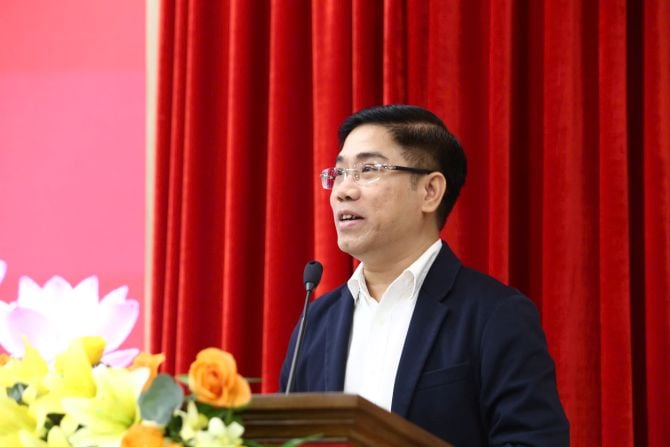
Dr. Dao Ngoc Bau, Ho Chi Minh National Academy of Politics.
However, international integration is posing a new historical mission for Vietnamese social sciences and humanities: the localization of knowledge and the formation of a "Vietnamese Doctrine".
Knowledge localization is not simply the "Vietnamization" of concepts or the illustration of theories with domestic examples, but rather a creative transformation process in which exogenous theories and models are tested, adjusted, and restructured within the specific historical, cultural, political, and social context of Vietnam. Through this process, exogenous knowledge no longer exists as "imposed templates," but becomes a truly effective analytical tool for local issues, while also being enriched in terms of theoretical content.
Based on the systematic and in-depth localization of knowledge, the highest mission of Vietnamese social sciences and humanities is to form a Vietnamese theory. A Vietnamese theory is not merely a summation of practical experience or a collection of isolated research results, but must be a relatively complete scientific theoretical system, encompassing theoretical assumptions, categories and concepts, approaches, and core theses capable of high generalization. More importantly, this theory should not only be valuable within Vietnam but also serve as a reference for the international academic community.
Challenges and investment directions for the future.
Although Vietnam's number of international publications (ISI/Scopus) has increased, with 441 prestigious international articles funded by the NAFOSTED Foundation between 2011 and 2025, the quality of research remains uneven and not closely linked to state management practices. The current evaluation mechanism is still heavily focused on short-term quantitative assessments and does not encourage long-term theoretical research.
Currently, much research in the social sciences and humanities remains fragmented and scattered across educational institutions or groups of individuals, failing to form "academic leaders" capable of guiding large-scale theoretical programs with lasting influence domestically and internationally.
According to Dr. Dao Ngoc Bau of the Ho Chi Minh National Academy of Politics, strategic solutions are needed to elevate the status of basic research in the new era.
Firstly, it is necessary to develop and promulgate a national strategy for the development of social science and humanities theory, linked to the national strategy for science, technology, and innovation development.
Secondly, it is necessary to establish a national-level foundational theoretical research fund, operating under a long-term funding mechanism (5-10 years), relatively independent from the usual administrative project mechanism.
Third, there is a need for fundamental reform of the scientific evaluation mechanism, shifting the focus from "purely quantitative" to "quality, depth, and long-term academic value."
Furthermore, it is necessary to promote interdisciplinary training, connecting social sciences and humanities with fields such as data science, artificial intelligence, and digital technology. Simultaneously, it is crucial to prioritize investment, establish international cooperation programs, and form national-level theoretical research centers.
Investing in basic research in the social sciences and humanities is an investment in the intellectual depth and resilience of the nation. As Associate Professor Dr. Doan Minh Huan emphasized: "Basic research is not only the foundation of knowledge but also the soft power of the nation." Only when Vietnam masters the capacity for theoretical creativity and forms theories with its own unique identity can it proactively shape its development path and affirm its position in the flow of human knowledge.
Source: https://doanhnghiepvn.vn/cong-nghe/vai-role-of-basic-research-in-the-field-of-social-sciences-and-humanities-in-the-digital-era/20251212085858304


![[Photo] Prime Minister Pham Minh Chinh attends the Conference summarizing and implementing tasks of the judicial sector.](/_next/image?url=https%3A%2F%2Fvphoto.vietnam.vn%2Fthumb%2F1200x675%2Fvietnam%2Fresource%2FIMAGE%2F2025%2F12%2F13%2F1765616082148_dsc-5565-jpg.webp&w=3840&q=75)




















































































Comment (0)