

Cold weather when returning home for Tet, consuming cold or spicy foods, irregular daily routines, and excessive use of the voice are factors that cause many people to suffer from rhinitis, pharyngitis, and laryngitis during Tet.
Medical news update February 13th: Increased cases of rhinitis, pharyngitis, and laryngitis after Tet holiday.
Cold weather when returning home for Tet, consuming cold or spicy foods, irregular daily routines, and excessive use of the voice are factors that cause many people to suffer from rhinitis, pharyngitis, and laryngitis during Tet.
Inflammation of the nose, throat, and laryngitis increases after Tet (Lunar New Year).
According to information from an ENT center at a multi-specialty medical facility, the center received nearly 600 patients with rhinitis, pharyngitis, and laryngitis in the first few days of the new year, an increase of about 20% compared to before Tet (Lunar New Year). Common symptoms included fever, cough, loss of voice, hoarseness, runny nose, sore throat, difficulty swallowing, and general body aches.
 |
| During the long Tet holiday, many medical facilities limit their operations, and patients often become complacent, thinking it's just a common cold and self-treating instead of seeking medical attention. |
Many patients, mainly from central and northern Vietnam, returned to the South after the Tet holiday. The main reason for the increase in cases is the cold, rainy weather in the northern and central provinces (around 15–20°C), which weakens the respiratory system.
Furthermore, the sudden change in living environment (from South to North and then back to South) exposes the body to foreign agents, from bacteria and viruses to allergens for which the body has not yet developed immunity.
In addition, unhealthy eating habits such as consuming spicy foods, alcohol, staying up late, or overusing one's voice during Tet celebrations and social gatherings can overload the vocal cords.
During the long Tet holiday, many medical facilities limit their operations, and patients often become complacent, thinking it's just a common cold and self-treating instead of seeking medical attention.
This leads to the disease not being controlled in a timely manner, causing it to become more serious. A typical case is Ms. KPT (30 years old) from Quang Ngai who returned to Ho Chi Minh City for work after Tet with symptoms of severe coughing, loss of voice, yellow phlegm, sore throat, and difficulty swallowing.
The weather in Quang Ngai at that time was quite cold (18–22°C), and coupled with frequent travel, eating spicy food, drinking sugary drinks, staying up late, and not keeping warm, she caught a cold, fever, and cough.
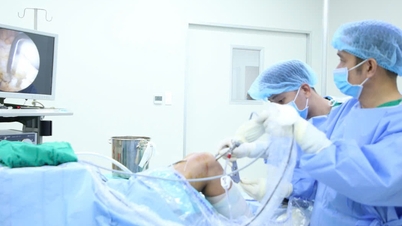
Despite self-medicating with antibiotics and anti-inflammatory drugs for three days, her condition did not improve. She lost her voice and had to go to the hospital for examination. After an endoscopy, the doctor diagnosed her with pharyngitis, laryngitis, and ulcerative colitis.
She was prescribed medication and given instructions on how to treat the condition. Similarly, LVH (7 years old), who returned to Ho Chi Minh City from Hanoi after the Tet holiday, experienced a runny nose, cough, fever, and discomfort due to the temperature change from the cold (15–18°C) in Hanoi to the hot and humid in Ho Chi Minh City (30°C). Her condition worsened when symptoms such as dry cough, insomnia, and high fever appeared. After examination, the doctor diagnosed her with acute nasopharyngitis accompanied by sinusitis.
According to doctors, the sudden temperature change from the North to the South makes it difficult for the body to adapt and weakens the immune system.
Furthermore, crowded gatherings and travel in enclosed spaces such as buses and airplanes increase the risk of viral and bacterial infections. If left untreated, nasopharyngitis can lead to serious complications such as acute sinusitis, bronchitis, or pneumonia.
To prevent post-Tet nasal and throat infections, according to Master's degree holder and specialist doctor Pham Thai Duy from Tam Anh General Hospital in Ho Chi Minh City, people should: keep their noses and throats clean; and keep their throats warm when going outside.
Limit your intake of cold water and opt for warm water or ginger tea with honey; wear a mask when going outside and avoid dry, dusty air; limit spicy foods and avoid speaking loudly or excessively; drink enough water (2 liters/day) and get enough sleep; maintain a healthy lifestyle. If you experience symptoms such as a sore throat, hoarseness, mild fever, or a runny nose lasting more than 3-5 days, you should seek medical attention promptly to avoid dangerous complications.
Joint replacement due to improper treatment of ankylosing spondylitis.
Mr. Hoang, 43 years old, suffered from ankylosing spondylitis but did not adhere to treatment, causing complications such as femoral head necrosis, requiring hip replacement surgery to avoid the risk of disability. Mr. Hoang (Khanh Hoa) discovered the disease 15 years ago but only took medication when the pain flared up, causing the disease to progress severely.
In his daily life, he experienced difficulties due to changes in his gait, difficulty spreading and closing his legs, back stiffness and pain, inability to bend over, and pain radiating down to his left groin…
"The patient's left hip joint was stiffened, with the ability to flex and extend it reduced to only 20-30 degrees," explained Dr. Tran Anh Vu, the specialist who directly treated the patient. He further explained that the patient suffered from chronic ankylosing spondylitis that was not well controlled, causing fusion and stiffness of the cervical vertebrae, lumbar vertebrae, and sacroiliac joints.
The most serious injury is to the left hip joint, leading to femoral head necrosis, causing pain, stiffness, and reduced mobility. Patients face a high risk of disability if they do not undergo artificial hip replacement surgery.
Dr. Vu assessed that Mr. Hoang's hip joint was stiff, making it difficult to choose the correct position during surgery and to expose the hip joint. Through calculations and surgical planning using specialized software like TraumaCad, the doctor replaced the patient's hip joint with an artificial one via a posterior approach.
Each joint component, such as tendons, muscles, and soft tissues, is slowly separated using specialized instruments, minimizing potential damage and exposing the femoral head and acetabulum that were previously fused together.
Another challenge in this case was the complete destruction of the acetabulum, making it difficult to accurately locate the artificial joint. If the artificial joint is misplaced, it could lead to recurrent hip dislocation after surgery. Therefore, repositioning the acetabulum was necessary. The entire surgery lasted 3 hours.
On the second day after surgery, the patient reported a significant improvement in their health, with easier mobility and no more pain, especially at night. The patient was discharged the following day. The prognosis is that, initially, the patient's leg flexion and extension will reach 60-90 degrees. This will then continue to recover to 120 degrees, gradually restoring a natural gait.
According to MSc. Dr. Pham Thi Xuan Thu, Department of Internal Medicine, Orthopedics and Traumatology, Center for Traumatology and Orthopedics, ankylosing spondylitis is a chronic disease characterized by lesions in the sacroiliac joints, spine, limb joints, and even tendon attachment points.
If left uncontrolled, inflammation will prompt the body to repair itself by forming new bone. The presence of these new bone segments narrows the space between joints or vertebrae, eventually causing them to fuse together. At that point, the spine or joints become stiff and lose their natural flexibility, making it difficult for the patient to walk, causing them to feel rigid and unable to bend their back.
Because it is a chronic disease, patients with ankylosing spondylitis must take medication for life. In Mr. Hoang's case, the disease had progressed to a late stage, so he was prescribed biological medication.
This method helps inhibit the inflammatory response, slow disease progression, improve mobility, prevent the formation of bone bridges causing adhesions in other joints, and does not rule out the possibility that artificial hip joints may also have a risk of recurrent stiffness. The earliest and characteristic symptom of ankylosing spondylitis is lower back pain, possibly accompanied by morning spinal stiffness.
The pain typically lasts at least 3 months and can start very early (17-45 years old). The pain does not subside with rest but improves with light exercise. Patients should seek medical attention if they notice any warning signs to receive timely treatment and avoid complications that impair their quality of life.
Patients suffer terribly from allergic rhinitis.
Allergic rhinitis is a condition where the nose overreacts to allergens such as pollen, fine dust, and animal dander. While not life-threatening, it causes significant discomfort and reduces the patient's quality of life.
Ms. NBG (30 years old, Ho Chi Minh City) experienced constant tearing and runny nose, sneezing, nasal congestion, a red nose tip, and a dry cough after her mother offered lilies and chrysanthemums as offerings.
At its worst, she also experienced shortness of breath and a dry cough. Nasal congestion made it difficult for her to breathe, forcing her to breathe through her mouth, which led to a sore throat. "Every year around Tet (Lunar New Year), my chronic allergic rhinitis flares up, and I have to go to the hospital," Ms. G. said.
For example, Mr. VNK (34 years old), who lives and works in South Korea, is well aware of his pollen allergy. Every flowering season, especially during the Lunar New Year and spring, his condition recurs.
This time, upon returning home, near Tet (Lunar New Year), contact with the flowers decorating his parents' and relatives' houses triggered a relapse of his allergic rhinitis. Mr. K. experienced watery eyes and runny nose; itchy eyes; swollen eyelids; sneezing, and nasal congestion.
He took medication to relieve symptoms, but he felt lethargic and tired. “Near Tet (Lunar New Year), people came to visit bringing apricot blossoms and lilies. Those scents made me sneeze incessantly, to the point where I had to ‘isolate’ myself in my bedroom,” Mr. K. said.
Fearing his condition might worsen during the Lunar New Year holiday, Mr. K. went for a check-up. An endoscopic examination of the ear, nose, and throat revealed no anatomical abnormalities. He was prescribed medication and given instructions on how to care for his nose and throat, lifestyle, and diet to prevent allergic rhinitis recurrence and reduce pollen allergy symptoms.
According to doctors, chronic, untreated allergic rhinitis can affect the sense of smell (reduced or lost ability to detect smells) or cause snoring due to inflammation and edema of the nasal and pharyngeal mucosa.
In some cases, chronic allergic rhinitis can lead to degeneration and edema of the nasal mucosa, and hypertrophy of the turbinates, requiring surgery. Surgery may also be considered if the doctor detects nasal polyps or anatomical abnormalities such as a deviated septum that worsen allergic rhinitis.
If allergic rhinitis symptoms flare up frequently, patients should see a doctor for treatment; at the same time, they should strengthen their immune system, eat and rest properly, avoid stress, and do light exercise.
If allergic rhinitis becomes complicated by bacterial infection, the patient must take medication as prescribed by a doctor. Without proper treatment, the condition can become prolonged and worsen, leading to complications such as acute and chronic sinusitis and nasal polyps; it also incurs higher costs, reduces financial resources, and lowers the quality of life.
To prevent allergies, people should avoid contact with allergens. Those prone to pollen allergies should keep doors and windows closed to prevent dust and pollen from entering their bedrooms; and regularly clean dust from tables, chairs, shelves, cabinets, and floors.
When you need to be outdoors, you should wear a mask to avoid inhaling pollen, and avoid visiting flower gardens where pollen and spores are easily dispersed.
If you are allergic to incense smoke, you can wear a mask when lighting incense, avoid staying in the worship room for too long, do not burn entire sticks but only one at a time, and rinse your eyes and nose with saline solution if the incense smoke causes irritation.
Source: https://baodautu.vn/tin-moi-y-te-ngay-132-viem-mui-hong-viem-thanh-quan-tang-sau-tet-d246000.html
![[Live] 2025 Community Action Awards Gala](/_next/image?url=https%3A%2F%2Fvphoto.vietnam.vn%2Fthumb%2F1200x675%2Fvietnam%2Fresource%2FIMAGE%2F2025%2F12%2F16%2F1765899631650_ndo_tr_z7334013144784-9f9fe10a6d63584c85aff40f2957c250-jpg.webp&w=3840&q=75)
![[Image] Leaked images ahead of the 2025 Community Action Awards gala.](/_next/image?url=https%3A%2F%2Fvphoto.vietnam.vn%2Fthumb%2F1200x675%2Fvietnam%2Fresource%2FIMAGE%2F2025%2F12%2F16%2F1765882828720_ndo_br_thiet-ke-chua-co-ten-45-png.webp&w=3840&q=75)
![[Photo] Prime Minister Pham Minh Chinh receives the Governor of Tochigi Province (Japan)](/_next/image?url=https%3A%2F%2Fvphoto.vietnam.vn%2Fthumb%2F1200x675%2Fvietnam%2Fresource%2FIMAGE%2F2025%2F12%2F16%2F1765892133176_dsc-8082-6425-jpg.webp&w=3840&q=75)

![[Photo] Prime Minister Pham Minh Chinh receives Lao Minister of Education and Sports Thongsalith Mangnormek](/_next/image?url=https%3A%2F%2Fvphoto.vietnam.vn%2Fthumb%2F1200x675%2Fvietnam%2Fresource%2FIMAGE%2F2025%2F12%2F16%2F1765876834721_dsc-7519-jpg.webp&w=3840&q=75)
































































































Comment (0)