

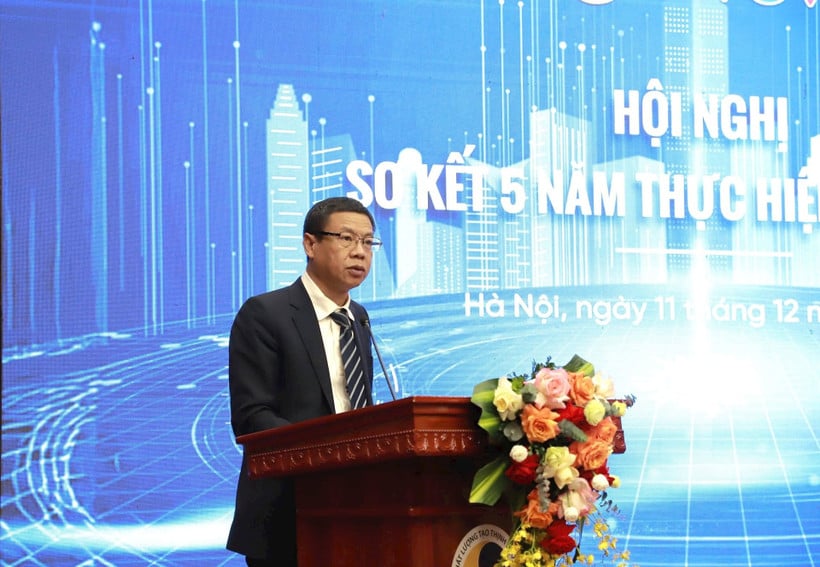
On the morning of December 11th in Hanoi, the Voice of Vietnam (VOV) online newspaper, in collaboration with the National Barcode Center and the National Committee for Standards, Metrology and Quality (Ministry of Science and Technology), organized a conference to review the first five years of implementing the Government's Project 100.
In his opening remarks at the conference, Mr. Nguyen Nam Hai, Chairman of the National Committee for Standards, Metrology and Quality, stated that over the past five years, the implementation of Project 100, as directed by the Prime Minister , has led to a significant transformation in traceability activities.
From its initial pilot stages, the traceability system has gradually developed into a unified data infrastructure, connecting multiple ministries and agencies, and spreading to localities and businesses nationwide. The results achieved not only contribute to improving the effectiveness of state management of product and goods quality but also pave the way for transparent and safe trade, strengthening consumer confidence domestically and meeting the increasingly high demands of the international market.
Entering a phase of deep integration, especially as major markets like the EU, the US, and Japan adopt new regulations on eco-design, digital product passports, and mandatory traceability, Vietnam increasingly needs to assert its position through advanced standards, reliable data systems, and the capacity to connect open, sustainable, and digitized supply chains. This presents both challenges and opportunities for Vietnamese goods to move faster and more firmly into the global supply chain.
According to Mr. Pham Manh Hung, Deputy General Director of the Voice of Vietnam, in an increasingly fierce and volatile competitive environment, traceability is not only a technical requirement but also a measure reflecting the level of development of a nation. Vietnam cannot stand outside this trend. To enhance the value of goods, strengthen national brands, and assert its position in the international market, it is necessary to build a modern, digitized, data-driven management platform with cross-border connectivity.
Therefore, Prime Minister's Decision 100 is a strategically significant policy, creating a foundation for us to build a modern, unified, and efficiently operating traceability system; strongly promoting digital transformation in production and business; and simultaneously enhancing consumer confidence both domestically and internationally.
It can be said that traceability is the "digital passport" that guarantees the credibility and quality of Vietnamese goods when participating in regional and global value chains.
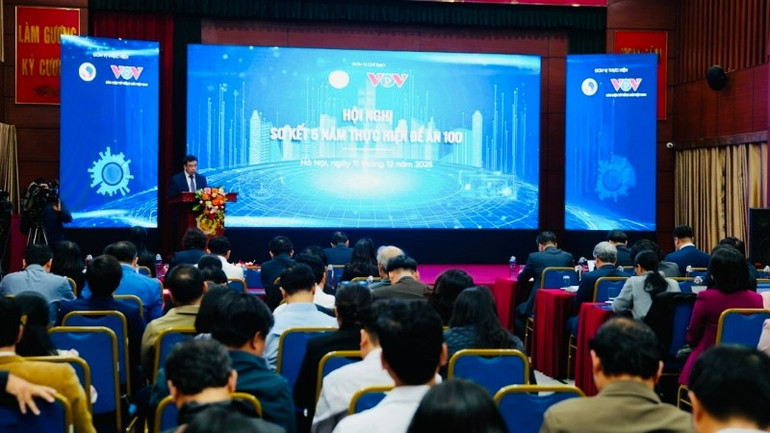
According to Mr. Bui Ba Chinh, Director of the National Barcode Center (Ministry of Science and Technology), over the past five years, the implementation of product traceability at the local level has seen many positive changes.
Local authorities have implemented various practical forms of support, the most common of which are issuing stamps and QR codes, subsidizing application costs, and providing technical assistance. The National Product and Goods Traceability Portal was officially launched on October 1, 2024, acting as a bridge to connect all participants in the supply chain, between ministries, sectors, localities, and businesses.
Currently, 13 provinces and cities have traceability information management systems technically connected to the Portal, with 4 localities connecting and sharing data with the Portal including: Lao Cai, Hung Yen, An Giang, and Can Tho; 100% of businesses use Vietnamese barcode numbers (starting with 893) with over 1.9 million products identified on the Portal, and more than 5000 products with complete supply chains connected and sharing data with the Portal.
Although relatively good results have been achieved, they are still uneven, with some localities only having issued plans or implemented them to a limited extent. Some sectors such as agriculture, fisheries, and processed foods have achieved positive results, but there is still a significant gap in sectors such as small-scale production, traditional crafts, and traditional distribution. In addition, the digital infrastructure is not yet synchronized, initial investment costs remain high, traditional production habits persist, and the lack of interconnected systems creates difficulties in data management.
Speaking at the event, Deputy Minister of Science and Technology Le Xuan Dinh emphasized: After 5 years of implementation, Project 100 has proven the correctness of a major policy. The past 5 years have been a journey of continuous effort by management agencies, ministries, localities, the business community, experts and the team of scientists.
From a relatively new concept in the field of product traceability, Vietnam has now built a policy framework, implementation models, and a relatively synchronized interconnected system that contributes to product information transparency, consumer protection, and enhanced competitiveness of Vietnamese goods.
The Deputy Minister stated that the world is changing very rapidly, with many major export markets requiring mandatory standards regarding information, environment, and sustainability. Resolution 57 of the Politburo has placed science and technology, innovation, and digital transformation as strategic breakthroughs. This creates tremendous opportunities for us to make traceability the backbone of quality management and a driving force for the development of a modern production and business ecosystem.
To implement traceability activities more effectively, Deputy Minister Le Xuan Dinh suggested that in the future, it is necessary to build a national traceability system that achieves standardized data, is interconnected across multiple sectors, and is internationally linked. The application should shift from technical connections to national data interoperability. At the same time, it must be ensured that all key product sectors, from agriculture, industry, pharmaceuticals to consumer goods, apply traceability according to a unified national standard.
"These directions need to be implemented faster, more decisively, and more synchronously. In the coming period, Project 100 must shift from implementation to breakthrough and from pilot to standardization," the Deputy Minister stated.
At the conference, the organizing committee also honored and presented certificates to the following localities and businesses: the Department of Science and Technology of Lao Cai province, the Department of Science and Technology of An Giang province, the Department of Science and Technology of Hung Yen province, the Department of Science and Technology of Can Tho province, Checkee Technology Joint Stock Company, and Icheck Trace Joint Stock Company. These are the units that have successfully connected to the national product and goods traceability portal.
Source: https://nhandan.vn/xay-dung-he-thong-truy-xuat-nguon-goc-quoc-gia-dat-chuan-post929592.html
![[Photo] Closing Ceremony of the 10th Session of the 15th National Assembly](/_next/image?url=https%3A%2F%2Fvphoto.vietnam.vn%2Fthumb%2F1200x675%2Fvietnam%2Fresource%2FIMAGE%2F2025%2F12%2F11%2F1765448959967_image-1437-jpg.webp&w=3840&q=75)













![[Video] Secretary General of the National Assembly presides over international press conference announcing the results of the 10th Session](https://vphoto.vietnam.vn/thumb/402x226/vietnam/resource/IMAGE/2025/12/11/1765457358315_img-2357-6607-png.webp)





















![[OFFICIAL] MISA GROUP ANNOUNCES ITS PIONEERING BRAND POSITIONING IN BUILDING AGENTIC AI FOR BUSINESSES, HOUSEHOLDS, AND THE GOVERNMENT](https://vphoto.vietnam.vn/thumb/402x226/vietnam/resource/IMAGE/2025/12/11/1765444754256_agentic-ai_postfb-scaled.png)











































Comment (0)