


According to Mr. Nguyen Quoc Manh, Deputy Director of the Department of Crop Production and Plant Protection, the agricultural sector estimates that banana production will reach 3 million tons by 2030. - Photo: VGP/Do Huong
Towards a billion-dollar agricultural product.
Many experts believe that, with effective production organization and disease control, Vietnam's banana export value could reach $1 billion in the near future.
According to banana growers and exporters, the global banana industry currently has a size of approximately US$15.3 billion (in 2024) and is projected to reach US$21 billion by 2030. Vietnam has risen to 9th place in the world in banana production, however, the export value is only about US$380 million, representing a very modest share of the global total.
In the Chinese market alone, Vietnam has gradually caught up with the Philippines – its biggest competitor – but its market share currently stands at less than 40%. Meanwhile, in Japan, despite Vietnamese bananas being highly regarded by consumers, its market share remains at only around 3%. In South Korea, despite advantages from free trade agreements and geographical proximity, Vietnam's banana market share has not yet reached 17%. These figures show that there is still significant growth potential for Vietnamese bananas, especially in key Asian markets such as China, Japan, and South Korea.
According to statistics, by 2025, the total banana cultivation area nationwide is estimated to reach over 163,000 hectares, with a production of approximately 2.75 million tons. In 2024 alone, banana exports reached nearly 372 million USD, further affirming its role as one of the key export fruit items and demonstrating significant growth potential.
According to information from the Ministry of Agriculture and Environment, the Project for the Development of Key Fruit Crops until 2025, with a vision to 2030, has identified bananas as one of the key commodities. Bananas are currently a high-value economic crop, ranking among the fruit crops with the largest planted area in Vietnam. However, current export value is still not commensurate with the scale of production and potential, especially when compared to countries in the region that have built stable export banana value chains, linked to high quality standards and strict disease control.
In recent years, Vietnam has seen the emergence of several businesses that have invested systematically in the banana industry, forming concentrated raw material areas, applying standardized technical processes, and strongly focusing on the export market.
According to Mr. Nguyen Quoc Manh, Deputy Director of the Department of Crop Production and Plant Protection, the plan for developing key fruit crops by 2025, with a vision to 2030, projects banana cultivation to reach 165,000-175,000 hectares, yielding 2.6-3 million tons. Thus, the Vietnamese banana industry has basically achieved the targets set for the period up to 2030. The future development direction for the banana industry is to build a sustainable production system that increasingly meets the stringent requirements of new and expanding export markets.
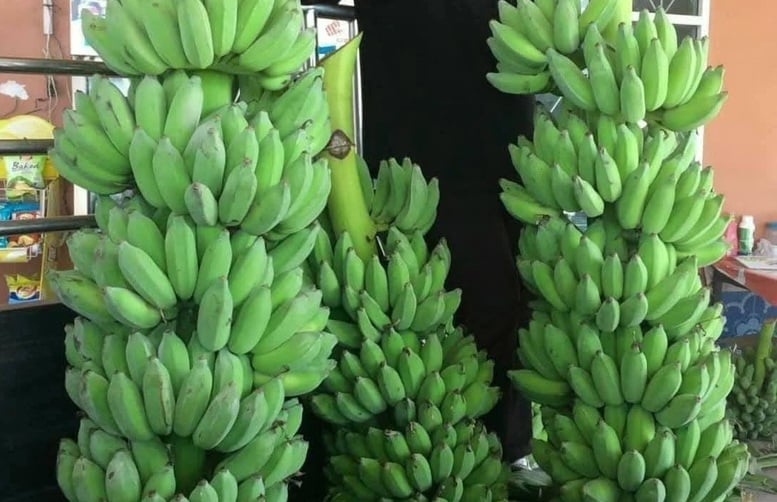
The banana leaf wilt disease is posing a threat to the development of this promising product - Photo: VGP/Do Huong
Removing barriers from the pandemic.
Many opinions expressed at the forum "Finding solutions to control banana wilt disease," held today, December 13th, by the Department of Crop Production and Plant Protection, Ministry of Agriculture and Environment, suggested that it is time to adjust the approach to managing the banana industry.
Mr. Nguyen Quoc Manh stated that the Ministry of Agriculture and Environment is urgently revising Circular 17/2019/TT-BNNPTNT to adjust the main crop groups. The goal is to expand the self-declaration mechanism for the circulation of new varieties to include several high-economic-value crops, including bananas, in order to shorten the time it takes to introduce new varieties into production.
According to Mr. Manh, amending Circular 17 is not just about adjusting legal and technical aspects, but also about addressing bottlenecks that have become apparent in practice. In the context of rapid development in many sectors, especially fruit trees, the overly strict management mechanism based on the list of main crops is slowing down the commercialization of varieties, causing missed market opportunities.
"The ultimate goal is for good seeds to reach producers as quickly as possible, creating real economic value, instead of being stuck in bureaucratic procedures for too long," Mr. Mạnh emphasized.
Opinions expressed at the Forum indicated that the proposal to remove bananas from the list of major crops is not an arbitrary loosening of management, but rather an adjustment of policy towards greater flexibility and suitability to the practical development of the industry. If implemented synchronously, along with the issuance of procedures for controlling banana wilt disease and strengthening the management of disease-free varieties, this could be an important step for the Vietnamese banana industry to overcome challenges, move towards sustainable development, and increase export value in the future.
Mr. Le Quoc Doanh, former Deputy Minister of Agriculture and Rural Development and Chairman of the Vietnam Horticultural Association, emphasized that the outbreak and spread of banana wilt disease is becoming the biggest obstacle, directly threatening the sustainability of the industry.
According to Mr. Doanh, the worrying issue is not a lack of research or technical solutions. In fact, research institutes, businesses, and experts have discussed various measures in great detail. The fundamental shortcoming is the lack of an officially issued procedure for controlling banana wilt disease.
Based on his experience in replanting coffee in the Central Highlands, he believes that to address complex disease problems, it requires the accumulation of scientific knowledge from research institutes and universities, along with decisive leadership from the government.
Regarding banana varieties, Mr. Doanh assessed that disease-free and disease-resistant varieties play a particularly important role in controlling Panama disease. The effectiveness of resistant varieties has been proven in practice, but variety management remains lax, lacking standardized procedures and mechanisms. This leads to the risk of counterfeit or substandard varieties, posing significant risks to production and to banana growers themselves.
Do Huong
Source: https://baochinhphu.vn/xuat-khau-chuoi-cua-viet-nam-hoan-toan-co-the-cham-moc-1-ty-usd-102251213133624358.htm
























































































Comment (0)