

(NLĐO) - What scientists describe as a "radio-jet monster" stretching 215,000 light-years, comes from an extremely terrifying ancient object.
According to Sci-News , a "monster" radio burst originating from a quasar, also considered one of the most monstrous in the early universe, has been simultaneously detected by multiple international observatories, including the Low Frequency Array (LOFAR), the Gemini North telescope, and the Hobby Eberly telescope.
Spanning 215,000 light-years, this is the most powerful radio beam from the early universe ever to reach the "all-seeing eye" of Earth's observatories.
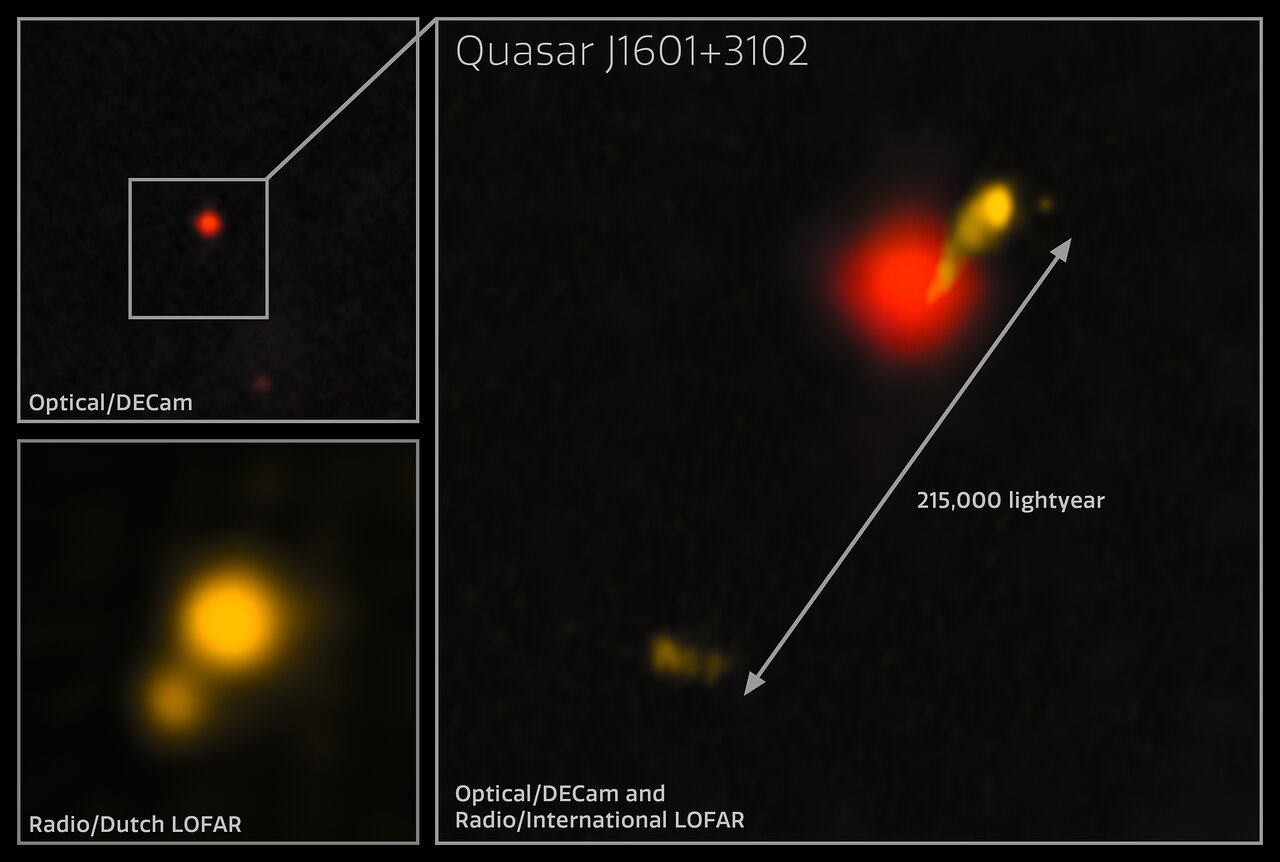
The images captured by LOFAR show the terrifying radio burst and the quasar that emitted it, both of which are "monsters" in the universe - Photo: LOFAR NOIRLab
According to Dr. Anniek Gloudemans from the NOIRLab of the U.S. National Science Foundation (NSF), the monstrous cosmic ray was discovered while they were using astronomical observation facilities to search for quasars emitting powerful jets in the early universe.
This aims to help understand when this type of radio radiation first appeared and its impact on the formation and early evolution of galaxies.
These rays also reflect characteristics of the quasar, such as its mass and rate of matter consumption, which are essential for understanding its formation history.
Quasars are essentially black holes "disguised" as stars, due to their extremely high consumption of matter. They are often the nuclei of galaxies.
The record-breaking radio beam was detected when they directed it toward J1601+3102, a quasar located in spacetime when the universe was only 1.2 billion years old.
That was about 12.6 billion years ago, because our universe is now over 13.8 billion years old.
Light naturally needs time to reach Earth. Therefore, using telescopes to observe objects billions of light-years away is also capturing images of those objects in the past, when they were still pristine and had not been pushed too far away by the expansion of the universe.
While the quasars we observe recently may have masses billions of times greater than the Sun, this ancient quasar was quite small, weighing only 450 million times the mass of the Sun.
The radio waves emitted from the two faces of this quasar are asymmetrical in both brightness and wavelength, suggesting they may be affected by the harsh environment and significantly different on either side of the black hole's plane.
A paper published in the scientific journal Astrophysical Journal Letters concludes that in the early universe, massive radio bursts could be created without the need for excessively large black holes.
This evidence adds to a growing body of evidence suggesting that the early universe was wilder than we imagined, with powerful processes and "monster" objects operating in ways that may no longer exist today.
Source: https://nld.com.vn/3-dai-thien-van-bat-duoc-tia-vo-tuyen-cuc-la-tu-quai-vat-126-ti-tuoi-196250208083740169.htm
































![[Video] The craft of making Dong Ho folk paintings has been inscribed by UNESCO on the List of Crafts in Need of Urgent Safeguarding.](https://vphoto.vietnam.vn/thumb/402x226/vietnam/resource/IMAGE/2025/12/10/1765350246533_tranh-dong-ho-734-jpg.webp)
































































Comment (0)