

80% of investors have not yet used digital asset management services.
On the morning of July 8th in Ho Chi Minh City, Thien Viet Securities Joint Stock Company (Stock code: TVS) held its 2025 investor conference.
At the event, Mr. Bui Thanh Trung - Senior Vice General Director of Thien Viet Securities Company (TVS) - shared the results of a 2025 survey conducted by Thien Viet Fund Management Company with 579 participating investors in 5 major cities in Vietnam. The report provides a clear picture of the behavior and trends in personal asset management among Vietnamese people.
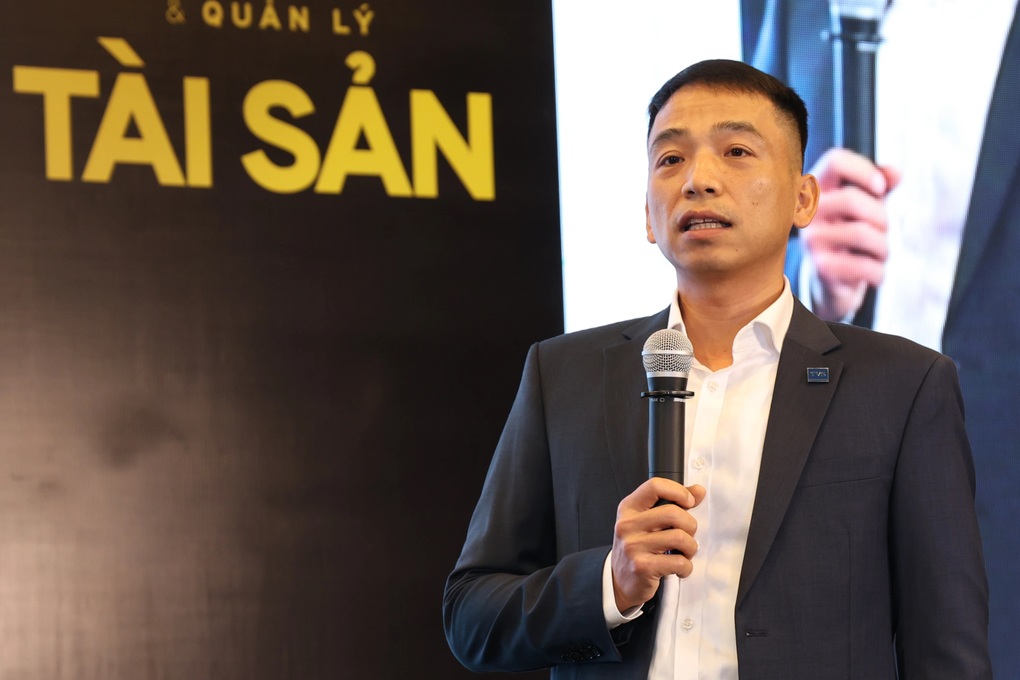
Mr. Bui Thanh Trung (Photo: Organizing Committee).
According to Mr. Trung, the proportion of assets allocated to listed stocks in Vietnam is still quite low compared to many developed markets. Specifically, this ratio in the US and Singapore usually exceeds 30%, in China it is around 25%, while in Vietnam and Thailand it is only around 17%.
Vietnamese consumers still prioritize traditional channels, most notably real estate, which accounts for 31% of their asset portfolio, and gold at around 14%. This reflects a preference for tangible assets, things that can be seen and touched, such as houses, land, gold, watches, paintings, wine, or antiques.
However, Mr. Trung noted that as people's incomes increase, investment trends will also shift towards more modern approaches, especially increasing the proportion of investment in highly liquid assets such as stocks and mutual funds - similar to the trend in developed countries.
Over the past five years, the three main investment channels have remained real estate, gold, and stocks. Some investors have also begun to show interest in alternative assets such as collecting, but the proportion is still small. This trend is expected to accelerate thanks to improvements in income and financial literacy.
Regarding profit expectations, over 80% of investors surveyed aspire to achieve a return of 7% or more per year. Of these, 41% expect returns between 7% and 15%, while 42% aim for returns between 15% and 30%.
Despite high expectations, 77% of survey participants reported difficulty identifying suitable investment channels and developing long-term financial plans. From this, Mr. Trung identified two prominent needs of investors today: firstly, access to professional financial advice, and secondly, access to new investment channels beyond traditional options.
However, accessing new investment channels still faces many obstacles. Many investors lack information, are concerned about legal risks, are unsure about the actual effectiveness, or are unclear about investment procedures.
Only about 16% of investors aware of personal asset management have ever used or are currently using digital investment platforms. The majority of investors' obstacles stem from various reasons such as wanting to invest independently, fear of personal data leaks, lack of transparency regarding costs, or feeling that digital products are not truly suited to their needs.
In particular, many people still prefer the guidance of expert consultants rather than relying entirely on technology platforms or artificial intelligence in their investment decision-making process.
Also at the event, Ms. Nguyen Anh Vien Phuong - Director of the Priority Clients Division, Standard Chartered Bank Vietnam - noted that Vietnamese investors' investment portfolios are still concentrated in traditional channels and are less diversified compared to developed countries.
In Vietnam, gold accounts for 15-20% of investment portfolios, primarily in physical form. In contrast, in Singapore or Hong Kong (China), this percentage is almost zero, and if present at all, it's "paper" gold.
Real estate investment also accounts for a large proportion, around 50%, while in developed markets like Singapore and Hong Kong it only fluctuates between 20-30%. Conversely, the proportion of stock market investment in Vietnam is still below 15%, while in open markets like Singapore and Hong Kong it reaches 30-60%.
According to Ms. Phuong, one reason is that Vietnamese people still have limited financial literacy – only about 25% of the population has basic financial understanding, compared to 60-70% in developed countries. However, with the current economic growth rate, Ms. Phuong believes that Vietnam will gradually narrow this gap.
How do Gen X and Gen Z manage their finances differently?
Mr. Tu Tien Phat, General Directorof ACB , believes that in today's flat world, the financial differences between generations are narrowing. Generation X (born 1965–1980) and Generation Z (1997–2012) are not entirely opposite in financial behavior as many people think.
Mr. Phat observed that while both generations share similarities, significant differences still exist. Gen X tends to choose safe investments such as real estate and long-term stocks, and often borrows capital for larger goals. Conversely, Gen Z is more flexible, prefers to experiment with new financial instruments, and often acts quickly when investment opportunities arise.
From another perspective, Mr. Do Quang Thuan - Standing Deputy General Director of MoMo Financial Services Joint Stock Company - said that Gen Z has a completely new approach to finance. They are willing to deposit savings online with just 1 million VND, something that previous generations rarely did.
For Gen Z, financial management is not just about efficiency but also about the experience, like "learning through play." Practices such as tracking daily expenses, optimizing cash flow, or automatically transferring money to online savings accounts are becoming increasingly common.
Source: https://dantri.com.vn/kinh-doanh/77-nha-dau-tu-gap-kho-khan-khi-tu-quan-danh-muc-tai-san-20250708162035003.htm

![[Image] Vietnam's colorful journey of innovation](/_next/image?url=https%3A%2F%2Fvphoto.vietnam.vn%2Fthumb%2F1200x675%2Fvietnam%2Fresource%2FIMAGE%2F2025%2F12%2F14%2F1765703036409_image-1.jpeg&w=3840&q=75)




























































![[Image] Vietnam's colorful journey of innovation](https://vphoto.vietnam.vn/thumb/402x226/vietnam/resource/IMAGE/2025/12/14/1765703036409_image-1.jpeg)






























Comment (0)