

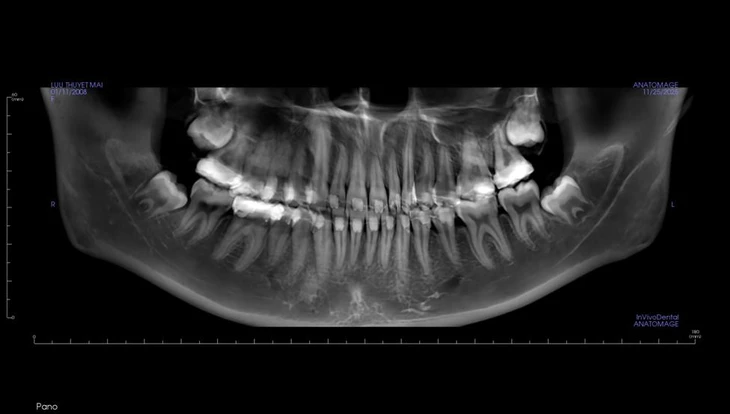
On the X-ray, the patient has 4 impacted wisdom teeth that need to be extracted - Photo: BSCC
Because when this tooth grows, the jawbone has stabilized, in most cases there is not enough room for the wisdom tooth to develop normally. As a result, the tooth can grow crooked, causing gingivitis, cavities in adjacent teeth, bone loss, or prolonged pain in the jaw angle area.
According to statistics from the American Association of Maxillofacial Surgeons, more than 70% of adults have to have at least one wisdom tooth extracted. This is a common procedure, but if not properly cared for, patients may experience complications such as swelling, pain, bleeding, and infection of the tooth socket after extraction. So how to safely extract wisdom teeth and recover quickly?
The first 24 hours - the "golden" period that determines wound healing
Immediately after tooth extraction, the body forms a blood clot in the socket. This is a “natural shield” that protects the underlying bone and nerves, helping to initiate the healing process. If the blood clot is dislodged by vigorous rinsing, spitting, smoking, or drinking hot beverages, the patient may develop dry socket – a complication that causes severe pain and slows healing.
Instructions for care after tooth extraction:
- Bite the gauze firmly for 30-45 minutes, do not change the gauze continuously.
- Do not rinse your mouth continuously, do not smoke, do not drink alcohol, do not spit. When using antibacterial mouthwash, gargle and spit gently.
- Do not use your tongue to touch the tooth socket area to see if it hurts.
- Apply cold compresses to the cheek area for 15 minutes at a time for the first 3-4 hours to reduce swelling.
- Take medication exactly as directed by your doctor, do not increase or decrease the dose on your own.
- Rest, avoid bending over, do not exercise vigorously.
"Many people think tooth extraction is just a simple surgery, but in fact the first 24 hours are the deciding factor in whether the tooth socket heals well or not."
Monday to Saturday - Be Careful and Patient
After 48 hours, soft tissue begins to regenerate and swelling gradually decreases. However, the patient still needs proper care to support the body's recovery.
Things to do:
- After 2 days, you can rinse your mouth gently with diluted salt water.
- Eat soft, cold foods, prioritize easy-to-chew foods such as porridge, soup, eggs, and yogurt.
- Clean teeth gently, avoiding touching the tooth socket.
- Drink enough water, avoid coffee, carbonated drinks, and spicy foods.
When should I see a doctor soon?
- Swelling does not decrease or increases after the 3rd day.
- Pain spreading to the ear, bad breath, heavy bleeding, fever.
- Unusual numbness or pain that lasts for a long time.
"If after three days the pain doesn't improve but increases, that's a sign you should go back to see your doctor immediately."
After 1-2 weeks - The tooth socket gradually stabilizes but do not be subjective: About 7-10 days after tooth extraction, soft tissue has covered the tooth socket. However, the bone inside the tooth socket is still regenerating during the next 6-8 weeks. Therefore, even if there is no more pain, the patient should not skip a follow-up visit or eat hard, chewy foods too soon.
During surgery, supportive technologies such as low-power lasers or PRF (platelet-rich plasma) membranes can help speed up the healing process and reduce swelling and pain.
Common complications and how to recognize them
1. Dry socket: Sharp pain, bad breath, feeling of bare bones. Need to return for examination to wash the tooth socket, apply anti-inflammatory and pain-relieving medication.
2. Tooth socket infection: Redness, swelling, spreading pain, mild fever, pus. Antibiotics should be used as directed.
3. Nerve damage: The patient has signs of numbness in the lips, chin or tongue. This is often seen in lower wisdom teeth with roots close to the lower dental nerve canal or embedded in the lower dental canal. This case requires monitoring and supportive treatment with vitamin 3B, laser and other measures.
Most complications come from the patient's subjectivity or improper hygiene. Therefore, consider the doctor's instructions as a 'prescription' for post-operative care.
Notes for special patient groups
Patients with underlying diseases such as diabetes, heart disease, high blood pressure, etc. need to have their disease controlled before extraction. After surgery, blood sugar should be monitored and underlying medications should not be stopped on their own.
Pregnant women: Tooth extraction should not be done during the first and last three months of pregnancy. The safest time is during the second trimester. If medication is needed, it must be specifically prescribed by a doctor.
Elderly: Healing is slower due to poor blood circulation. Take vitamin C supplements, eat enough protein, and return for follow-up appointments.
Five common mistakes after wisdom teeth extraction
1. Gargle with concentrated salt water: Causes pain and dissolves blood clots.
2. Drink hot water or eat hot porridge: Dissolve blood clots and stop bleeding.
3. Stopping the medication early: Causes inflammation to recur.
4. Using leaves or folk remedies on your own: Can easily lead to serious infection.
5. Not returning for check-ups as scheduled: Complications are not detected promptly, so if complications do occur, the problem becomes more serious.
A successful wisdom tooth extraction depends not only on the doctor’s skills, but also on the patient’s cooperation and understanding. Therefore, the patient needs to follow the doctor’s instructions.
Prevent complications before extraction
To prevent complications after tooth extraction, you need to pay attention and do the following: (1) Examine and take 3D Cone Beam CT to determine the position of the tooth and nerve, thereby predicting the surgical method as well as preventing complications. (2) Clean your mouth thoroughly before surgery to reduce bacteria. (3) Inform your doctor about your medical history and medications you are taking. (4) Keep your mind relaxed, get enough sleep, and eat a light meal before extraction.
With proper preparation, wisdom teeth extraction today is quick, safe, and patients usually recover well in just a few days.
We need to understand correctly so as not to be afraid of wisdom tooth extraction. Wisdom tooth extraction is not as scary as many people think, although all surgical interventions have hidden unexpected incidents.
To avoid complications after tooth extraction, the problem is not "difficult or easy to extract teeth", but the understanding and cooperation of the patient. A proactive attitude, compliance with instructions and timely follow-up visits will help the recovery process to be quick, gentle and safe. Understanding is the best medicine to help you avoid complications after wisdom tooth extraction.
Source: https://tuoitre.vn/bac-si-huong-dan-tranh-sai-lam-sau-nho-rang-khon-vi-khach-den-muon-nhieu-phien-toai-20251202090123812.htm



![[Photo] Parade to celebrate the 50th anniversary of Laos' National Day](/_next/image?url=https%3A%2F%2Fvphoto.vietnam.vn%2Fthumb%2F1200x675%2Fvietnam%2Fresource%2FIMAGE%2F2025%2F12%2F02%2F1764691918289_ndo_br_0-jpg.webp&w=3840&q=75)
![[Photo] Worshiping the Tuyet Son statue - a nearly 400-year-old treasure at Keo Pagoda](/_next/image?url=https%3A%2F%2Fvphoto.vietnam.vn%2Fthumb%2F1200x675%2Fvietnam%2Fresource%2FIMAGE%2F2025%2F12%2F02%2F1764679323086_ndo_br_tempimageomw0hi-4884-jpg.webp&w=3840&q=75)
























































































Comment (0)