

Supply does not meet demand.
Coming from a mountainous province in Northern Vietnam to study in Hanoi , N.D.M hoped to live in a dormitory to reduce living expenses and have a place to stay during her studies. However, upon enrollment, M learned that the University of Electrical Engineering did not have dormitory accommodations available this year due to renovations. NT H was accepted into one of the universities under the Vietnam National University, Hanoi. Although she needed dormitory accommodation, after researching, H found no opportunity.
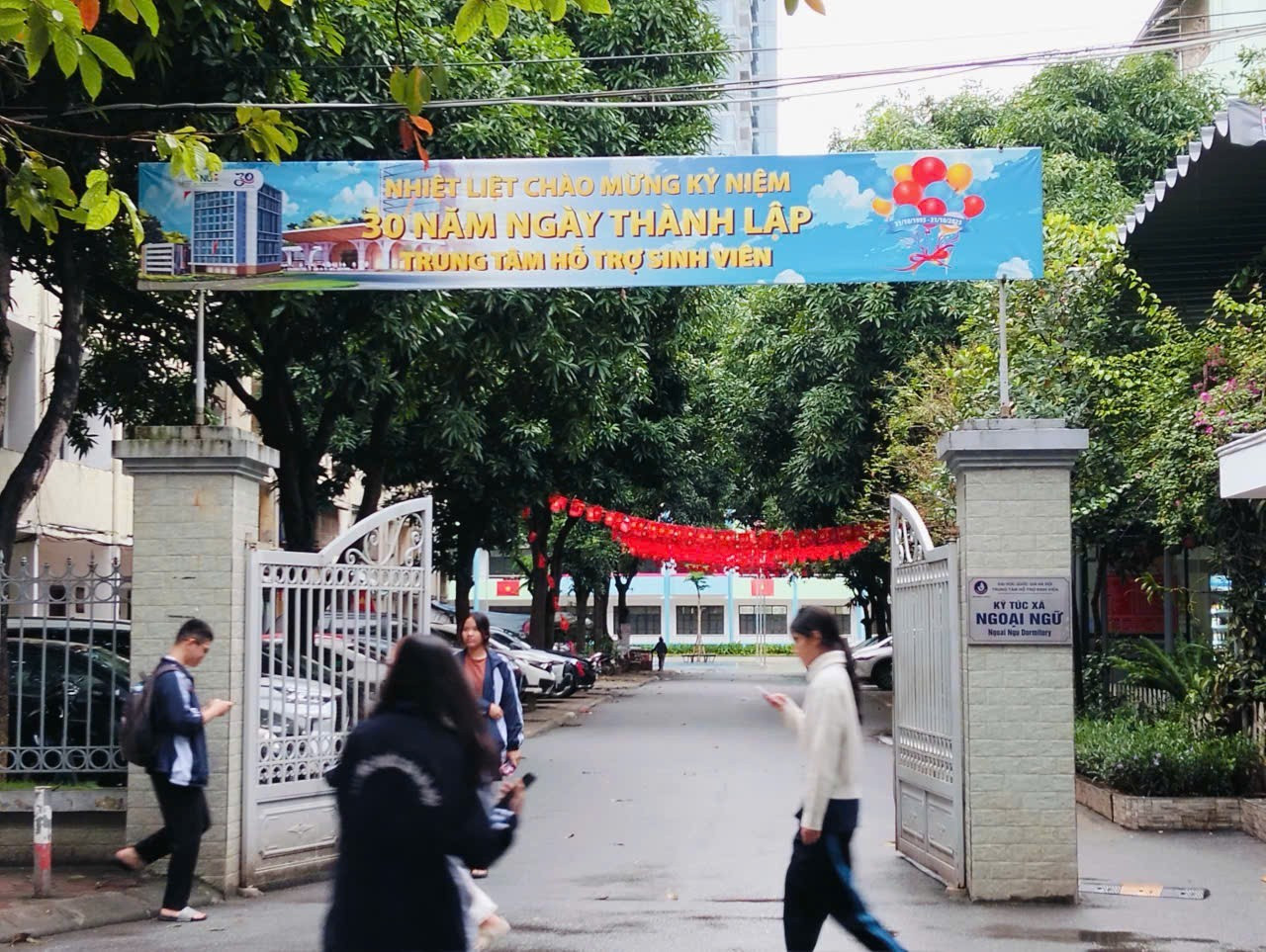
The high demand for student dormitories stems from two main reasons: rising living costs, increased rental prices, and many places failing to meet fire safety requirements. Nguyen Thi Hien, a first-year student living in the dormitory of the University of Foreign Languages (Vietnam National University, Hanoi), said that compared to her friends who rent rooms outside for 3-4 million VND/month, living in the dormitory saves a considerable amount of money. Rent is only a few hundred thousand VND/month, the rooms have air conditioning, are self-contained, and are safe. Although the living space is a bit cramped, it suits students.
Some universities have relatively complete facilities in the provinces but only send first-year students there to study basic subjects, national defense education , and physical education. In subsequent years, students return to the main campus in Hanoi to study because it meets the needs of employment and internships.
According to reporters, the demand for dormitory accommodation among students from outside Hanoi studying in Hanoi is very high. Each year, the demand for dormitory space at Hanoi University of Science and Technology is around 4,000-5,000 students, but the university can only provide about 1,000 places.
The dormitory system of Hanoi National University includes: Me Tri dormitory with nearly 1,826 beds for students of the University of Social Sciences and Humanities, the University of Natural Sciences, and two specialized high schools. The dormitory of the University of Foreign Languages has approximately 1,700 beds for students from the following universities: Foreign Languages, Economics , Technology, Law, Medicine, and the Specialized High School for Foreign Languages… My Dinh dormitory has 388 rooms with 2,328 beds for Vietnamese and foreign students studying at Hanoi National University and other universities and colleges in Hanoi. Hoa Lac dormitory in Hanoi, from the 2025 academic year onwards, will provide more than 6,000 beds for resident students.
The total number of dormitory places at the Vietnam National University is approximately 13,000, while the number of students admitted this year is over 20,000. The Hoa Lac dormitory has the most places, but currently only accommodates first-year students from some schools within the Vietnam National University, Hanoi. The majority of students still study at campuses within Hanoi's city center. Therefore, student accommodation remains scarce.
Integrated solutions and long-term planning
Associate Professor Nguyen Phong Dien, Vice Director of Hanoi University of Science and Technology, shared that the university had actually worked with the Hanoi People's Committee on the option of renting dormitories in the Phap Van - Tu Hiep area for students. However, paradoxically, while Hanoi University of Science and Technology's dormitories are insufficient for students, when the option of renting rooms in the Phap Van - Tu Hiep area was raised, only about 10 rooms were booked. The reason is that this dormitory area lacks a comprehensive service ecosystem for students.
Students' needs for amenities are very practical. For example, food services must be nearby, and public bus transportation must be convenient. The Phap Van - Tu Hiep dormitory complex fails to meet just these two needs.
At a press conference announcing the results of the 18th Congress of the Hanoi City Party Committee, term 2025-2030, the Standing Deputy Secretary of the Hanoi City Party Committee, Nguyen Van Phong, stated that in the documents of the 18th Congress of the Hanoi City Party Committee, the city clearly defined its focus on developing satellite cities in the coming period, especially in the western area with the Hoa Lac satellite city, linked to the Hoa Lac High-Tech Park and the concentrated university area in Hoa Lac.
To realize this vision, a comprehensive and synchronized solution is needed. It is expected that by the end of this year, Hanoi will begin construction of the Van Cao - Hoa Lac Metro urban railway line, creating a foundation for developing this area into a university and science and technology hub, with the Hoa Lac High-Tech Park, Hanoi National University, and approximately 300 hectares of land allocated for a concentrated university zone to relocate universities from the inner city to this area.
However, Mr. Nguyen Van Phong shared that many people and educational institutions have misunderstood the situation and need to understand that the relocation of all universities from the inner city is not the same as relocating the entire university campus. Only the student training facilities will be moved. The universities will remain, continuing to serve as centers for research, postgraduate training, and international cooperation.
By 2030, the capital city is expected to have approximately 650,000-700,000 students, accounting for 40% of the total student population in the Red River Delta region. Hanoi City aims to reduce the scale of training in the inner city to a maximum of 200,000 students. Schools with an area smaller than 2 hectares are encouraged to relocate outside the city center.
Relocating to the suburbs offers many advantages, such as adequate facilities for teaching, learning, and student accommodation. However, it also fails to meet the needs for part-time work and the desire to experience cultural, political, and economic activities in the inner city. This inadequacy is clearly evident in the difficulties faced by some universities that already have campuses in the suburbs but are unable to bring students there for training.
Source: https://tienphong.vn/bai-toan-cho-o-cho-sinh-vien-post1792784.tpo
































![[Photo] Reception to welcome General Secretary and President To Lam and his wife on their State visit to the Philippines](https://vphoto.vietnam.vn/thumb/1200x675/vietnam/resource/IMAGE/2026/06/01/1780295488620_vna-potal-chieu-dai-chao-mung-tong-bi-thu-chu-tich-nuoc-to-lam-va-phu-nhan-tham-cap-nha-nuoc-toi-philippines-8798060-7855-jpg.webp)































































Comment (0)