

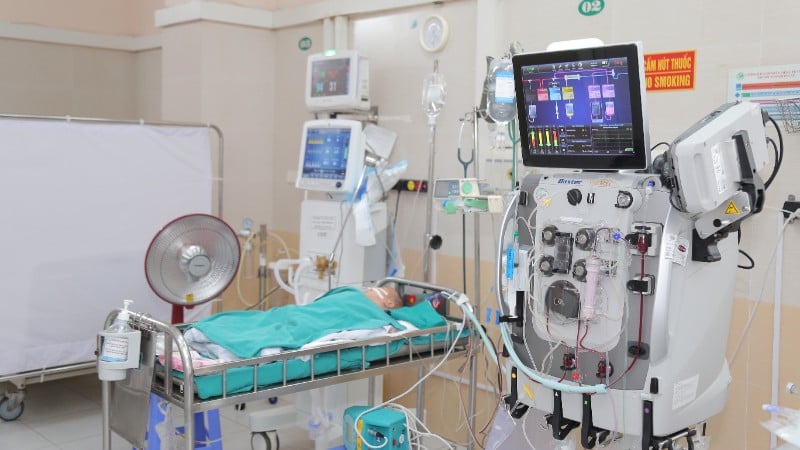
Three days before, the child had a high fever of 39-40 degrees Celsius, accompanied by vomiting about 5-6 times/day, and watery stools 7-8 times/day. The child's family did not take him to see a doctor or receive any treatment. When admitted to the hospital, the child was pale, breathing rapidly, had a difficult pulse, and had cold hands and feet.
Doctors determined this was a case of septic shock-sepsis, suspected of having an entrance from the digestive tract, and quickly implemented initial resuscitation measures: endotracheal intubation-mechanical ventilation support, central venous catheter placement, rapid anti-shock fluid infusion, early use of vasopressors and antibiotics.
For many hours, the team took turns closely monitoring the patient's every breath and vital sign. Although active management and treatment measures were applied to the patient with septic shock, the child still had a high fever, responded poorly to antipyretics, had unstable hemodynamics, increased vasomotor index, and worsened kidney function.
After consultation, the team of doctors decided to perform continuous blood filtration for the child. This is a modern resuscitation technique, helping to eliminate toxins, stabilize the acid-base balance and temporarily "replace" the failing kidney.
After continuous hemodialysis, fever decreased rapidly, circulatory and respiratory signs stabilized, and metabolic acidosis gradually improved.
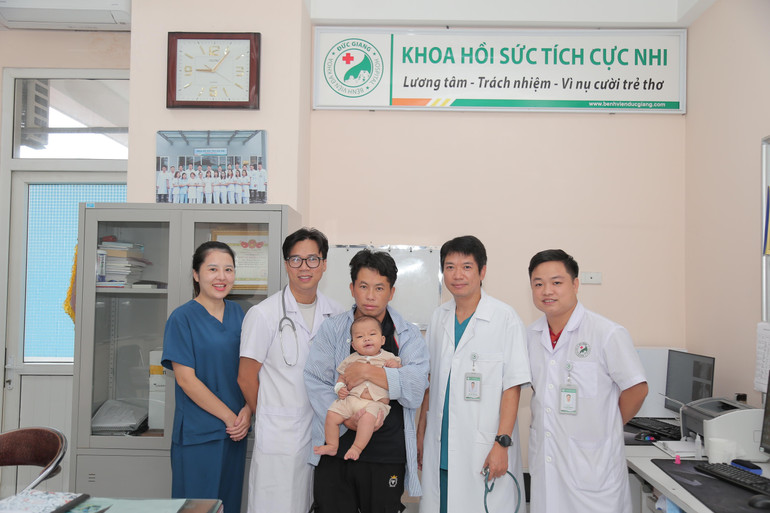
After more than 40 hours, the baby was continuously monitored, combined with comprehensive care. The harmonious coordination between respiratory resuscitation, cardiovascular, infection control and blood filtration brought good results, however, the patient's kidney function had not yet recovered, so blood filtration therapy was continued to wait for the kidney to recover.
After 13 days of continuous dialysis, the child's kidney function gradually recovered, and he began to produce urine. The amount of urine gradually increased with each shift, the diuretic gradually decreased, the child safely finished dialysis, was weaned off the ventilator, the endotracheal tube was removed, and after 23 days of treatment, the child was discharged from the hospital in a state of complete recovery, with the joy of the staff of the Pediatric Intensive Care Unit, the family, the hospital, and benefactors.
Specialist Doctor I Nguyen Thi Lan Anh, Department of Pediatric Intensive Care, shared that although she had successfully treated many cases of dialysis in children at Duc Giang General Hospital, this case really left the most impression and pressure on the medical team and doctors regarding the treatment journey with a rather long dialysis time (13 consecutive days).
The success of this case helps to improve the reputation of the quality of examination and treatment of serious and critical illnesses at the Pediatric Intensive Care Department, Duc Giang General Hospital.
Due to the difficult family circumstances, the patient is an ethnic minority, so communication is difficult due to language barriers, as well as some administrative procedures. During the treatment process, the patient has received support from philanthropists. This is a great source of strength for the patient and his family.
Through the above case, the doctor recommends to parents the following important points: When the child has severe clinical symptoms such as: continuous high fever, frequent vomiting, diarrhea, refusal to breastfeed, rapid breathing, cyanosis or impaired consciousness (lethargy, difficult to wake up), it is necessary to take the child immediately to the nearest hospital or medical facility for timely examination, diagnosis and monitoring.
Second, do not self-treat at home, because the condition can progress rapidly to a severe, even critical level.
Third, early detection and timely medical intervention are key factors in improving the chances of saving lives and restoring children's health.
Source: https://nhandan.vn/be-trai-nguoi-hmong-hoi-sinh-ky-dieu-sau-soc-nhiem-khuan-post910747.html
![[Photo] Explore the US Navy's USS Robert Smalls warship](/_next/image?url=https%3A%2F%2Fvphoto.vietnam.vn%2Fthumb%2F1200x675%2Fvietnam%2Fresource%2FIMAGE%2F2025%2F12%2F10%2F1765341533272_11212121-8303-jpg.webp&w=3840&q=75)


![[Photo] The captivating scenery of the fragrant maple forest in Quang Tri](/_next/image?url=https%3A%2F%2Fvphoto.vietnam.vn%2Fthumb%2F1200x675%2Fvietnam%2Fresource%2FIMAGE%2F2025%2F12%2F10%2F1765353233198_lan09046-jpg.webp&w=3840&q=75)











![[Video] National Assembly passes Cybersecurity Law with 91.75% of delegates voting in favor](https://vphoto.vietnam.vn/thumb/402x226/vietnam/resource/IMAGE/2025/12/10/1765354445335_1-1521-png.webp)
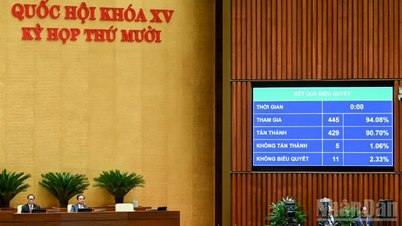
![[Video] National Assembly passes Law on Disease Prevention with many new policies on regular health check-ups and free screening.](https://vphoto.vietnam.vn/thumb/402x226/vietnam/resource/IMAGE/2025/12/10/1765353842077_3-1228-png.webp)
![[Video] National Assembly passes the amended Personal Income Tax Law with many changes to tax rates and family deductions.](https://vphoto.vietnam.vn/thumb/402x226/vietnam/resource/IMAGE/2025/12/10/1765353535343_2-2763-png.webp)
![[Photo] The captivating scenery of the fragrant maple forest in Quang Tri](https://vphoto.vietnam.vn/thumb/402x226/vietnam/resource/IMAGE/2025/12/10/1765353233198_lan09046-jpg.webp)

![[Video] The craft of making Dong Ho folk paintings has been inscribed by UNESCO on the List of Crafts in Need of Urgent Safeguarding.](https://vphoto.vietnam.vn/thumb/402x226/vietnam/resource/IMAGE/2025/12/10/1765350246533_tranh-dong-ho-734-jpg.webp)



















































Comment (0)