

Faced with the pressure of "greening" the global supply chain, the transition to a green, smart port model is no longer an option but a survival imperative. Despite its prime location on the maritime map, Vietnam is facing a difficult problem of connecting infrastructure and technology to truly become a regional logistics hub.
Vietnam is facing a "golden opportunity" to reposition itself with more than 3,260 km of coastline and located close to the busiest international shipping route. However, the global "rules of the game" are changing rapidly as major shipping lines prioritize choosing seaports with low emissions (Green Port) and smart processing (Smart Port).
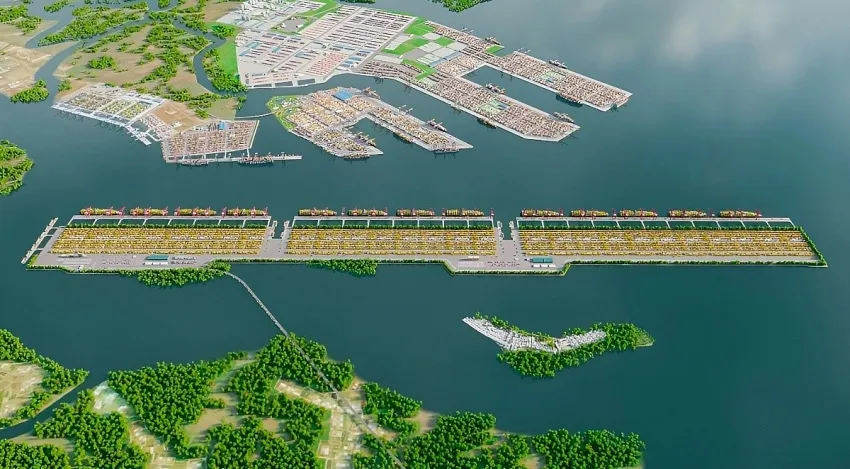
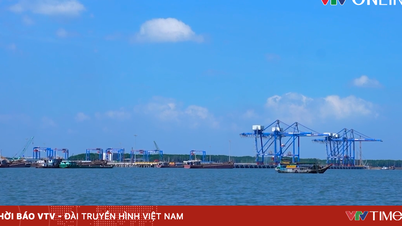
Can Gio International Port model is a port project in the green and smart port development strategy of Ho Chi Minh City.
Race with the "giants"
Commenting on this trend, Mr. Benoit de Quillacq - General Director of MSC Vietnam Co., Ltd. - emphasized that reducing carbon emissions and digitalizing logistics activities is an inevitable trend for global maritime transport.
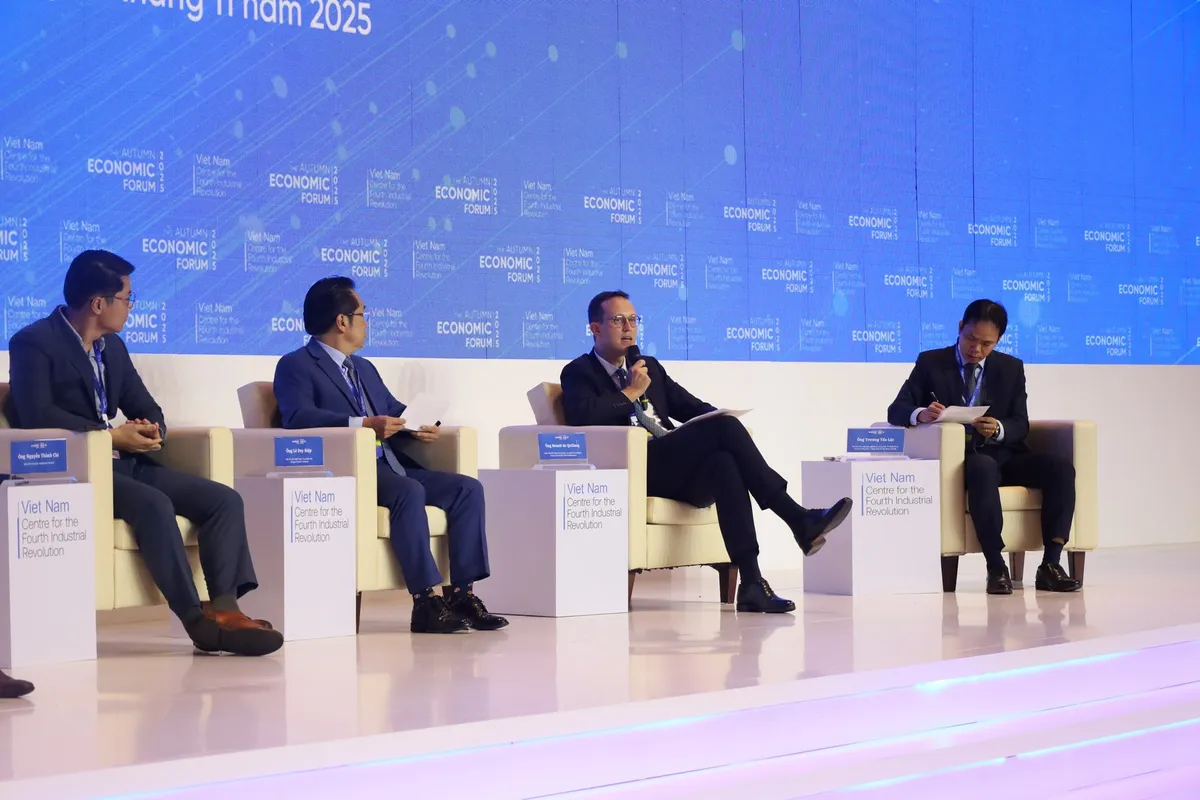
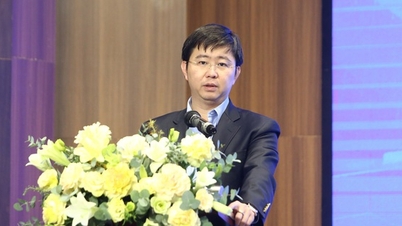
Mr. Benoit de Quillacq - General Director of MSC Vietnam Co., Ltd. spoke at the Autumn Economic Forum 2025.
According to a representative of MSC, Vietnam is competing directly with major ports in the region such as Shanghai and Singapore. "We want to bring larger ships to Vietnam, and to do that, the ports must have enough capacity and capability to serve. MSC Vietnam wants to deliver goods directly to customers in Vietnam," said Mr. Benoit de Quillacq.
However, he also pointed out the fact that currently there are only two domestic container ports capable of receiving super-large ships. This is a good sign but not enough as the market size and ship size continue to increase.
Sharing the same view, Mr. Benjamin Lim - Senior Director of Strategy at YCH Group - said that Vietnam has the opportunity to become a regional logistics connection center. This group has recently switched to a "superport" model development strategy, in which the prerequisite is that the infrastructure must ensure multimodal connectivity, creating connections between different means of transport.
Technology - Leverage for performance
To realize the dream of a smart port, technology plays a key role. Mr. Bui Van Quy - Chairman of the Advisory Council of the Asia- Pacific Port Network (APSN), Deputy General Director of Saigon Newport Corporation - pointed out the main trends taking place.
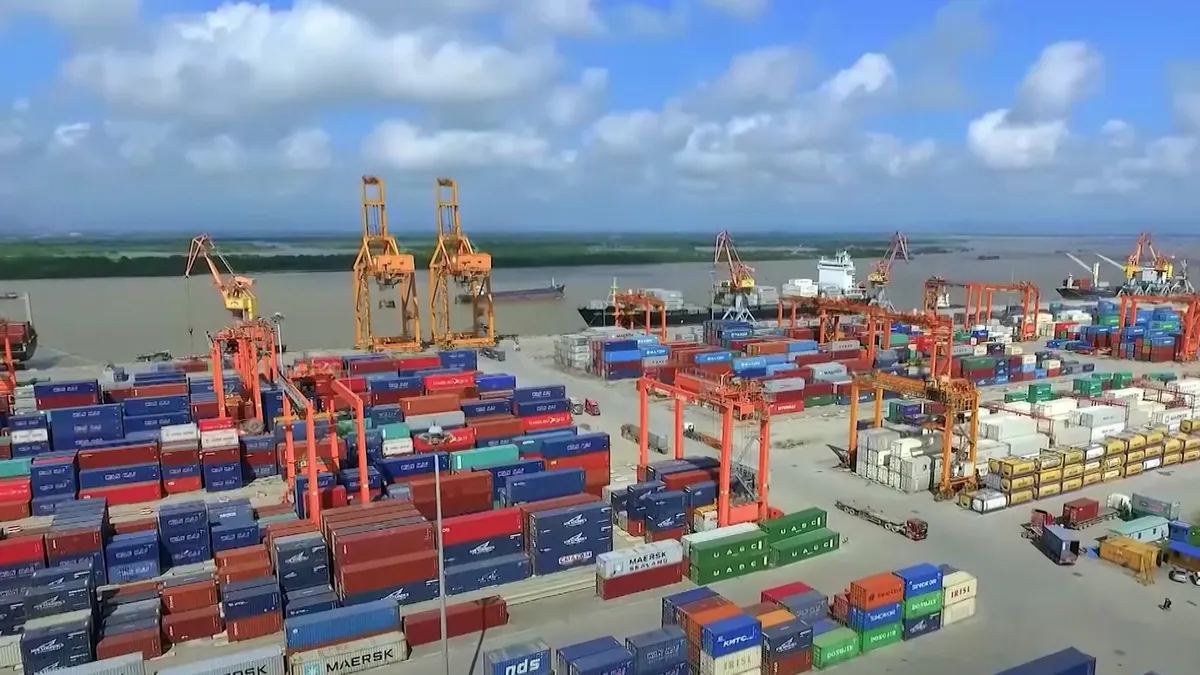
According to Mr. Quy, modern seaports around the world are integrating Port Community Systems, Digital Twin simulations and AI-based forecasting to allocate berths and schedule maintenance.
"These technologies help improve operational efficiency, reduce congestion and increase service reliability for shipping lines and logistics businesses," said Mr. Bui Van Quy. He also revealed that Port No. 7 & 8 in Lach Huyen (Hai Phong) is being invested to become the first semi-automated deep-water port in Vietnam, expected to operate by the end of 2028 with automatic equipment and meet green port standards.
Paradox "river route is longer than sea route"
Despite the great potential, experts have frankly acknowledged that infrastructure bottlenecks are holding back Vietnam's logistics. A paradox was pointed out by Mr. Benoit de Quillacq in the southern region: "Cai Mep port area is currently connected to ICD Ho Chi Minh City by river. However, the transit time from Cai Mep to the center of Ho Chi Minh City is sometimes equivalent to the transit time from Singapore to Cai Mep."
MSC representative emphasized: "Domestic connectivity must be given equal attention as offshore connectivity, because if there is any problem domestically, the entire supply chain will be affected."
From a macro perspective, Ms. Dang Minh Phuong - Chairman of the Ho Chi Minh City Logistics and Seaport Association - said that logistics costs in Vietnam are still much higher than in the region, accounting for about 16.8% - 17% of GDP. The main reason lies in the lack of synchronization between planning and implementation, making infrastructure capacity and traffic congestion still a big challenge.
In addition to hard infrastructure, businesses also face difficulties with "soft infrastructure". Mr. Le Duy Hiep - General Director of Transimex - said that out of 40,000 logistics businesses, up to 75% are small and medium enterprises (SMEs). These units are facing great difficulties in terms of resources for digital transformation investment and need a suitable roadmap that is close to reality.
Three pillars for vision 2035
For the logistics industry to truly "take off", Ms. Dang Minh Phuong proposed three strategic pillars for the 2030-2035 period: Building world-class infrastructure and connectivity; Green and sustainable development; Building a smart and digital ecosystem.
The seaport economic market is forecast to reach 52 billion USD by 2025 and 72 billion USD by 2030. To capture this figure, Mr. Thomas Sim - President of the International Federation of Freight Forwarders Associations (FIATA) - suggested that Vietnam should build a fully integrated smart port ecosystem, connecting shipping lines, customs and inland transport.
Mr. Thomas Sim concluded impressively about the future of the industry: "Today, digitalization must go hand in hand with trust... The future belongs to faster, greener, smarter connected economies and Vietnam holds the opportunity to become one of the leading countries."
Source: https://vtv.vn/cang-xanh-thong-minh-chia-khoa-de-logistics-viet-nam-cat-canh-100251204161615141.htm


![[Photo] Cat Ba - Green island paradise](/_next/image?url=https%3A%2F%2Fvphoto.vietnam.vn%2Fthumb%2F1200x675%2Fvietnam%2Fresource%2FIMAGE%2F2025%2F12%2F04%2F1764821844074_ndo_br_1-dcbthienduongxanh638-jpg.webp&w=3840&q=75)





























![[VIMC 40 days of lightning speed] Da Nang Port: Unity - Lightning speed - Breakthrough to the finish line](https://vphoto.vietnam.vn/thumb/402x226/vietnam/resource/IMAGE/2025/12/04/1764833540882_cdn_4-12-25.jpeg)




































Comment (0)