

Without receiving sponsorship or calling for donations, she maintains the classroom herself with the sole hope: "With a job and income, the children will be more confident in life."
Teaching from the heart
Ms. Le Thi Hong Hoa, 66 years old, living in Cai Khe ward ( Can Tho city) is the person who directly founded and teaches at Hoa Moc Len facility. Her class is made up of people with many disabilities, who come to learn a trade and restore their faith.
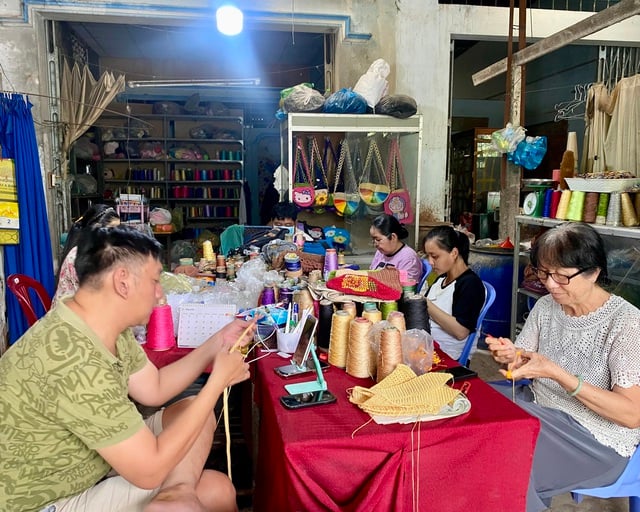
Ms. Hong Hoa (right) and students crocheting together. PHOTO: VAN ANH
The opportunity to teach crochet appeared in 2003, when she had the opportunity to cooperate with a school for disabled children. In the first days of teaching, she personally guided each crochet stitch for the children. The more she interacted with them, the more she realized the perseverance, carefulness and spirit of overcoming difficulties of her students. From then on, with the heart of "a teacher like a kind mother", she believed that people with disabilities can absolutely make beautiful and valuable products like anyone else.
Understanding the disadvantages of the children, Ms. Hoa decided to open a free training facility so that anyone in difficulty could have the opportunity to learn a trade. After 3 years of preparation, in 2006, the first class was opened right at home. A year later, the class was licensed to operate by the District People's Committee and the file was sent to the Department of Labor, Invalids and Social Affairs of Can Tho City at that time to complete the procedures.
In 2008, the class was officially recognized by the Department of Labor, Invalids and Social Affairs, allowing it to train students with disabilities. Since then, the Hoa Moc Len class has persisted, becoming a support for many people to regain faith and direction in life.
“I will keep doing this job until I no longer have the strength to do it,” Ms. Hoa shared.
Persistence lights up the small classroom
Currently, the class has 12 students, including 6 people with severe disabilities, limited mobility and 6 people who are deaf and mute from birth. The number of students attending each class is not fixed. Some days there are many, some days there are only a few people, because each student's health, family or personal circumstances are different. Ms. Hoa never pressures. She just waits quietly, as long as the students still want to learn, still believe in their own hands.
For those who are severely disabled and cannot walk, their families will come to pick up the materials and take them home. When they are done, they send the products back to receive credit. Students who are deaf and mute but can walk come to class directly. For pregnant women or women who have just given birth, she will proactively send materials to their homes. As for those who are in poor health, she tries to keep in touch and patiently waits for them to return when they can.
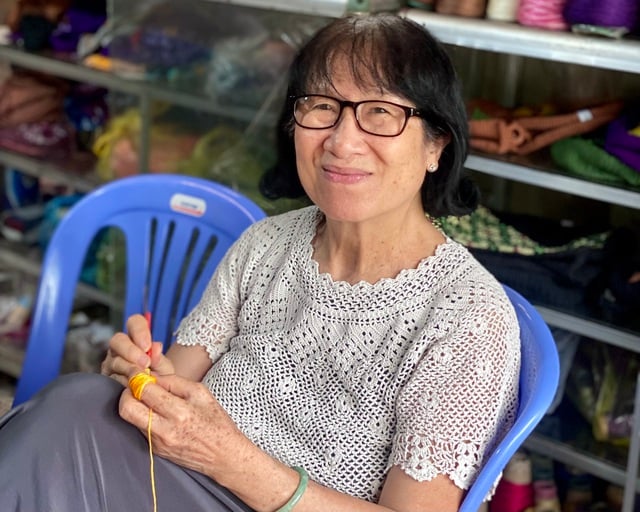
Ms. Hong Hoa has nearly 20 years of experience in teaching the less fortunate. PHOTO: VAN ANH
“I have never considered the students as weak. They are very honest, innocent and talented. Many of them learn very quickly and are extremely skillful,” Ms. Hoa shared with all her respect.
The class takes place on Mondays, Wednesdays and Fridays, from 2pm to 4pm. All materials from wool, needles to tools are prepared by Ms. Hoa herself.
“Students can study for free and receive credit for each product. New students can earn a few hundred thousand per month, while those who stick around for a long time can earn up to several million. Although it is not a large amount, it helps their lives become more stable and gives them hope to contribute to the community,” Ms. Hoa shared.
During class, Ms. Hoa wrote down the theory on paper for the students to read. When practicing, she carefully demonstrated each movement, using her eyes and gestures instead of words. The students also helped each other with each stitch, so that in that small room, patience became the common language.
Ms. Hoa pays the students in advance for all the products she makes before selling them. On lucky days, Ms. Hoa sells them all. On days when she can’t sell them, she calmly collects the products and takes them home without a word of complaint. For her, the most important thing is that the students have income.
For nearly 20 years, the facility has always faced difficulties, especially when she did not receive sponsorship or solicit donations. There was a time when she consigned products to hotels and shopping malls, but the results were not high, and some places even refused to return the goods. She felt sad and quietly stopped consigning to avoid being misunderstood as "begging".
Currently, the class’s products are sold at My Khanh Tourist Area in the summer, at Truc Lam Phuong Nam Zen Monastery during 3 major holidays and at some supported trade fairs. Despite the hardship, she still perseveres with the belief: “Give a job, give income, give hope to the disadvantaged”.
Companions of Hope
Beside Ms. Hoa are people who have been with her for a long time in her youth.
Nguyen Bang Phu, 37 years old, a deaf student has been with her for more than 15 years. In his diary, he wrote: “Ms. Hoa is a serious, honest and kind person. Crocheting has helped me earn income, save money and support my life for the past 15 years.” For Mr. Phu, she is not only a vocational teacher, but also someone who opened up an independent and sustainable path for him.
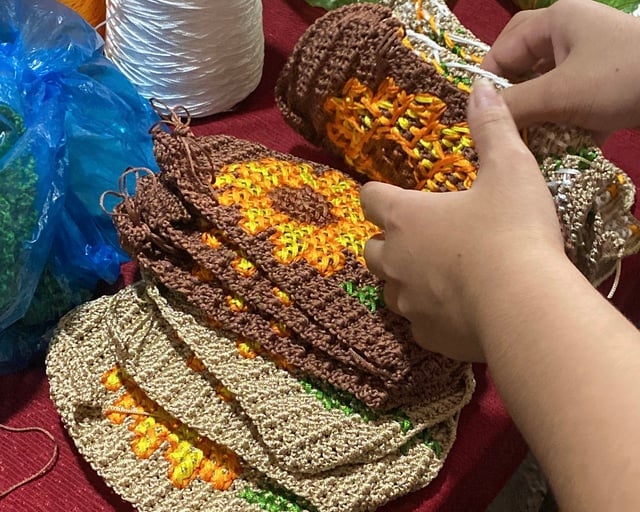
Finished products from skillful hands. PHOTO: VAN ANH
Ms. Ho Thi Be Men, 31 years old, came to the class in 2012, when she was a college student majoring in English. From a student working part-time, she decided to move in and accompany Ms. Hoa, taking care of every little thing in the class: picking up and dropping off students, selling products, and managing output. Thanks to Ms. Men, the students' bags, woolen animals, and crocheted clothes are sold more regularly, helping the facility operate smoothly and steadily.
Behind Ms. Hoa is her husband who has always been a silent support. In the past, he used to drive an ambulance and a charity hearse. After the heart valve surgery, his health deteriorated and he had to stop working. But occasionally, he still tries to help transport herbal medicine to the pagoda. Now, the couple relies on each other to operate this small crochet facility. She shared: "He has always been a spiritual support for me and the students."
For nearly 20 years, countless products have been born, bringing income and trust to those who once struggled with their disabilities.
“Seeing the children making their own products, selling them and taking care of their own lives, I feel that all their efforts are worth it. I am proud to be able to teach them a trade, give them income, and give them hope,” Ms. Hoa confided.
Hoa Moc Len facility still quietly lights up every day, like a small roof where hands and hearts are given the opportunity to stand firm with their own abilities.
Source: https://thanhnien.vn/gan-20-nam-truyen-nghe-gioi-hy-vong-cho-nhung-so-phan-yeu-the-185251204225408448.htm
![[Photo] National Assembly Chairman Tran Thanh Man attends the VinFuture 2025 Award Ceremony](/_next/image?url=https%3A%2F%2Fvphoto.vietnam.vn%2Fthumb%2F1200x675%2Fvietnam%2Fresource%2FIMAGE%2F2025%2F12%2F05%2F1764951162416_2628509768338816493-6995-jpg.webp&w=3840&q=75)


![[Photo] 60th Anniversary of the Founding of the Vietnam Association of Photographic Artists](/_next/image?url=https%3A%2F%2Fvphoto.vietnam.vn%2Fthumb%2F1200x675%2Fvietnam%2Fresource%2FIMAGE%2F2025%2F12%2F05%2F1764935864512_a1-bnd-0841-9740-jpg.webp&w=3840&q=75)

















































































Comment (0)