

Some people worry that deep squats can affect the knee joints. But in fact, many research evidence shows that deep squats do not increase the risk of knee injury in people with healthy knees, practicing with correct technique and reasonable weight loading, according to the health website Verywell Fit (USA).
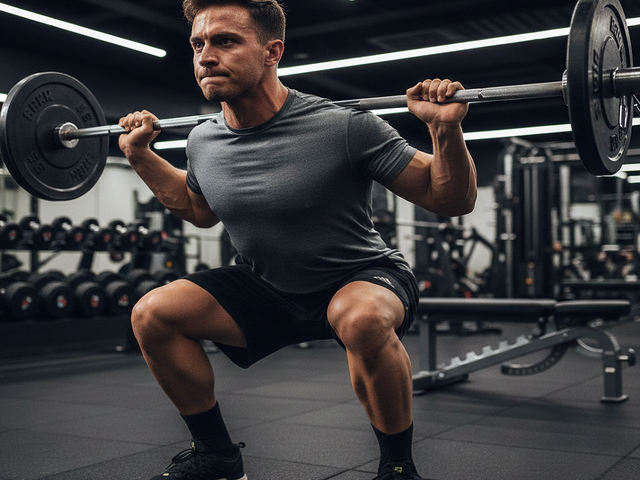
Squatting too deep with weak knees will increase the risk of knee pain and even injury.
PHOTO: AI
To squat effectively and avoid the risk of damaging the knee joint, practitioners need to avoid the following mistakes:
Pillow facing inward
When you do a squat, your knees will lower your body down and then lift up. During the exercise, your knees should be in line with your toes. However, if your knees tend to come together and point towards each other, that is the wrong way to do it.
Because when the knee is turned inward, the force is concentrated on the front and outside of the knee joint, increasing the load on the patellofemoral joint. This is the joint between the kneecap and the lower end of the femur. As a result, the knee joint is prone to pain. When this error occurs, the practitioner should reduce the weight of the weight to correct the exercise technique.
Improper squat depth
The appropriate level of squat depth can vary from person to person, depending on their physique and training experience. However, if you try to go so deep that you feel pain in your knees and your joints are out of control, that is a warning sign.
In addition, people with weak knees or a history of knee injuries should avoid holding a 60-90° knee bend position for too long, such as wall squats. This position will increase pressure on the knee joints.
For people with strong, pain-free knees, if they want to squat deeply, they should not suddenly squat deeper. Instead, they should squat a little deeper each week. This process takes place gradually so that the body can adapt. The depth of the squat should be maintained within a controlled range, for example, the knee is still stable when going down and there is no pain.
Let the pillow "fall freely"
Some people have a habit of lowering themselves down very quickly when squatting, then only squeezing hard when they hit the bottom and then bouncing back up. This is more like a bounce than a controlled movement.
When you lower too quickly, your knees and hips have difficulty controlling their movements, causing a sudden increase in the force on your knee joint. For beginners or those with weak joints, this pressure can easily cause a sharp pain in the front of your knee.
Therefore, the practitioner needs to focus on the rhythm. The down phase lasts 2–3 seconds, is smooth and controlled. The up phase is fast and strong but still keeps the knees and hips in the correct axis of movement, according to Verywell Fit .
Source: https://thanhnien.vn/3-sai-lam-khi-squat-khien-dau-goi-khoc-thet-185251205190915831.htm
![[Photo] National Assembly Chairman Tran Thanh Man attends the VinFuture 2025 Award Ceremony](/_next/image?url=https%3A%2F%2Fvphoto.vietnam.vn%2Fthumb%2F1200x675%2Fvietnam%2Fresource%2FIMAGE%2F2025%2F12%2F05%2F1764951162416_2628509768338816493-6995-jpg.webp&w=3840&q=75)


![[Photo] 60th Anniversary of the Founding of the Vietnam Association of Photographic Artists](/_next/image?url=https%3A%2F%2Fvphoto.vietnam.vn%2Fthumb%2F1200x675%2Fvietnam%2Fresource%2FIMAGE%2F2025%2F12%2F05%2F1764935864512_a1-bnd-0841-9740-jpg.webp&w=3840&q=75)







![[Infographic] Air pollution and recommendations from the Ministry of Health](https://vphoto.vietnam.vn/thumb/402x226/vietnam/resource/IMAGE/2025/12/05/1764950568593_screen-shot-2025-12-05-at-222015-png.webp)














































































Comment (0)