

Efforts to negotiate passion fruit exports.
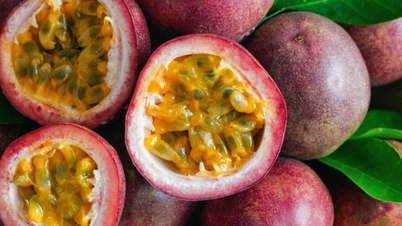
Recently, the Plant Protection Department (PPD) collaborated with the Australian Embassy in Vietnam to organize the "Ceremony announcing the export of Vietnamese passion fruit to Australia and Australian plums to Vietnam". Mr. Huynh Tan Dat, Director of the PPD, stated that Vietnam has potential and advantages in tropical fruits. Currently, Vietnamese fruits are exported to more than 60 countries and territories. Passion fruit alone is exported to 20 countries, in various forms such as fresh fruit, frozen fruit, and juice.
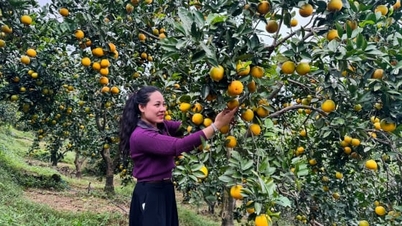
"The area planted with passion fruit is increasingly trending upwards, with over 12,000 hectares, mainly concentrated in the northern mountainous region. Currently, passion fruit is also attracting attention from many provinces in the Central Highlands, with expansion of cultivation area," Mr. Dat said.
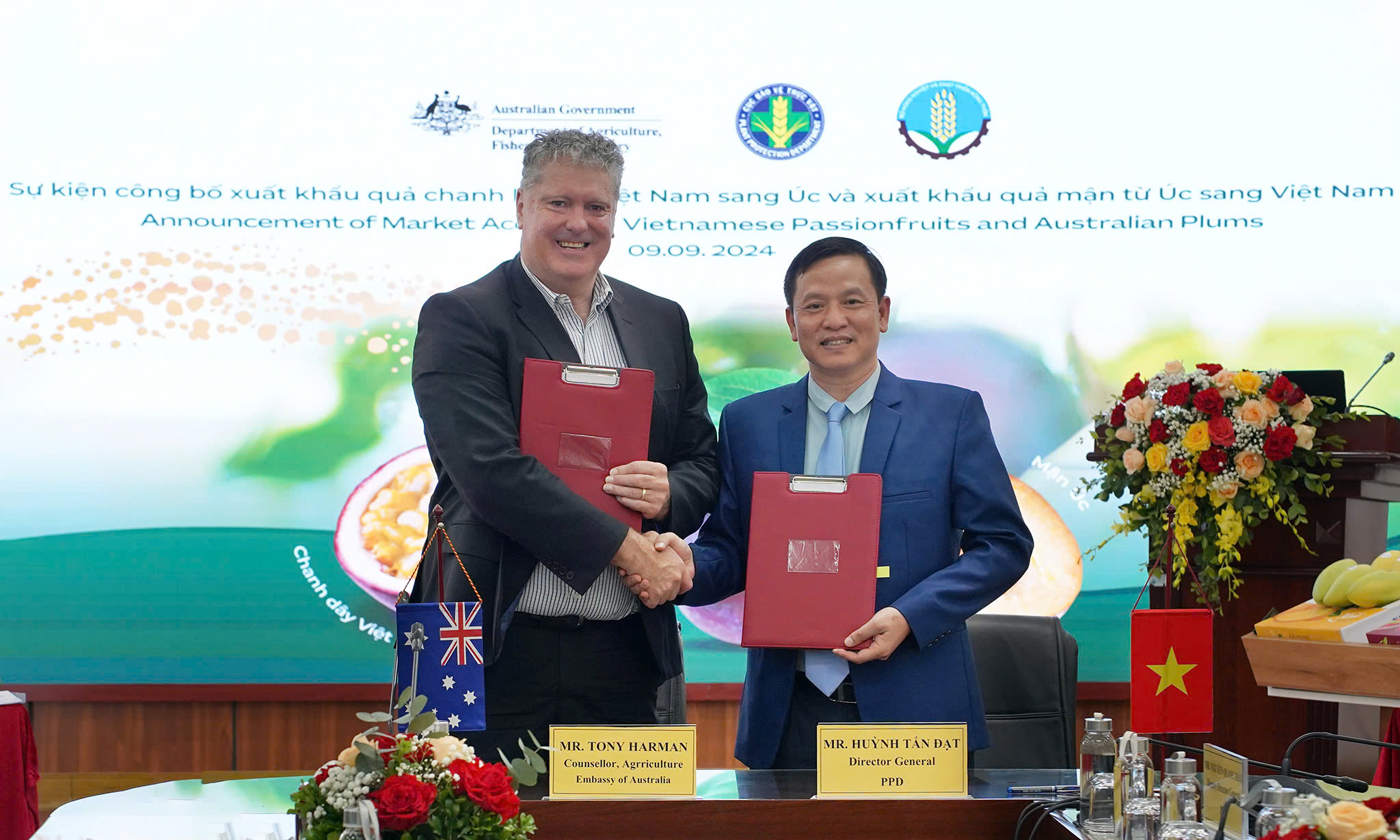
Director General Huynh Tan Dat and the Australian Agricultural Attaché in Vietnam, Tony Harman, exchanged the signed agreement to export passion fruit to Australia. Photo: Bao Thang
Currently, Vietnamese fruits are exported to more than 60 countries and territories. Passion fruit alone is exported to 20 countries, in various forms such as fresh fruit, frozen fruit, and juice. The area planted with passion fruit is currently over 12,000 hectares, mainly concentrated in the northern mountainous region, and is attracting attention from many provinces in the Central Highlands, with plans to expand the planted area.
In recent years, Vietnam has focused on improving quality, producing passion fruit in a value chain, and ensuring traceability, with a focus on two varieties: yellow and purple passion fruit.
Regarding the Australian market, Mr. Huynh Tan Dat said that in recent years, the agricultural sectors of both countries have made great efforts in exchanging information and negotiating to enable Vietnam to export many types of agricultural products and fruits to Australia, which is considered one of the most demanding markets.
"Although your side has very high requirements regarding plant quarantine and food safety, many types of Vietnamese agricultural products and fruits have met the requirements, proving that our production processes, production management solutions, harvesting, processing, and packaging are strictly implemented, and pesticide residue and heavy metal residue are well controlled, which is why they are accepted by the markets," Mr. Dat said.
According to Mr. Dat, the negotiation process to bring passion fruit to Australia was not easy because Australia also grows passion fruit and has many unique, high-quality products. However, Vietnamese passion fruit, with its distinctive flavor, meets the tastes of Australian consumers.
"Passion fruit is the fifth Vietnamese product licensed for export to the Australian market, after mangoes, longan, lychees, and dragon fruit. In the near future, we will prioritize negotiations to bring pomelos to Australia; if nothing changes, we will announce it in early 2025, followed by seedless green lemons, avocados, custard apples, etc.," Mr. Dat said.
Ambassador Andrew Goledzinowski of Australia to Vietnam stated that trade in agricultural products, including fruit, between the two countries has continuously developed over time. Many high-quality fruits from one country have appeared in the other's market. "Vietnam and Australia have truly become close friends. What we have achieved today is based on trust and joint efforts," Mr. Goledzinowski shared.
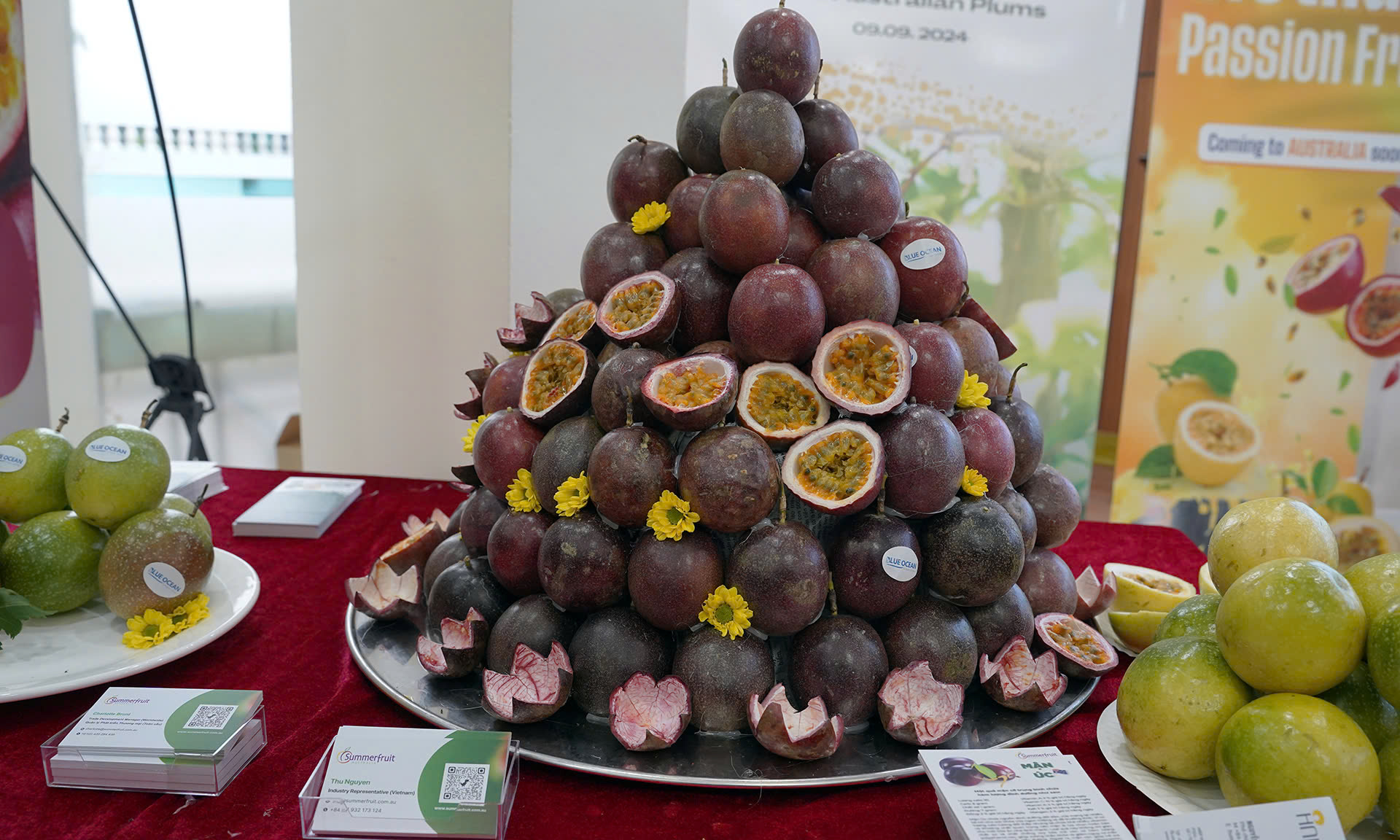
Vietnamese passion fruit meets the tastes of Australian consumers.
Passion fruit for export must be packed in sealed cardboard boxes without ventilation holes, or cardboard boxes with ventilation holes that are sealed with mesh with a hole size of no more than 1.6mm and a thread thickness of no less than 0.16mm. The packaging must bear the following information in English: Passionfruit, Product of Viet Nam for Australia, Packing facility code/name, Processing facility code/name, Processing Identification Number (TIN).
Besides jointly announcing the import of passion fruit and plums, the Australian Ambassador also stated that Australia is supporting Vietnam in cultivating 200,000 hectares of high-quality, emission-reducing rice as part of the 1 million hectare rice project that the Government and the Ministry of Agriculture and Rural Development are focusing on.
Commenting specifically on Vietnamese passion fruit, Ambassador Goledzinowski said the fruit was "very delicious." He and his family regularly consume it daily, even replacing breakfast. In addition to promoting and opening markets for passion fruit and plums, the two countries will continue to finalize the last stages so that Vietnamese pomelo and Australian blueberries will be available in the partner market.
Conditions for Vietnamese passion fruit to be exported to Australia.
Mr. Nguyen Quang Hieu, Deputy Director of the Plant Protection Department, said that since 2016, the Department has initiated negotiations to open the export market to Australia. Over the years, both sides have actively cooperated to promote pest risk analysis and information exchange to reach an agreement on plant quarantine requirements for passion fruit imported into Australia. To date, an agreement has been reached, and passion fruit is permitted to be imported into Australia along with dragon fruit, lychee, longan, and mango.
According to the Agreement on the Australian Export Plan for Vietnamese Passion Fruit (OWP), some of Australia's Biosecurity Conditions (BICON) for Vietnamese passion fruit should be noted as follows: Passion fruit, including the whole fruit such as peel, flesh, and seeds, with or without a small stem (maximum 3cm), commercially produced in Vietnam, is permitted for export to Australia for consumption purposes. Passion fruit orchards exporting to Australia can be registered according to the guidelines in document No. 1776/BNN-BVTV.
Packing and processing facilities must be approved and registered in accordance with Guideline No. 1776/BNN-BVTV on the registration and management process of orchards and packing facilities for agricultural products for export. Passion fruit shipments to Australia must be processed at an approved irradiation facility, with a minimum absorbed irradiation dose of 400 Gy.
Conduct plant quarantine inspections before export in accordance with Circular No. 33/2014/TT-BNNPTNT and the national technical standard QCVN 01-141:2013/BNNPTNT. If quarantine pests such as fruit flies, mealybugs, or bark borers are detected, further irradiation treatment will be applied. If thrips or mites are detected, the shipment will be discarded or re-treated and re-inspected.
"To ensure full compliance with plant quarantine and food safety requirements for passion fruit exported to Australia, the Plant Protection Department will coordinate with specialized agencies in localities to disseminate regulations on plant quarantine and food safety; guide the establishment and issuance of codes for growing areas and packaging facilities for export passion fruit..."
"The Plant Protection Department wishes to widely publicize the quarantine requirements for fresh passion fruit imported from Vietnam to Australia to relevant management units, organizations, individuals, and businesses exporting passion fruit to Australia so that they are aware and can quickly implement them," Mr. Hieu said.
Director Huynh Tan Dat also advised passion fruit growing areas to apply good agricultural practices (VietGAP) during production, effectively control food safety, conduct plant quarantine, minimize the use of chemicals to protect plant health; and effectively control heavy metal residues and microorganisms to meet the food safety regulations of the Australian market.
Source: https://danviet.vn/chanh-leo-viet-nam-chinh-thuc-nhan-giay-thong-hanh-sang-uc-202409121639381.htm





![Looking back at the peak month of combating IUU: [Part 3] Synchronizing fisheries infrastructure](https://vphoto.vietnam.vn/thumb/402x226/vietnam/resource/IMAGE/2025/12/13/1765608279533_2109-b32-133759_237.jpeg)





































































Comment (0)