

The market experienced significant divergence in November.
November 2025 ended with a familiar paradox, but more obvious than previous months: VN-Index increased, but most investors' portfolios decreased. The market-representative index increased by more than 3% in the month, reaching 1,690.99 points, but liquidity fell to the lowest level in the past three months.
According to data from the Ho Chi Minh City Stock Exchange (HOSE), the average trading volume was only 769 million shares per session, down nearly 28% compared to October, while the average trading value plummeted more than 32%.
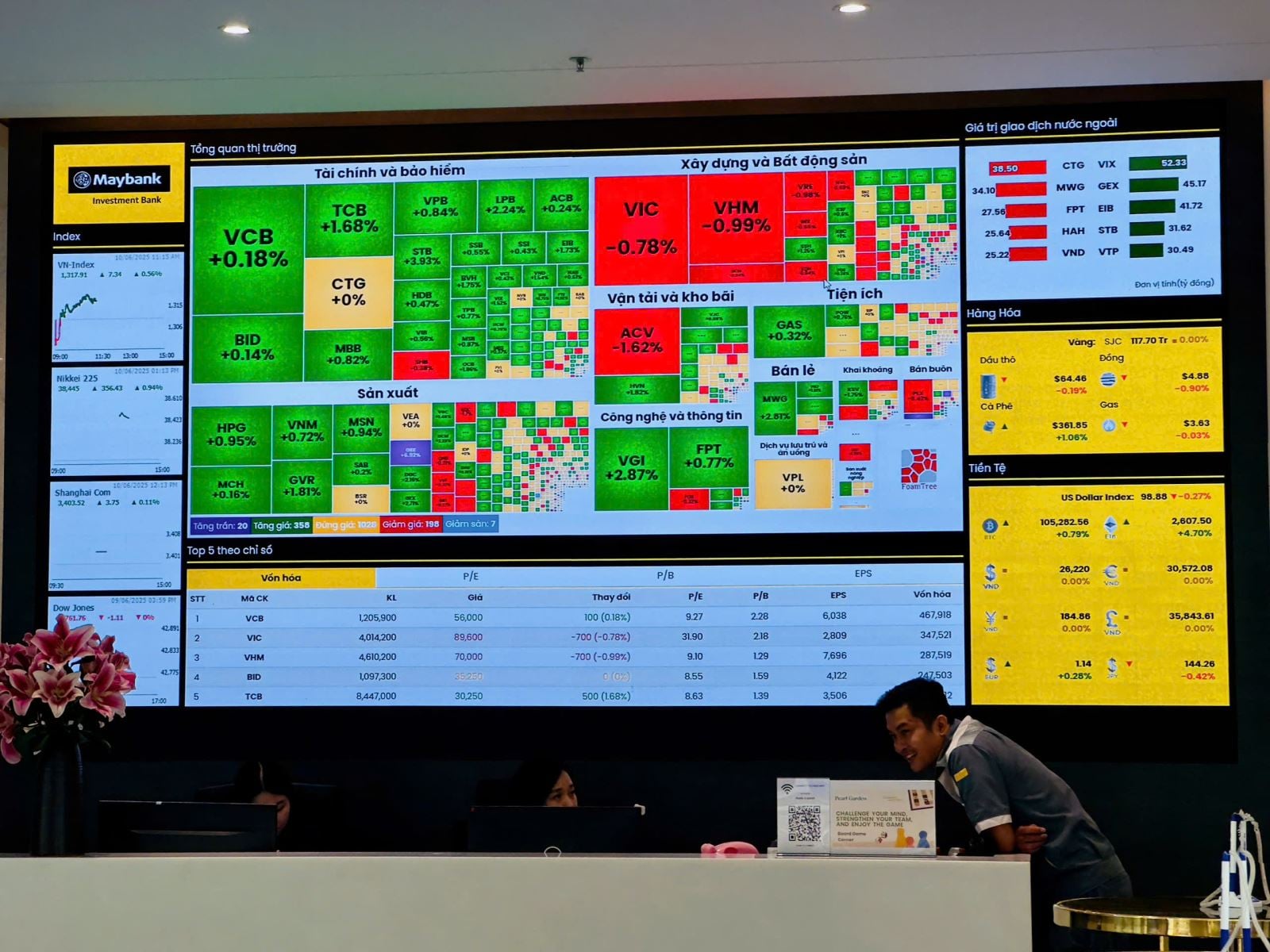
The sharp decline in liquidity indicates that the market does not lack support from large-cap stocks, but lacks widespread momentum. Domestic capital flows continue to play a dominant role, remaining stable but cautious. Meanwhile, net selling pressure from foreign investors decreased compared to the previous month but remained at VND 7,018 billion, marking the third consecutive month of net selling.
The overall picture therefore reveals a significant discrepancy between index movements and portfolio performance. While the VN-Index is approaching its previous peak, it doesn't represent the general price level: many stocks have corrected by 20-40% from their peaks a few months ago. The "green pillars - red board" effect is recurring, clearly demonstrated by the fact that large-cap stocks like Vingroup, GELEX , VJC, VNM, and some bank stocks continue to drive the index upwards, while most mid- and small-cap stocks weaken.
In November, the market also saw strong divergence across sectors. According to HOSE, the real estate sector led the gains with over 16%, mainly driven by expectations of a recovery cycle in the industrial park segment and stocks with restructuring news. The energy sector rose nearly 10%, benefiting from expectations of price adjustments and higher electricity demand during the dry season. Utilities, a large-cap group, also maintained stable gains.
Conversely, information technology declined by more than 6%, while finance and healthcare both fell by around 3%. These are all sectors that experienced strong growth in Q3 and are now entering a revaluation phase. The significant divergence between sectors indicates that capital flows tend to favor those with clearer profit prospects in Q4 and 2026, especially exports, energy, and industrial real estate.
Along with differentiation, the market also witnessed strong expansion in size. HOSE recorded 49 companies with a market capitalization exceeding $1 billion, with Vingroup, Vietcombank , and Vinhomes leading the way with market capitalizations exceeding $10 billion. The total market capitalization reached over 7.49 trillion VND, equivalent to more than 65% of GDP in 2024, demonstrating the market's strength despite declining short-term liquidity.
December "accumulation anchor"
As the year draws to a close, many securities companies view the market as a "consolidation" phase before a new direction is formed. Tien Phong Securities (TPS) believes that the VN-Index is in a lull within its upward cycle, as the index approaches strong resistance levels while capital flows are not yet ready to expand.

According to TPS, December will be influenced by three main groups of factors. The first is a supportive macroeconomic environment. The probability of the Fed continuing to lower interest rates in December is nearly 90%, creating favorable conditions for capital flows into emerging markets. Domestically, the State Bank of Vietnam maintains a stable interest rate environment, Q4 GDP is expected to grow by 8.4%, and the government has set a growth target of 10% for 2026. These factors reinforce expectations of a new growth cycle, although they may not create an immediate boost.
Secondly, the market upgrade story continues to generate expectations. FTSE is expected to announce the results of Vietnam's upgrade in March 2026. According to the analysis team, the upgrade expectation is seen as an opportunity for valuations to return to the 10-year average, similar to the strong growth periods of 2017-2018 and 2020-2021.
The third factor is the business profit outlook. TPS forecasts that Q4/2025 profit will increase by over 20% and will continue into 2026. The manufacturing - export group (textiles, wood, electronic components, etc.) is showing signs of order recovery, while P/E valuation is still lower than the 5-year average.
In this context, TPS has developed three scenarios for the VN-Index in December. The base scenario has the highest probability (70%), in which the VN-Index maintains a sideways trend, consolidating in the 1,700 - 1,800 point range. After a strong recovery from 1,580 points, the Falling Wedge pattern is creating a solid support base. With this scenario, a reasonable cash allocation is around 50%.
In the positive scenario (15%), VN-Index could surpass 1,800 points and head towards the 1,905 point zone thanks to cash flow spreading to the large-cap group. At that time, the cash ratio could fall to 40%.
The negative scenario (15%) occurs when profit-taking pressure increases, pulling the index down to the 1,580-point zone. This is still a strong support zone and can attract bottom-fishing cash flow. In this case, the cash ratio should increase to 60%.
For investors, experts recommend reducing focus on short-term index fluctuations and instead selecting stock groups with strong fundamentals, bright profit prospects in Q4 and 2026, attractive valuations, or those benefiting from export recovery and public investment. Positively assessed groups include banking, energy and utilities, manufacturing and exports, industrial real estate, and construction and materials.
Based on the developments in November and the outlook for December, financial experts believe that the market is entering a new equilibrium zone, not pessimistic but lacking momentum, with strong differentiation but still maintaining a medium-term upward trend. This is considered an important accumulation phase before a clearer trend forms in the first quarter of 2026.
Source: https://baotintuc.vn/thi-truong-tien-te/chung-khoan-thang-12-nghieng-ve-tich-luy-co-hoi-mo-ra-o-nhom-co-phieu-co-ban-20251209203200745.htm


![[Photo] Explore the US Navy's USS Robert Smalls warship](/_next/image?url=https%3A%2F%2Fvphoto.vietnam.vn%2Fthumb%2F1200x675%2Fvietnam%2Fresource%2FIMAGE%2F2025%2F12%2F10%2F1765341533272_11212121-8303-jpg.webp&w=3840&q=75)






























































































Comment (0)