

At the invitation of Malaysian Prime Minister Anwar Ibrahim, Chairman of ASEAN 2025, Prime Minister Pham Minh Chinh led a high-level Vietnamese delegation to attend the 47th ASEAN Summit and related Summits in Kuala Lumpur from October 25-28.
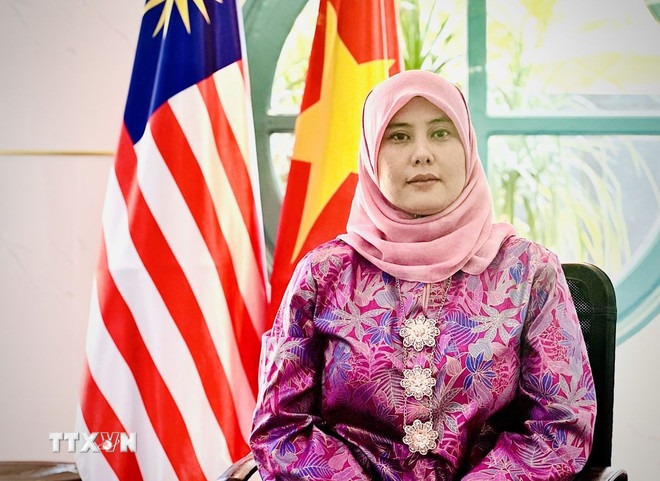
On this occasion, a reporter from VNA had an interview with Ms. Cik Aida Safura Niza Othman, Deputy Ambassador of Malaysia to Vietnam.
- How do you assess the importance of Prime Minister Pham Minh Chinh's trip to Malaysia to attend the 47th ASEAN Summit?
Deputy Ambassador Cik Aida Safura Niza Othman: Prime Minister Pham Minh Chinh's visit is of significant importance to both ASEAN and bilateral relations. At the regional level, the visit demonstrates Vietnam's strong support for Malaysia's priorities during its ASEAN chairmanship. We expect the visit to strengthen substantive cooperation in areas such as the ASEAN Power Grid and digital connectivity, contributing to maintaining a stable strategic environment through diplomacy and cooperation.
Bilaterally, the visit is an opportunity to further strengthen commitments within the Comprehensive Strategic Partnership Framework between the two countries. Both sides are coordinating to achieve concrete results in priority areas such as clean energy, grid connectivity; trade and investment; and the development of a reliable digital economy, enabling micro, small, and medium-sized enterprises (MSMEs) to participate in regional value chains.
Both sides also agreed to promote the Halal industry, cooperate on science and technology, and green growth; strengthen maritime cooperation and defense links; and expand people-to-people exchanges through education, tourism, and skilled labor mobility, thereby making the relationship even closer and more sustainable.
- Could the Deputy Ambassador please tell us what important documents, agreements, or declarations are expected to be adopted at this conference, particularly those related to the theme of "Inclusiveness and Sustainability"?
Deputy Ambassador Cik Aida Safura Niza Othman: This will be the largest series of ASEAN conferences in decades; Kuala Lumpur will host many high-ranking guests, including expected attendees such as US President Donald Trump, Chinese Premier Li Qiang, Brazilian President Luiz Inácio Lula da Silva, South African President Cyril Ramaphosa, European Council President Antonio Costa, and Japanese Prime Minister Sanae Takaichi, among many other leaders. Approximately 12,000 delegates will attend, and around 2,800 journalists have registered to cover the event. Leaders are expected to approve nearly 80 documents during the conference.
In terms of content, this conference will translate the theme of "Inclusiveness and Sustainability" into practical action. A historic step will be the admission of Timor-Leste as the 11th member of ASEAN, along with specific mechanisms to enable Dili to participate effectively from the very beginning.
Economically, the leaders will promote the upgrading of the ASEAN Trade in Goods Agreement (ATIGA); update the ASEAN-China Free Trade Agreement version 3.0 (ACFTA 3.0); and develop the ASEAN Digital Economy Framework Agreement...
Regarding sustainable development, the recently adopted ASEAN Energy Plan aims to achieve 45% of total installed capacity from renewable energy sources by 2030, complementing the ASEAN Power Grid to ensure clean, stable, and affordable electricity. Malaysia will also launch a Centre for MSMEs along with the ASEAN AHEAD innovation initiative to support small and medium-sized enterprises in adopting green strategies and digital skills.
- Regarding the prospect of officially admitting Timor Leste as an ASEAN member within the framework of this Summit, can you share more information and how Malaysia has supported this process?
Deputy Ambassador Cik Aida Safura Niza Othman: The accession of Timor Leste is a common goal of ASEAN, and our approach is to implement this process comprehensively and effectively. At the 46th ASEAN Summit in May 2025, ASEAN Ministers and senior officials were tasked with taking the procedural steps to admit Timor Leste as the 11th member. This process is currently on track, with the formal admission of Timor Leste expected to take place on October 26th.
Malaysia has worked closely with ASEAN member states to support Timor Leste's progress toward full membership. At the regional level, several initiatives have been implemented, including: the Roadmap to Full Membership adopted at the 42nd ASEAN Summit in 2023; the Guidelines on Observer Participation, adopted in August 2023; and the ASEAN Accession Capacity Building Programme implemented by the ASEAN Secretariat (ASEC) in collaboration with the Asian Development Bank (ADB) in 2025.
At the bilateral level, Malaysia has expanded capacity-building activities through the Malaysian Technical Cooperation Programme; signed a Memorandum of Understanding on Cooperation in the field of Higher Education; and implemented specialized training courses on vocational education and public administration, such as the INFRA Rural Leadership Programme.
In addition, both sides are promoting people-to-people exchanges, including the opening of a direct Kuala Lumpur-Dili flight route and a visa-free policy for Malaysian citizens. All these efforts are crucial to ensuring that, when Timor-Leste officially joins ASEAN, the country will have the practical tools to succeed.
- What is the Deputy Ambassador's assessment of the prospects for Vietnam-Malaysia relations, particularly in the context of ASEAN's strategic positioning globally?
Deputy Ambassador Cik Aida Safura Niza Othman: It must be affirmed that the future of bilateral relations is very promising. Malaysia and Vietnam are entering the next phase of their Comprehensive Strategic Partnership with complementary strengths, in line with ASEAN priorities. Vietnam's production scale, digital capabilities, and export dynamics combine effectively with Malaysia's experience in finance and energy systems.
In the energy sector, we view Vietnam-Malaysia cooperation as a catalyst for the ASEAN Power Grid, while also developing reliable renewable energy certification.
Furthermore, both sides need to strengthen integration in key areas, including reliable cross-border data sources, compatible payments, cybersecurity capabilities, and common standards to reduce costs for micro, small, and medium-sized enterprises (MSMEs). It should be emphasized that stability will continue to be a necessary condition. Malaysia will continue to cooperate with Vietnam to strengthen peace and security in the region. At the same time, both sides will invest in resilience, including greener supply chains, food security cooperation, disaster response, and skills development.
To maintain momentum, building on the foundation of the Comprehensive Strategic Partnership (CSP), both sides should aim to develop public-private partnership projects, starting in sectors such as semiconductors, advanced manufacturing, agro-trade, halal standards, tourism, and education. If successfully implemented, the Vietnam-Malaysia relationship will not only boost the economic development of both sides but also enhance ASEAN's prestige as a more equitable and effectively transformed ASEAN through consistent and sustainable cooperation.
- We would like to express our sincere gratitude to Deputy Ambassador Cik Aida Safura Niza Othman!
Source: https://www.vietnamplus.vn/chuyen-cong-tac-cua-thu-tuong-co-y-nghia-quan-trong-doi-voi-asean-post1072626.vnp











![[Video] National Assembly passes the amended Civil Servant Law with 92.39% of delegates voting in favor](https://vphoto.vietnam.vn/thumb/402x226/vietnam/resource/IMAGE/2025/12/10/1765379039932_1-6690-3945-png.webp)















![[Video] The craft of making Dong Ho folk paintings has been inscribed by UNESCO on the List of Crafts in Need of Urgent Safeguarding.](https://vphoto.vietnam.vn/thumb/402x226/vietnam/resource/IMAGE/2025/12/10/1765350246533_tranh-dong-ho-734-jpg.webp)












































Comment (0)