Speaking at the Ho Chi Minh City Economic Forum (HEF) 2023, themed "Green Growth - A Journey Towards Net-Zero Emissions," held on September 15th in Ho Chi Minh City, Mr. Jan Jambon, Minister-President of the Flanders region, Kingdom of Belgium, suggested several solutions to help Ho Chi Minh City promote green growth and build a climate-resilient city.
According to Mr. Jan Jambon, over the past 50 years, since the establishment of
diplomatic relations (March 22, 1973), the Vietnam-Belgium relationship has been continuously strengthened and developed strongly in both quantity and quality. And what is wonderful is that in the process of green transition, Vietnam and Belgium are not standing alone but are moving forward together.
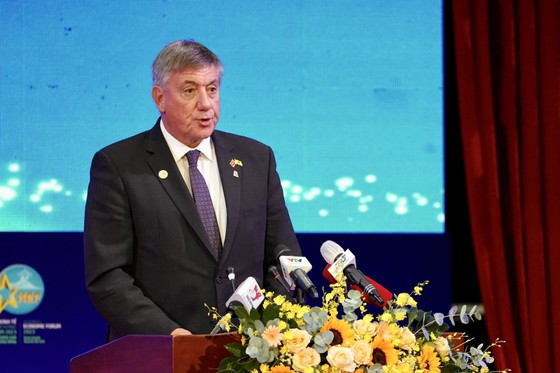 Mr. Jan Jambon, Minister-President of the Flanders region, Kingdom of Belgium, speaking at the Ho Chi Minh City Economic Forum (HEF) 2023 (Photo: SGGP)
“Over the years, Ho Chi Minh City in particular, and Vietnam in general, have played an increasingly important role in the overall development of the region, clearly demonstrating a dynamic and innovative economy. For the Flanders region, we have a large petrochemical industry and face significant environmental pressures. However, we strive to allocate a large portion of our GDP to technological innovation, environmental protection, and especially the application of artificial intelligence (AI)… Through technology, we are gradually solving complex problems and recycling nearly 50% of all types of waste released into the environment. Above all, factors including sustainable policies and mechanisms will help to reduce net emissions and promote a circular economy, gradually achieving effectiveness; contributing to inspiring countries, regions, and territories around
the world …”, said Mr. Jan Jambon. Sharing Flanders' experiences in building sustainable cities and adapting to climate conditions, similar to Ho Chi Minh City, Mr. Jan Jambon highlighted several initiatives. First is the Green Deal, aimed at addressing water scarcity and flooding. Through a combination of robust protection measures in urban areas, Flanders is preparing to cope with rising sea levels, heavy rainfall, and droughts. Alongside this is an environmental transformation policy designed to protect open spaces in both urban and rural areas. Flanders is adopting a new approach to urban planning, with urbanization taking into account factors such as mobility and green spaces. The development of the Green Deal reflects a more sustainable approach to building design. “In this project, several tools and guidelines supporting policies for sustainable buildings have also been developed. This project illustrates the innovative approach of the people of Flanders. Collaboration between research institutions, the government, and companies is also aimed at finding new solutions,” shared Mr. Jan Jambon. According to Mr. Jambon, businesses with potential and strengths in the fields of port infrastructure construction, transportation, providing smart technology solutions to support urban development challenges, wind power development, waste-to-energy conversion, and circular industrial park construction are ready to share their experience and promote cooperation with businesses in Ho Chi Minh City in these areas.
 According to experts from Belgium, Ho Chi Minh City needs to build a green and smart city to address the challenges posed by climate change.
In addition, experts from Belgium also presented many urban design solutions suitable for high population density and construction, including advanced solutions, sustainable construction techniques, and flood-resistant designs... aiming to build a green lifestyle, in harmony with nature, and create a green and smart city. Steven Petit, Creative Director of Omegeving (a company specializing in architecture and planning), shared that large cities like
Ho Chi Minh City currently face many challenges in the context of climate change. To adapt, urban design needs to be based on nature, ensuring the city can withstand floods and inundation. This could involve designing a water feature within the city to create a green environment for residents. Sharing this view, Patrick Swartenbroeckx, CEO of Hydroscan (a company specializing in environmental services), stated that flood-resilient design is essential, not only as a matter of adapting to climate change but also for the benefit of the people.
Ngoc Chau


![[Photo] Prime Minister Pham Minh Chinh holds a phone call with the CEO of Russia's Rosatom Corporation.](/_next/image?url=https%3A%2F%2Fvphoto.vietnam.vn%2Fthumb%2F1200x675%2Fvietnam%2Fresource%2FIMAGE%2F2025%2F12%2F11%2F1765464552365_dsc-5295-jpg.webp&w=3840&q=75)
![[Photo] Closing Ceremony of the 10th Session of the 15th National Assembly](/_next/image?url=https%3A%2F%2Fvphoto.vietnam.vn%2Fthumb%2F1200x675%2Fvietnam%2Fresource%2FIMAGE%2F2025%2F12%2F11%2F1765448959967_image-1437-jpg.webp&w=3840&q=75)










































![[OFFICIAL] MISA GROUP ANNOUNCES ITS PIONEERING BRAND POSITIONING IN BUILDING AGENTIC AI FOR BUSINESSES, HOUSEHOLDS, AND THE GOVERNMENT](https://vphoto.vietnam.vn/thumb/402x226/vietnam/resource/IMAGE/2025/12/11/1765444754256_agentic-ai_postfb-scaled.png)










































Comment (0)