

As the most common method and the one that most clearly reflects the financial nature of real estate projects, eliminating the surplus method, according to experts, is a step backward in land valuation, causing long-term consequences for the supply and market of real estate.
Commenting on this issue, Dr. Nguyen Tien Thoa – Chairman of the Vietnam Valuation Association – said that this is not wrong, but only partially correct. The more important part is that when allowing land with development potential to achieve the highest and best use, the state must also know the land price according to market principles to achieve that goal, as a basis for determining financial obligations between the state and organizations and individuals using the land. And the appropriate method for valuing such development land is the surplus method.
" To determine the price, we must base it on legal grounds (planning, licensing, etc.) and objective market data, not on arbitrary, baseless calculations ," Dr. Thoa emphasized.
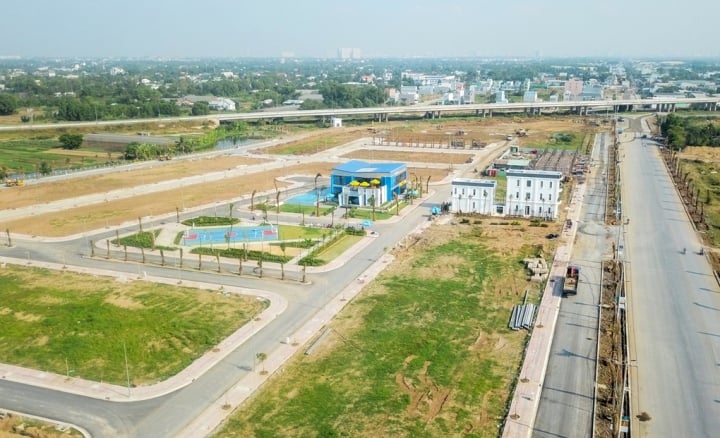
Experts argue that the surplus method should not be abandoned in land valuation.
Further elaborating on this aspect, a real estate legal expert stated that the surplus method clearly reflects the financial nature of a real estate project: identifying costs, revenues, and profits in a scientific and objective manner. This method clearly reflects how to exploit, allocate, and share the "land rent differential." It is also a modern real estate valuation method, in line with international practice.
“ The drafting agency argues that due to a lack of data for valuation, valuations must be based on hypothetical and inaccurate factors, thus abandoning this method. In my opinion, this is unconvincing. If the problem is a lack of data, the solution should be to create a high-quality, reliable database, instead of abandoning the surplus method (dismantling the production machine). Therefore, if the abandonment of the surplus method becomes a reality, it will be a step backward in land valuation ,” he commented.
The surplus method should be retained.
With the proposal to eliminate the surplus method, the draft Decree amending Decree 44 will only have three methods: comparative, income, and land price adjustment coefficient. However, it is immediately apparent that these three methods are insufficient to replace the surplus method when valuing land with development potential.
In a detailed analysis, experts pointed out three shortcomings. Firstly, land valuation is based on potential future development uses, not current uses as is the case with comparative or income-based methods.
Secondly, for land types with common development potential, there are no comparable or similar assets that have been successfully traded on the market to apply the comparative method (provided there are at least 3 comparable assets, except in exceptional cases), so the comparative method cannot be applied for valuation.
Thirdly, the income method determines future income based on the assumption that income is stable and permanent, and the risk associated with future income is fixed. The surplus method, on the other hand, is the complete opposite. Therefore, the income method cannot be used as a substitute for the surplus method.
According to a real estate legal expert, eliminating the surplus method would create a gap in land valuation. “ What method would state agencies use to value land when allocating land to investors for projects without auction? Currently, for the vast majority of real estate projects, when allocating land to investors, state agencies apply the surplus method to value the land (except for some low-value land plots where the adjustment coefficient method is applied); even in the case of auctioning land use rights, the starting price must be determined using the surplus method .”
Commenting further on this issue, Professor Dang Hung Vo, former Deputy Minister of Natural Resources and Environment , suggested that the land price adjustment coefficient method should be removed from land valuation methods, while the surplus method should be retained or supplemented for valuing real estate development projects on land.
Accordingly, the land price adjustment coefficient method is simply a multiplication of the value on the land price list stipulated by the provincial People's Committee with a coefficient also decided by the provincial People's Committee. "Market-appropriate land price is an objective quantity; it cannot be forced to equal the product of two subjective quantities both stipulated and decided by the provincial People's Committee. Therefore, it can be concluded that this is a method of determining land prices without any scientific basis," Professor Vo asserted.
The Prime Minister recently issued a directive requesting the Ministry of Natural Resources and Environment and the leaders of provinces and cities to quickly resolve difficulties and obstacles in land valuation. A key point is that the Ministry of Natural Resources and Environment must submit to the Government for consideration and promulgation, before July 31st, a Decree amending and supplementing Decree No. 44/2014/ND-CP on land prices, as well as completing the amendment and supplementation of Circular No. 36/2014/TT-BTNMT detailing the methods for land valuation, the construction and adjustment of land price tables, specific land valuation, and land price determination consultancy.
However, according to experts, the amendments to Decree 44 and Circular 36 have major shortcomings that will lead to significant consequences for land valuation as well as the development of the real estate market. This is because the drafting agency has eliminated the surplus method in land valuation, which is the most practical method and has a complete, stable, and transparent input data database.
Hai Anh
Beneficial
Emotion
Creative
Unique
Wrath
Source





























































































Comment (0)