

Concerns about the "aftermath" of war.
Cluster munitions are projectiles containing multiple smaller bombs, each with its own individual warhead. This type of weapon was developed towards the end of World War II and became popular during the Cold War. To distinguish them from cluster munitions, conventional bombs or artillery shells are called single-shot munitions.
The tactical advantages of this type of weapon are undeniable, as it can create multiple explosions covering a larger area, and can be used to attack everything from armored vehicles and infantry to logistical targets and air defense systems. However, the high rate of unexploded ordnance (UXO) from cluster bombs is a major issue, leading over 100 countries to sign a petition banning its use in modern warfare. For example, the M270 – an older rocket launcher system than HIMARS – can fire a warhead containing 644 M77 grenades, but each shot leaves up to 4% (26 grenades) unexploded on the ground.
This rate poses a potential danger to civilians for years after the war. The Convention on Cluster Munitions prohibits the “use, stockpiling, manufacture and transfer” of this type of weapon. However, the US, Russia, and Ukraine are non-signatories to the Convention.
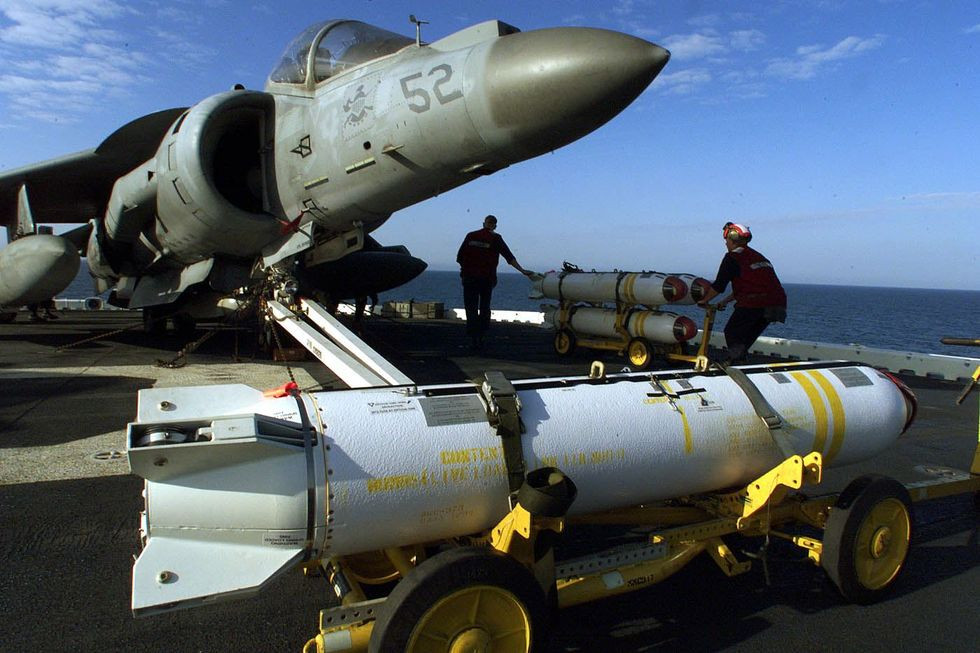
In March, Reuters revealed that Kyiv had lobbied Washington to transfer Mk-20 (Rockeye) cluster bombs, a weapon from the Vietnam War era. Each Rockeye bomb weighs over 500 pounds (~220 kg) and contains 247 smaller bombs, but is incompatible with Ukraine's current aircraft. The Ukrainian military says they can dismantle the warheads of the Rockeye to use the individual smaller bombs as weapons for drones. Ukraine also wants 155 mm DPICM artillery shells, containing 88 cluster bombs, to destroy Russian armor.
Both Ukraine and Russia widely use commercial quadcopter drones in combat, with the most common payload being the modified Vog-17 fragmentation grenade, capable of effectively eliminating infantry.
Significantly improved the anti-tank capabilities of drones.
Meanwhile, Ukrainian Aerorozvidka units use larger R18 drones to drop Soviet-made RTG-3 anti-tank grenades, weighing about 3 pounds (~1.3 kg), or highly effective RPG warheads against armored vehicles. However, these warheads are too heavy for commercially available drones. Quadrotor drones can only use "homemade" ammunition from American 40mm M433 grenades, also known as "golden eggs" due to their yellow-marked noses, or other temporary replacement grenades.
In addition, drones in the Ukrainian battlefield are also equipped with improved grenades featuring new impact fuses and 3D-printed tail fins to allow them to fall straight down, but this combination is often insufficient to neutralize heavily armored tanks, and the impact fuses themselves are unreliable.
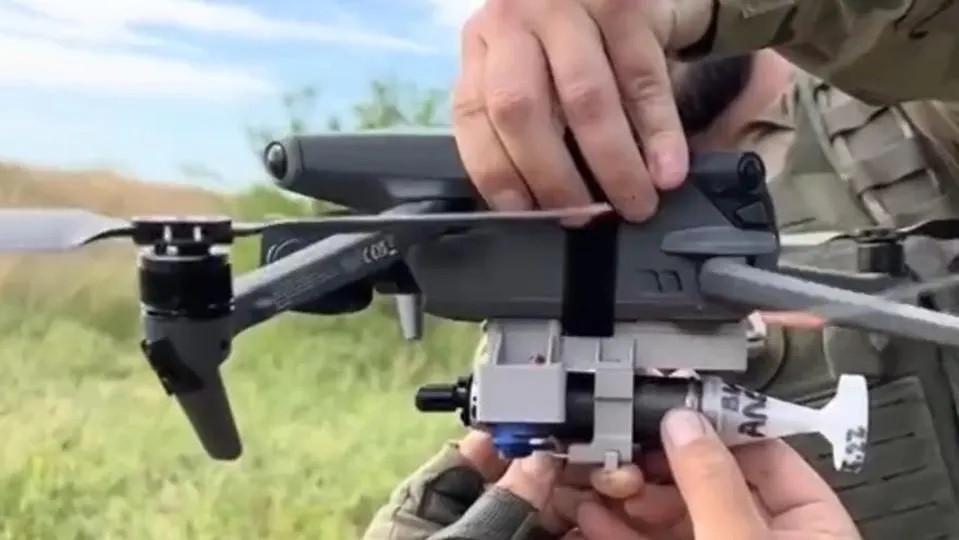
Ukrainian military forces are also repurposing Soviet-era cluster bombs to equip drones. For example, the PTAB 2.5, containing six small warheads, is used to arm "heavy" bomber drones or mounted on suicide drones.
Meanwhile, the 1.2-pound (~0.5 kg) submunition in the Rockeye bomb is sized appropriately for small drones. It's also designed for air-dropping, featuring aerodynamic fins, an impact fuse, and a warhead capable of penetrating 10 inches (~25 cm) of armor.
During the Iraq War, Rockeye bombs had a "dead bomb" rate of up to 30%, leaving thousands of dangerous unexploded ordnance on the ground. This was likely due to the terrain, where they fell onto soft sand and lacked sufficient force to trigger the fuse.
The U.S. has hundreds of millions of cluster munitions in its arsenal, and destroying them presents a significant financial challenge. Sending these munitions to Ukraine would be a "two birds with one stone," but the move could also harm Washington's efforts to "build alliances and advance arms control agreements."
(According to PopMech and Forbes)
Source


![[Photo] Prime Minister Pham Minh Chinh holds a phone call with the CEO of Russia's Rosatom Corporation.](/_next/image?url=https%3A%2F%2Fvphoto.vietnam.vn%2Fthumb%2F1200x675%2Fvietnam%2Fresource%2FIMAGE%2F2025%2F12%2F11%2F1765464552365_dsc-5295-jpg.webp&w=3840&q=75)

![[Photo] Closing Ceremony of the 10th Session of the 15th National Assembly](/_next/image?url=https%3A%2F%2Fvphoto.vietnam.vn%2Fthumb%2F1200x675%2Fvietnam%2Fresource%2FIMAGE%2F2025%2F12%2F11%2F1765448959967_image-1437-jpg.webp&w=3840&q=75)










































![[OFFICIAL] MISA GROUP ANNOUNCES ITS PIONEERING BRAND POSITIONING IN BUILDING AGENTIC AI FOR BUSINESSES, HOUSEHOLDS, AND THE GOVERNMENT](https://vphoto.vietnam.vn/thumb/402x226/vietnam/resource/IMAGE/2025/12/11/1765444754256_agentic-ai_postfb-scaled.png)


















































Comment (0)