

Getting a score of 9 still doesn't make me happy if it's lower than my classmates' scores.
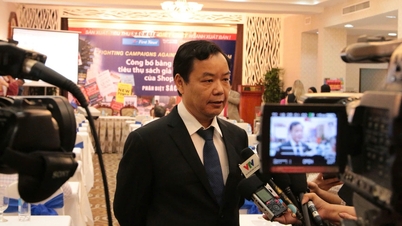
Professor Le Anh Vinh, Director of the Vietnam Institute of Educational Sciences, opened the seminar with a small survey conducted in the auditorium, presenting three ways to assess students' learning outcomes for delegates to choose from: one, grading; two, a combination of grading and comments; and three, only comments. The results showed that the majority of delegates chose the second method.

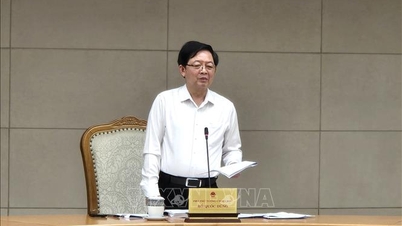
Many stories were shared by experts at the workshop with the aim of reducing pressure on students.
PHOTO: NAVAL NEWS
However, according to Professor Vinh, a research study has shown that grading or a combination of grading and comments does not bring about significant changes in students' learning outcomes; only grading with comments brings about the expected changes.
Professor Le Anh Vinh recalled the changes in primary school student assessment following Circular 30, which abolished regular grading. Schools and teachers faced immense pressure because they were unsure whether their comments accurately and comprehensively assessed students' performance. Furthermore, parents were "confused" when their children came home without grades. Even if the teacher commented that their child had improved and praised them, parents were still not as reassured and happy as if their child had received a grade of 9 or 10. Consequently, Circular 30 had to be significantly revised before it could be implemented effectively.
Director Le Anh Vinh said, "We often think that more is better, and combining both grading and feedback is better than just one form. Teachers praising students is good, but parents still want their children to get 9s or 10s. There was a funny but thought-provoking story about a child showing off a 9 to their father. The father praised the child, but then heard the child say, '9, but the lowest in the class,' and the father was disappointed. Conversely, when a child gets a 6, but it's the highest in the class, the parents are still happy and praise their child for being so good."
Professor Le Anh Vinh stated: "Simply because once grades are given, no one cares about the feedback and the true nature of what's happening in the classroom. We have too many students with high grades, many perfect scores, but also many problems. Grades aren't everything."
According to Professor Le Anh Vinh, the reason many countries extend primary school from 5 to 6 years is because they want children to have more time to live carefree lives, without pressure, and to be equipped with fundamental skills, rather than focusing heavily on knowledge and academic achievements.
The most serious form of "achievement-oriented" behavior comes from the authorities.
Associate Professor Nguyen Thi Hong Thuan, Director of the Center for Psychological and Educational Research (Vietnam Academy of Educational Sciences ), stated that her research group's study on pressure in schools has shown that the most severe form of "achievement-oriented syndrome" originates from administrative agencies. These agencies then impose pressure on schools, which in turn pressure teachers, ultimately leading to pressure on students. In complying with these demands from above, teachers often fail to realize they are creating pressure on students, resulting in regrettable consequences for their mental health.
Ms. Thuan also pointed out that students face a lot of pressure, not just academic results. When providing psychological treatment to students, some first-grade students experience stress from unexpected demands. For example, simply preparing and organizing school supplies before class can cause stress because students are often criticized by teachers for mistakes at school or severely reprimanded if they lack school supplies. Some students even wake up in a panic from a dream about bringing too few supplies to class!
Many students share that they only wish for one full day off from school because they are currently studying too much, spending the whole week at school and attending numerous extra classes on weekends; many others wish they didn't have to participate in so many exams… This pressure also comes from their families, with their excessively high expectations of their children.
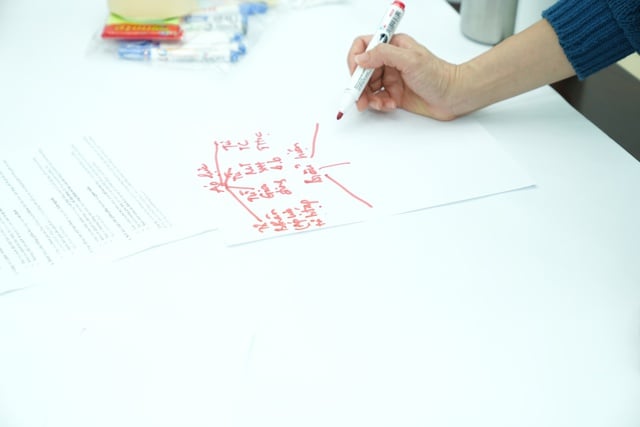
Students face a lot of pressure, and it's not just about academic results.
Photo: Hai Su
Associate Professor Tran Thanh Nam, Vice Rector of the University of Education (Vietnam National University , Hanoi ), believes that even without setting direct expectations or demands, parents' behavior creates pressure on children, such as: admiring the academic achievements of "other people's children," creating negative emotions by only commenting when children make mistakes, while failing to praise or encourage them when they do well or try hard...
Dr. Thach Thi Lan Anh, Vice Principal of the Experimental School of Educational Sciences (Vietnam Institute of Educational Sciences), confidently asserted that her school has never created pressure within the school. Citing examples from major competitions, Dr. Anh stated that although the school participates, it has never had a dedicated "spearhead" team for any activity. When a competition is launched, the school allows students to register voluntarily rather than selecting students for a team and organizing intensive training to achieve awards or accomplishments.
Professor Le Anh Vinh also believes that adults often have high expectations and set goals for children, such as expecting them to be excellent students, to win this or that award, to get into a particular school A or school B… "But I want to emphasize that those goals are too small for a person… If we don't put too much pressure on each small step, we can go the distance…", said Professor Vinh.
"We often say that high school and university students are weak in self-learning ability, but if we don't cultivate self-learning skills in children from elementary school onwards, we can't expect them to be able to learn independently when they grow up. There is no easy solution to the problem of pressure on children. Ultimately, it all comes down to love, care, and the genuine desire from the bottom of our hearts for the child to improve...", Professor Le Anh Vinh concluded the seminar.
Many students have to study for over 10 hours a day.
The Vietnam Institute of Educational Sciences, citing UNICEF research, shows that the mental and psychosocial health of children and adolescents in Vietnam is facing many challenges. Academic pressure, family expectations, and social competition are the main factors contributing to this situation. Academic pressure not only affects mental health but also has serious consequences for children's physical health. According to one report, many students study for over 10 hours a day, resulting in less than 8 hours of sleep. Prolonged sleep deprivation can cause numerous health problems such as fatigue, impaired memory and concentration, and even cardiovascular issues.
Reflections stemming from a statement by a student competing in the International Mathematical Olympiad.
Professor Le Anh Vinh shared a story that made him think a lot about the pressure his students are under. During his 10 years leading student teams to the International Mathematical Olympiad, there was one time, while having dinner with his students before the competition, a very nervous team member told him: "Professor, there are only two days left, and then I'll never have to take a math competition again." "It seemed like a very ordinary statement, but coming from one of the most outstanding math students, it surprised me," Professor Le Anh Vinh recounted, adding that he immediately reassured the students that he didn't put any pressure on them, nor did he feel any pressure regarding the team's performance.
However, he had to remind the student why they started with math in the first place. Did they once love math and study it with the greatest freedom? He said, "In the most stressful moments, remember why you started. Enter the exam room like a primary school child and tackle the math problems in the Olympiad as the best problems of your life, not for the prize."
Source: https://archive.vietnam.vn/de-hoc-sinh-co-tuoi-tho-khong-ap-luc/


![[Photo] General Secretary and President To Lam meets with National Assembly delegates from ethnic minorities.](https://vphoto.vietnam.vn/thumb/1200x675/vietnam/resource/IMAGE/2026/04/20/1776696701056_a1-bnd-8331-3342-jpg.webp)
![[Image] National Assembly discusses the implementation of the socio-economic development plan.](https://vphoto.vietnam.vn/thumb/1200x675/vietnam/resource/IMAGE/2026/04/20/1776696707422_ndo_br_img-20260420-185419-jpg.webp)






















































































Comment (0)